- Fungi Including Lichens
- ›Ascomycete Fungi
- ›Sac Fungi and Lichens
- ›Dothideomycetes
- ›Botryosphaeriales
- ›Botryosphaeriaceae
- ›Cophinforma
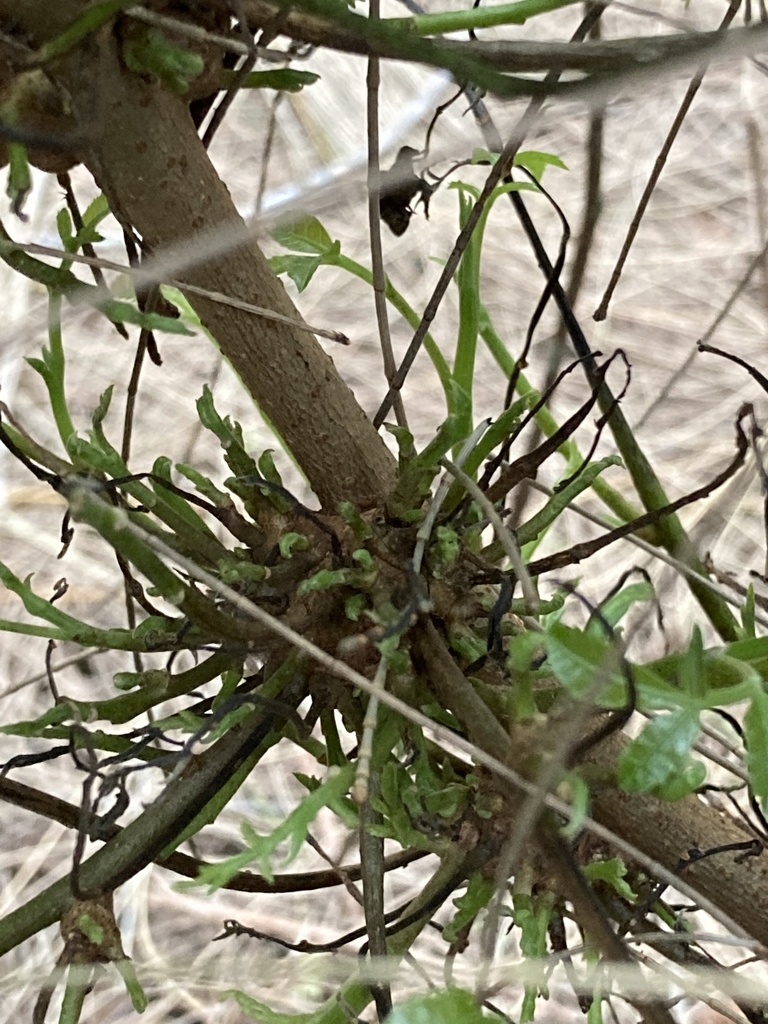
Cophinforma tumefaciens
Cophinforma tumefaciens is an ascomycete fungus that is a plant pathogen infecting citruses, and other shrubs and trees.
From the article Cophinforma tumefaciens on Wikipedia (CC BY-SA), quoted section by section
Description
It can form galls (rounded swellings beneath undisturbed bark) on Edison's St. John's-Wort (Hypericum edisonianum (Small) Adams & Robson) in Florida. 'Sphaeropsis gall' also affects holly bushes as well. Many other plant genera in Florida and other places are also known to be affected by this disease, including citrus, lime (Citrus aurantifolia), oleander, holly (Ilex spp.), bottlebrush (Callistemon spp), Carissa, crape myrtle, Ligustrum and the Brazilian Peppertree (Schinus terebinthifolius). as well as rose bay (Nerium oleander) and avocado (Persea americana Mill). Other host plants include: cashew trees (Anacardium occidentale), Bauhinia spp., Cinnamomum camphora, Citrofortunella mitis, Eucalyptus sp., (including Eucalyptus cinerea and Eucalyptus urophylla), Eugenia sp., Jatropha sp., Lagerstroemia indica, Mangifera indica, Morus alba, Myrica cerifera, Pittosporum tobira, Poncirus trifoliate, Portlandia grandiflora, Pyracantha coccinea, Vigna angularis and Wisteria sinensis. The mycelium have conidiomata which are pycnidial, superficial or semi-immersed and measureing 135–400 μm in diam. They are solitary or confluent, dark brown to black (in colour), complex, effuse, (sub-)globose, densely covered with dark brown hyphae. …
Range & habitat
The disease has been reported as being found in the USA (within Florida), Cameroon, Ceylon, Cuba, Egypt, Guyana, Indonesia, India, Jamaica, Mexico, Puerto Rico, and Venezuela. Also by 2021, it was also found in Japan, Pakistan, West Indies and in Europe (within Austria and Greece).
Wikipedia: “Geographic distribution”
In human culture
It was published in 1911, as Sphaeropsis tumefaciens with the holotype found on Citrus limon in Jamaica. But it was transferred to Cophinforma tumefaciens in 2021. Due to the generic circumscriptions of the macroconidia and spermatia/microconidia of this species matching that of Botryosphaeria, Cophinforma, or Neofusicoccum genera, rather than genus Sphaeropsis.
Wikipedia: “History”
Where it lives
Recorded sightings
—
geo-referenced records in GBIF, from museums, herbaria and field observers.
Drag the globe to turn it. Dots are where records exist, not a range map; darker means more records.
In the stacks
Searching the stacks…
Every page naming Cophinforma tumefaciens in the Biodiversity Heritage Library →
This page is assembled live from iNaturalist, GBIF, Wikipedia, the Source Library and the Internet Archive. It is not yet part of the hand-edited codex. iNaturalist taxon 1360682.