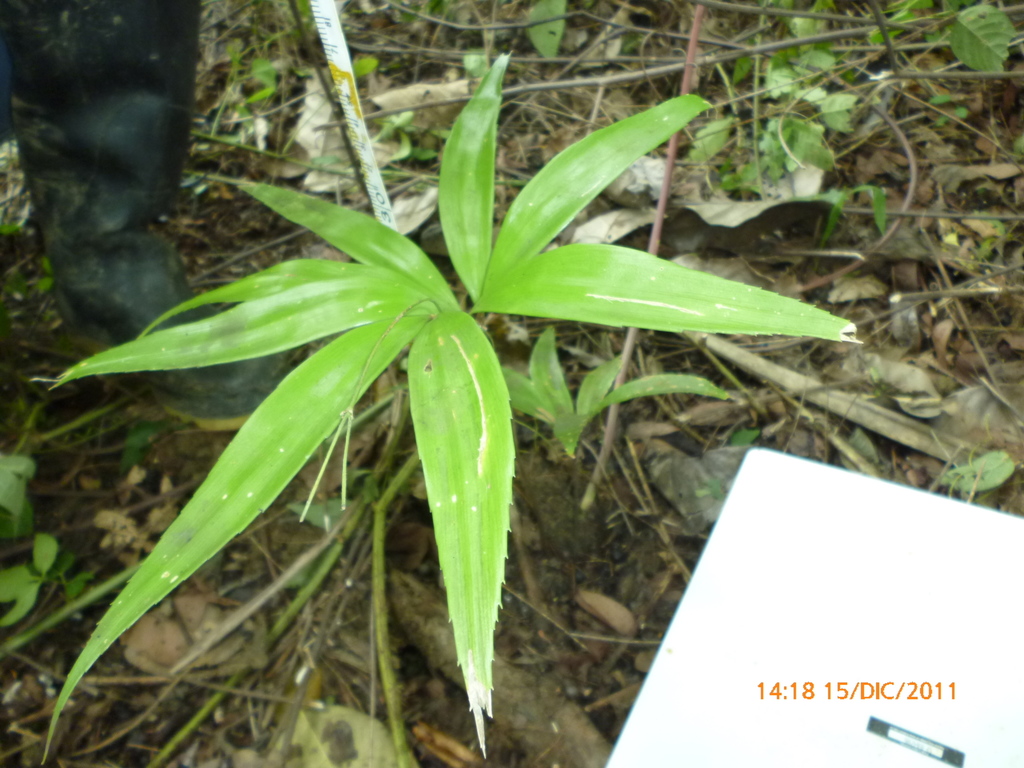
Zamia melanorrhachis
Zamia melanorrhachis is a species of plant in the family Zamiaceae. It has been found in Amazonas, Córdoba, Meta, and Santander departments in Colombia. It grows in forests between sea level and 300 metres (980 ft) altitude. It is commonly known as corocito.
From the article Zamia melanorrhachis on Wikipedia (CC BY-SA), quoted section by section
Description
The stem is subterranean, 5 to 8 centimetres (2.0 to 3.1 in) in diameter. Each plant has two to five upright oblong compound-leaves 50 centimetres (20 in) long, on a dark purple to black petiole (stalk) up to 25 centimetres (9.8 in) long. The stalk is covered with very small prickles, extending into the lower half of the dark brown to dark purple rachis (leaf axis). The four to ten pairs of leaflets on a leaf are lanceolate, pointed on the ends, and toothed on the edges of the outer two-thirds of each leaflet. Leaflets are 12 to 15 centimetres (4.7 to 5.9 in) long and 1 to 2 centimetres (0.39 to 0.79 in) wide in the middle of the leaf. Like all Zamias, Z. melanorrachis is dioecious, with each plant being either male or female. Male strobili (cones) are ovoid, 1 to 3 centimetres (0.39 to 1.18 in) long and 0.5 to 1 centimetre (0.20 to 0.39 in) in diameter, cream to tan in color, and stand on 30 to 50 centimetres (12 to 20 in) long peduncles (stalks). Female cones are cylindrical to ovoid-cylindrical, 5 to 8 centimetres (2.0 to 3.1 in) long and 3 to 4 centimetres (1.2 to 1.6 in) in diameter, and wine-red to dark red-brown in colored. …
Where it lives
Recorded sightings
—
geo-referenced records in GBIF, from museums, herbaria and field observers.
Drag the globe to turn it. Dots are where records exist, not a range map; darker means more records.
In the stacks
Searching the stacks…
Every page naming Zamia melanorrhachis in the Biodiversity Heritage Library →
This page is assembled live from iNaturalist, GBIF, Wikipedia, the Source Library and the Internet Archive. It is not yet part of the hand-edited codex. iNaturalist taxon 135569.