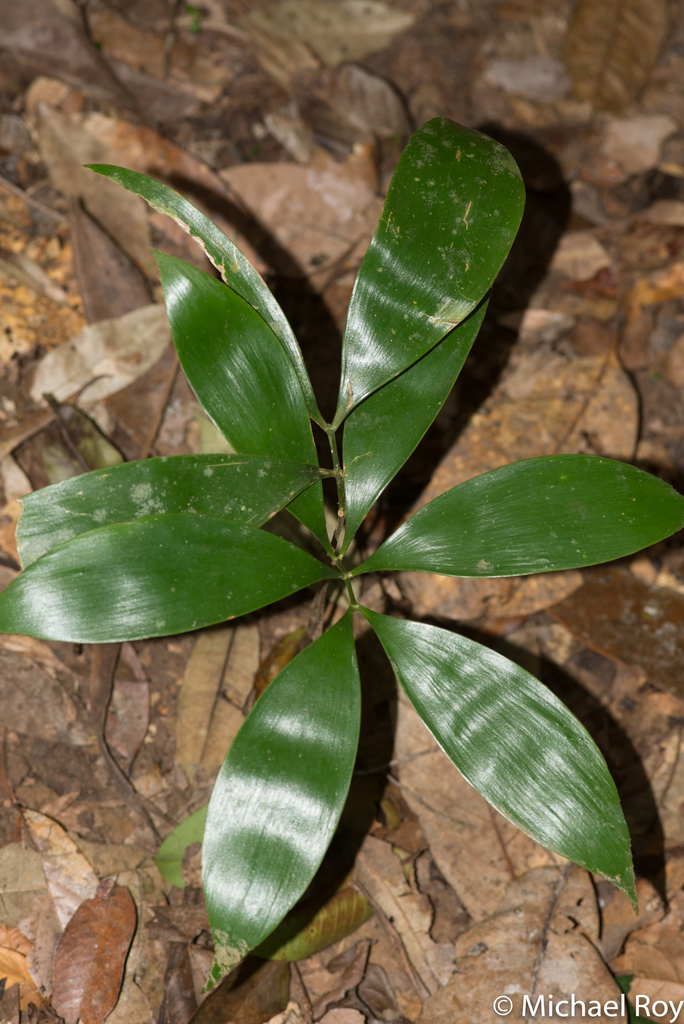
Zamia cunaria
Zamia cunaria is a species of plant in the Zamiaceae family. It is endemic to the Cuna Yale area of Comarca de San Blas Province, Panamá. It is common around Llan Cartis Road and Kuna Llala.
From the article Zamia cunaria on Wikipedia (CC BY-SA), quoted section by section
Description
Zamia cunaria was described in 1993 by Dennis Stevenson based on a type found in 1989 in Guna Yala, Panama. The stem of Zamia cunaria is subterranean, sub-globose, and up to 10 centimetres (3.9 in) in diameter. There is usually one, but sometimes up to three, compound leaves on the stem apex. The leaves are 0.5 to 1.5 metres (1 ft 8 in to 4 ft 11 in) long, with a 15 to 50 centimetres (5.9 to 19.7 in) long petiole (leaf stalk). The petiole is sparsely to densely covered by prickles. There are three to twelve pairs of leaflets on the rachis (shaft) of the leaf. The leaflets are lanceolate or oblanceolate, wedge-shaped at the base and tapering to a point. The edges are toothed on the outer third of the leaflets. Larger leaflets are 20 to 40 centimetres (7.9 to 15.7 in) long and 5 to 8 centimetres (2.0 to 3.1 in) wide. Like all cycads, Zamia cunaria is dioecious, with individual plants being either male or female. Male strobili (cones) are cream to tan in color, cylindrical to ovoid-cylindrical in shape, 4 to 6 centimetres (1.6 to 2.4 in) long and 1 to 1.5 centimetres (0.39 to 0.59 in) in diameter, standing on a peduncle 2 to 4 centimetres (0.79 to 1.57 in) tall. Female strobili are wine-red to dark red-brown in color, ovoid to ovoid-cylindrical in shape, 15 to 20 centimetres (5.9 to 7.9 in) long and 5 to 7 centimetres (2.0 to 2.8 in) in diameter. …
Range & habitat
Zamia cunaria usually is found on clay soils in secondary vegetation in hilly country between 400 and 800 metres (1,300 and 2,600 ft) above sea level.
Wikipedia: “Distribution and habitat”
In human culture
The epithet cunaria refers to the Guna people (formerly spelled "Kuna" or "Cuna"), who make necklaces from the seeds of the plant, and in whose territory the species is endemic. The Guna call the plant obset.
Wikipedia: “Etymology”
Where it lives
Recorded sightings
—
geo-referenced records in GBIF, from museums, herbaria and field observers.
Drag the globe to turn it. Dots are where records exist, not a range map; darker means more records.
In the stacks
Searching the stacks…
Every page naming Zamia cunaria in the Biodiversity Heritage Library →
This page is assembled live from iNaturalist, GBIF, Wikipedia, the Source Library and the Internet Archive. It is not yet part of the hand-edited codex. iNaturalist taxon 135531.