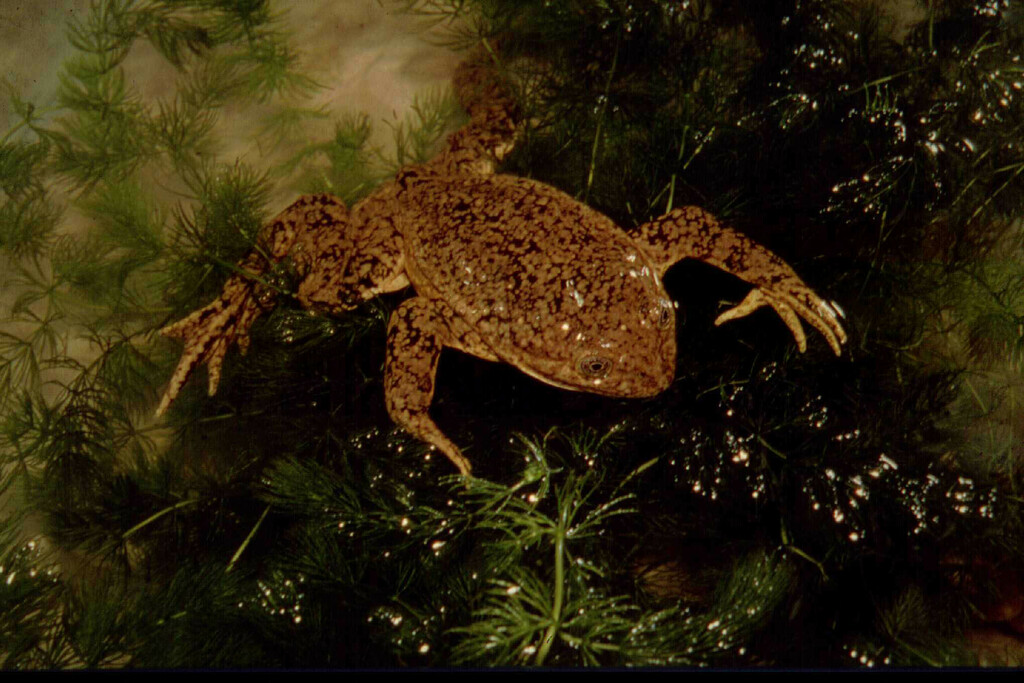
Junín Giant Frog
Telmatobius macrostomus
Telmatobius macrostomus, also known as the Lake Junin (giant) frog or Andes smooth frog, is a very large and endangered species of frog in the family Telmatobiidae. This completely aquatic frog is endemic to lakes and associated waters at altitudes of 4,000–4,600 m (13,100–15,100 ft) in the Andes of Junín and Pasco in central Peru. It has been introduced to slow-moving parts of the upper Mantaro River, although it is unclear if this population still persists.
Together with the closely related Amable Maria frog (T. brachydactylus), it is sometimes placed in the genus Batrachophrynus.
From the article Telmatobius macrostomus on Wikipedia (CC BY-SA), quoted section by section
What it does
T. macrostomus is completely aquatic, and restricted to lakes (notably Lake Junín) and waters that are directly connected to them like rivers, streams and canals. It has also been introduced to the upper part of the Mantaro River, but it is unclear if this population persists. It is found both in large marshy lakes and smaller deep lakes. This smooth-skinned, dark brownish frog generally ranges from shallow water to a depth of 12 m (39 ft), but prefers places with extensive aquatic vegetation and 1–5 m (3–16 ft) deep. In its native habitat the water temperature typically is between 7 and 17 °C (45–63 °F). Captives have been kept in aquariums for more than 5 years at around 20 °C (68 °F). It feeds on aquatic snails (especially Physidae), amphipods, aquatic insects (especially Baetidae mayfly larvae) and small fish. T. macrostomus is among the largest frogs in the world and the largest exclusively aquatic frog, a title sometimes incorrectly awarded to its somewhat smaller relative, the Titicaca water frog (T. culeus). T. macrostomus measures up to 30 cm (12 in) in snout–vent length, and 70 cm (28 in) in total length including outstretched legs. It can weigh up to about 2 kg (4.5 lb), and the hindlegs alone can surpass 40 cm (16 in) in length. Very large individuals are rare; most adults have a snout–vent length of 12.4–17.3 cm (4.9–6.8 in) and weigh less than 0.5 kg (1.1 lb). …
Wikipedia: “Ecology and appearance”
Listen
Looking for field recordings…
Where it lives
Recorded sightings
—
geo-referenced records in GBIF, from museums, herbaria and field observers.
Drag the globe to turn it. Dots are where records exist, not a range map; darker means more records.
In the stacks
Searching the stacks…
Every page naming Telmatobius macrostomus in the Biodiversity Heritage Library →
This page is assembled live from iNaturalist, GBIF, Wikipedia, the Source Library and the Internet Archive. It is not yet part of the hand-edited codex. iNaturalist taxon 135145.