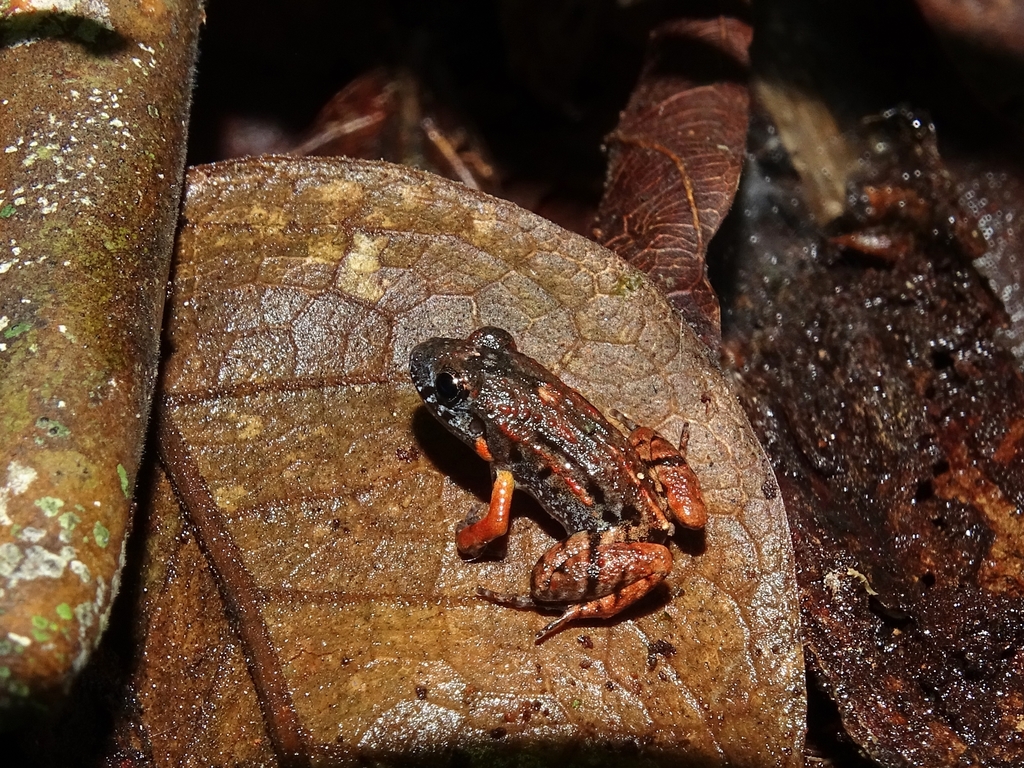
Segakiato Tropical Bullfrog
Adenomera simonstuarti
Adenomera simonstuarti is a frog. It is endemic to Peru and Brazil and suspected in Ecuador, Bolivia, Colombia, and Venezuela.
From the article Adenomera simonstuarti on Wikipedia (CC BY-SA), quoted section by section
Description
The adult male frog measures 26.2 mm in snout-vent length and the adult female frog 25.2 mm. The skin of the dorsum is gray-brown in color with darker marks from the middle of the back to the groin. There is a tan-orange line from each eye to near the end. There is a dark stripe on each side of the body with a light stripe next to it. There are two dark bars under each eye. There are white spots on both lips. The upper skin of the front feet are the heels is orange-red in color. The belly is gray-white in color.
Range & habitat
This terrestrial frog has been seen on the leaf litter in Amazon primary and secondary forest. This frog has shown some tolerance to habitat disturbance. It has been found on cacao farms and areas subjected to selective logging. Scientists have seen this frog between 280 and 700 m (920 and 2,300 ft) meters above sea level. Scientists have seen these frogs in a protected places.
Wikipedia: “Habitat”
Listen
Looking for field recordings…
Where it lives
Recorded sightings
—
geo-referenced records in GBIF, from museums, herbaria and field observers.
Drag the globe to turn it. Dots are where records exist, not a range map; darker means more records.
In the stacks
Searching the stacks…
Every page naming Adenomera simonstuarti in the Biodiversity Heritage Library →
This page is assembled live from iNaturalist, GBIF, Wikipedia, the Source Library and the Internet Archive. It is not yet part of the hand-edited codex. iNaturalist taxon 135023.