- Animals
- ›Chordates
- ›Vertebrates
- ›Amphibians
- ›Salamanders
- ›Lungless Salamanders
- ›Hemidactyliine Salamanders
- ›Ixalotriton
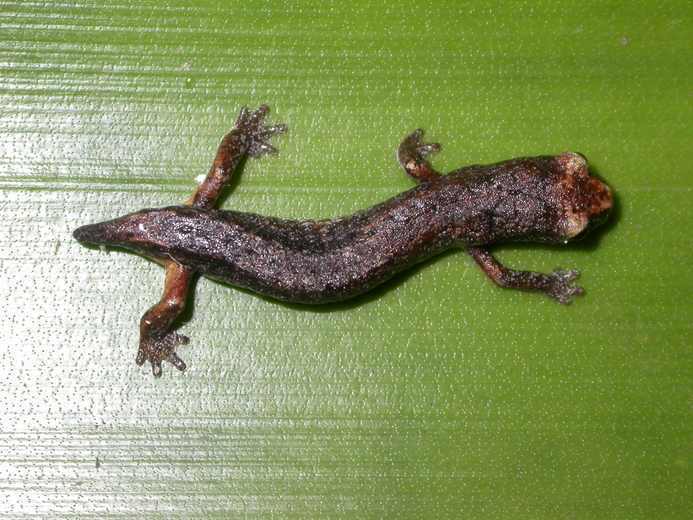
Dwarf False Brook Salamander
Ixalotriton parvus
Ixalotriton parvus, the dwarf false brook salamander, is a species of salamander in the family Plethodontidae. It is endemic to a small mountainous area of Mexico where its natural habitat is subtropical or tropical moist montane forests. It is threatened by habitat loss.
From the article Ixalotriton parvus on Wikipedia (CC BY-SA), quoted section by section
Description
The dwarf false brook salamander is small with a broad head, small nostrils, protruding eyes and slender body. It grows to a length of about 7.5 centimetres (3.0 in), half of which is the tail. It is a greyish-brown colour with a pale brown stripe running along the ridge of the back and a few whitish spots on the tail, which is prehensile. In appearance it is very similar to Aquiloeurycea praecellens.
Range & habitat
The dwarf false brook salamander is endemic to the Cerro Baul Mountains in the eastern part of Oaxaca State, Mexico at an altitude of about 1,600 metres (5,200 ft) above sea level. It lives in virgin cloud forests and does not flourish after forestry operations have caused disturbance. It is a terrestrial species and is usually found in the water that collects in the centre of bromeliads.
Wikipedia: “Distribution and habitat”
Listen
Looking for field recordings…
Where it lives
Recorded sightings
—
geo-referenced records in GBIF, from museums, herbaria and field observers.
Drag the globe to turn it. Dots are where records exist, not a range map; darker means more records.
In the stacks
Searching the stacks…
Every page naming Ixalotriton parvus in the Biodiversity Heritage Library →
This page is assembled live from iNaturalist, GBIF, Wikipedia, the Source Library and the Internet Archive. It is not yet part of the hand-edited codex. iNaturalist taxon 134372.