- Plants
- ›Vascular Plants
- ›conifers
- ›conifers
- ›cypress family
- ›Cypresses, Cedars, Junipers, and Allies
- ›Juniperus
- ›Juniperus
- ›Juniperus oxycedrus
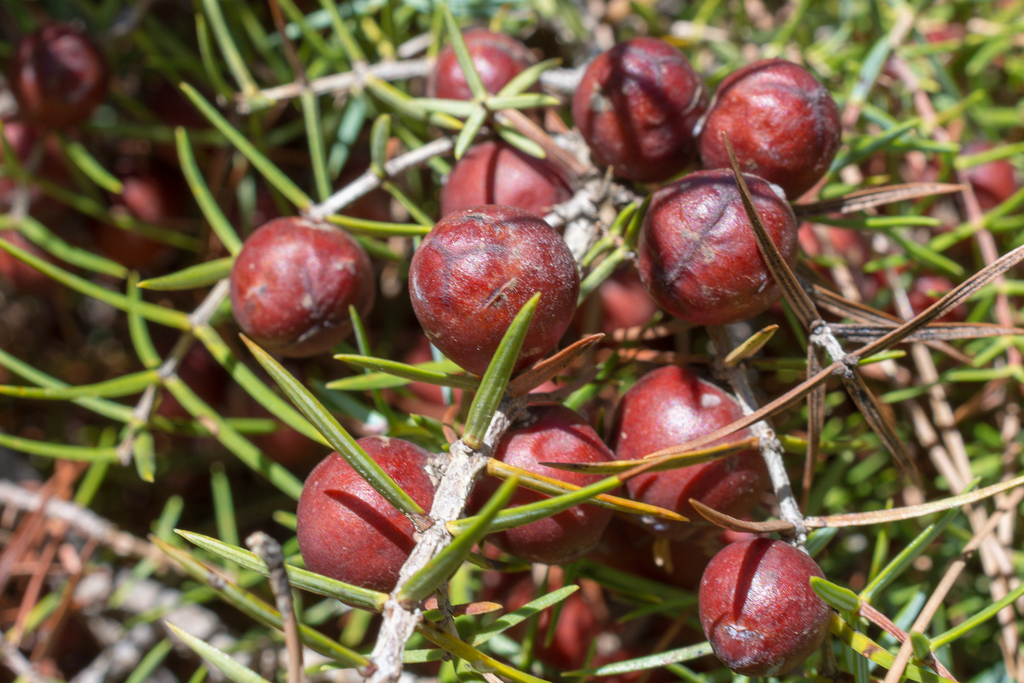
western prickly juniper
Juniperus oxycedrus
Juniperus oxycedrus (prickly juniper, prickly cedar, cade juniper and cade (from the French genévrier cade), sharp cedar) is a species of juniper, native across the Mediterranean region from Morocco and Portugal, north to southern France, east to westernmost Iran, and south to Lebanon and Israel, growing on a variety of rocky sites from sea level up to 1600 m elevation. The specific epithet oxycedrus means "sharp cedar" and this species may have been the original cedar...
From the article Juniperus oxycedrus on Wikipedia (CC BY-SA), quoted section by section
Description
Juniperus oxycedrus is very variable in shape, forming a spreading shrub 2–3 metres (6+1⁄2–10 feet) tall to a small erect tree 10–15 m (33–49 ft) tall. It has needle-like leaves in whorls of three; the leaves are green, 5–20 millimetres (1⁄4–3⁄4 inch) long and 1–2 mm (1⁄32–3⁄32 in) broad, with a double white stomatal band (split by a green midrib) on the inner surface. It is usually dioecious, with separate male and female plants. The seed cones are berry-like, green ripening in 18 months to orange-red with a variable pink waxy coating; they are spherical, 7–12 mm (1⁄4–1⁄2 in) diameter, and have three or six fused scales in 1–2 whorls, three of the scales with a single seed. The seeds are dispersed when birds eat the cones, digesting the fleshy scales and passing the hard seeds in their droppings. The pollen cones are yellow, 2–3 mm (1⁄16–1⁄8 in) long, and fall soon after shedding their pollen in late winter or early spring.
Subspecies. As to be expected from the wide range, J. oxycedrus is very variable, and multiple subspecies have been recognised. However, multiple studies have found the subspecies not to be closely related to one another, resulting in the recognition of multiple species:
Juniperus oxycedrus L. – Western prickly juniper. …
At the table
Cade oil is the essential oil obtained through destructive distillation of the wood of this shrub. It is a dark, aromatic oil with a strong smoky smell which is used in some cosmetics and (traditional) skin treatment drugs, as well as incense. Cade oil has, on rare occasions, caused severe allergic reactions in infants.
Wikipedia: “Uses”
Where it lives
Recorded sightings
—
geo-referenced records in GBIF, from museums, herbaria and field observers.
Drag the globe to turn it. Dots are where records exist, not a range map; darker means more records.
In the stacks
Searching the stacks…
Every page naming Juniperus oxycedrus in the Biodiversity Heritage Library →
This page is assembled live from iNaturalist, GBIF, Wikipedia, the Source Library and the Internet Archive. It is not yet part of the hand-edited codex. iNaturalist taxon 133994.