- Animals
- ›Arthropods
- ›Chelicerates
- ›Arachnids
- ›Spiders
- ›Typical Spiders
- ›Entelegyne Spiders
- ›RTA Clade Spiders
- ›Huntsman Spiders
- ›Heteropodinae
- ›Heteropoda
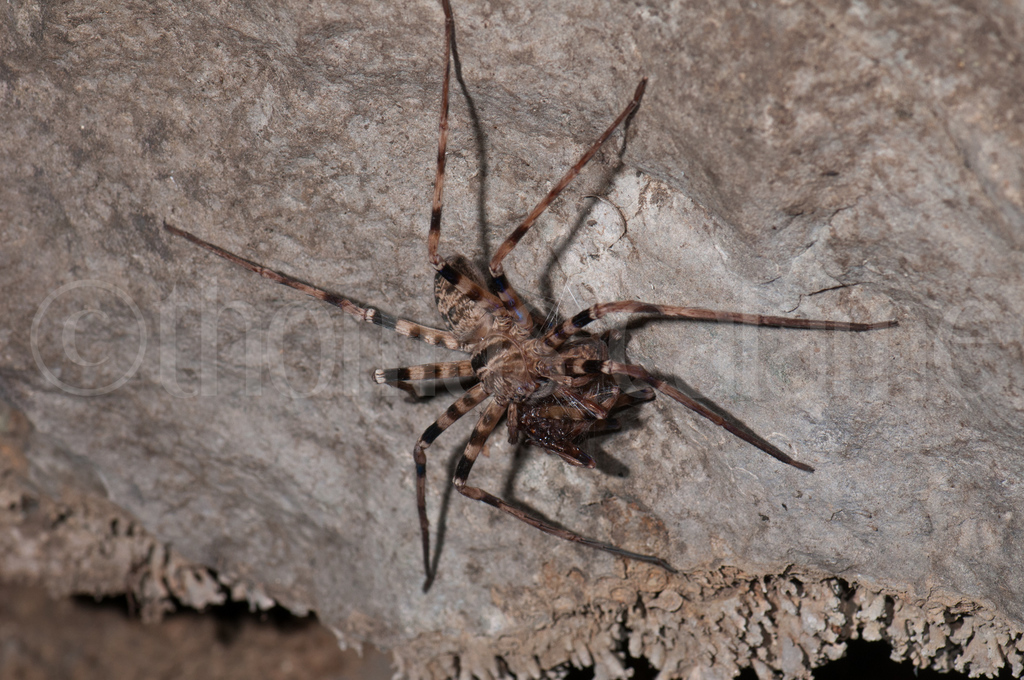
Giant Huntsman Spider
Heteropoda maxima
The giant huntsman spider (Heteropoda maxima, "the largest") is a species of huntsman spider (Sparassidae), a family of large, fast spiders that actively hunt down prey. It is considered the world's largest spider by leg span, which can reach up to 1 foot (30 centimeters).It eats only insects.
From the article Giant huntsman spider on Wikipedia (CC BY-SA), quoted section by section
Description
The coloration is yellowish-brown with several irregularly distributed dark spots on the rear half. The legs have wide dark bands before the first bend. Like all huntsman spiders, the legs of the giant huntsman spider are long compared to the body, and twist forward in a crab-like fashion. Apart from its size, the H. maxima can be distinguished from other species of Heteropoda by genital characteristics. On males, the cymbium is at least three times longer than the tegulum. The female is distinguished by a characteristically shaped epigyneal field with two anterior directed bands, and the course of their internal ducts. The giant huntsman spider is the largest member of the family Sparassidae, boasting a 30 cm (12 in) leg-span, and 4.6 cm (1.8 in) body-length. The largest known member of the Sparassidae known prior to the discovery of H. maxima was the Australian Beregama aurea (L. Koch, 1875) with a body length of about 4 cm (1.6 in). (Other relatively large members of Sparassidae have been discovered in recent years, including Cerbalus aravaensis, the largest in the Middle East).
Range & habitat
The giant huntsman spider is found in Laos, and is believed to be a cave dweller because of its pale colour, long legs and special hairs on the second foot of the male. There is no apparent reduction of the eyes, possibly because the species lives near cave entrances.
Wikipedia: “Distribution and habitat”
Where it lives
Recorded sightings
—
geo-referenced records in GBIF, from museums, herbaria and field observers.
Drag the globe to turn it. Dots are where records exist, not a range map; darker means more records.
In the stacks
Searching the stacks…
Every page naming Heteropoda maxima in the Biodiversity Heritage Library →
This page is assembled live from iNaturalist, GBIF, Wikipedia, the Source Library and the Internet Archive. It is not yet part of the hand-edited codex. iNaturalist taxon 130562.