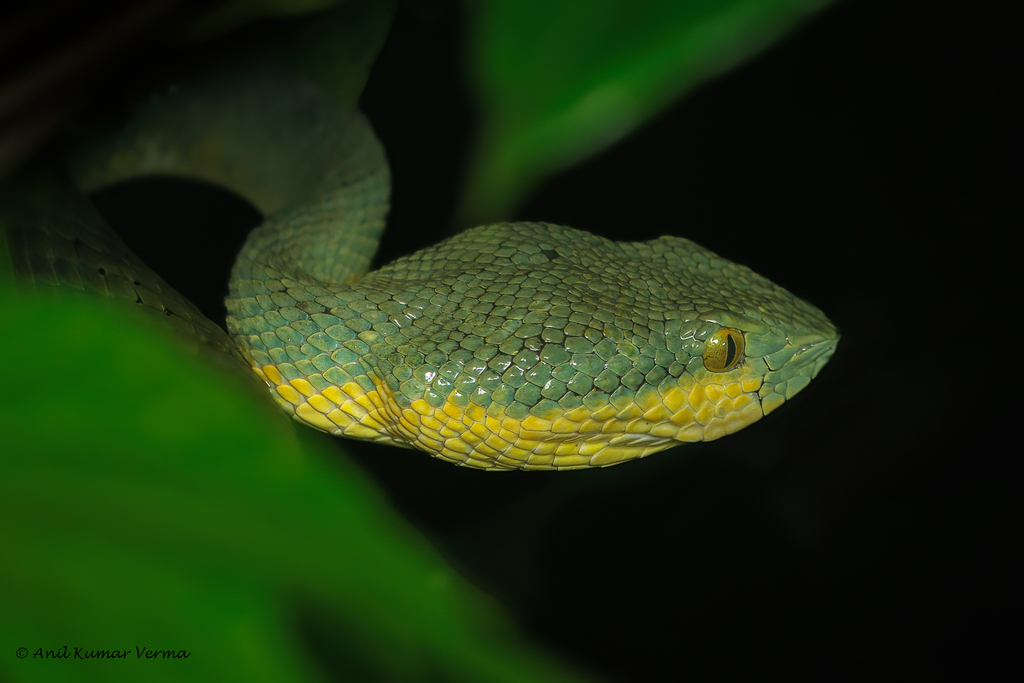
Common Bamboo Viper
Craspedocephalus gramineus
Craspedocephalus gramineus, known as the bamboo pit viper, Indian green pit viper, or common green pit viper, is a venomous pit viper species found in the southern and north eastern parts of India. No subspecies are currently recognized.
From the article Craspedocephalus gramineus on Wikipedia (CC BY-SA), quoted section by section
Description
The rostral scale is as deep as broad or broader than deep. The upper head-scales are small, smooth, imbricate; supraocular scale narrow, rarely broken up. The internasals are contact or separated by one or two scales. There are 8 to 13 scales on a line between the supraoculars; usually one or two, rarely three, series of scales between the suboculars and the labials; 9 to 12 upper labials, second usually forming the anterior border of the loreal pit, third largest; temporal scales smooth. The dorsal scales are more or less distinctly keeled, in 21 (rarely 19 or 23) rows; ventrals 145–175; anal scale entire; subcaudals in two rows 53–76. The upper parts are usually bright green, rarely yellowish, greyish, or purplish brown, with or without black, brown, or reddish spots; usually a light, white, yellow, or red streak along the outer row of scales; end of tail frequently yellow or red; lower parts green, yellow, or whitish. It grows to a total length of 3.25 feet (0.99 m). The tail is 5.5 inches (14 cm) in length.
Range & habitat
The Bamboo Pit Viper is a widespread species throughout the peninsular India. It is also found albeit very scarcely in the eastern region of India spanning from Odisha, Jharkhand, and West Bengal. The type locality is "Vizagapatam, India", which is based on Russell (1796).
Wikipedia: “Geographic range”
What it does
C. gramineus is arboreal and nocturnal. When threatened, it is aggressive and does not hesitate to bite. The venom is hemotoxic and neurotoxic.
Wikipedia: “Behaviour”
Where it lives
Recorded sightings
—
geo-referenced records in GBIF, from museums, herbaria and field observers.
Drag the globe to turn it. Dots are where records exist, not a range map; darker means more records.
In the stacks
Searching the stacks…
Every page naming Craspedocephalus gramineus in the Biodiversity Heritage Library →
This page is assembled live from iNaturalist, GBIF, Wikipedia, the Source Library and the Internet Archive. It is not yet part of the hand-edited codex. iNaturalist taxon 1304706.