- Animals
- ›Chordates
- ›Vertebrates
- ›Birds
- ›Swifts and Hummingbirds
- ›Hummingbirds
- ›Bee Hummingbirds, Emeralds, Mountain-gems, and Allies
- ›Emerald Hummingbirds and Allies
- ›Eupetomena
On eBird ↗
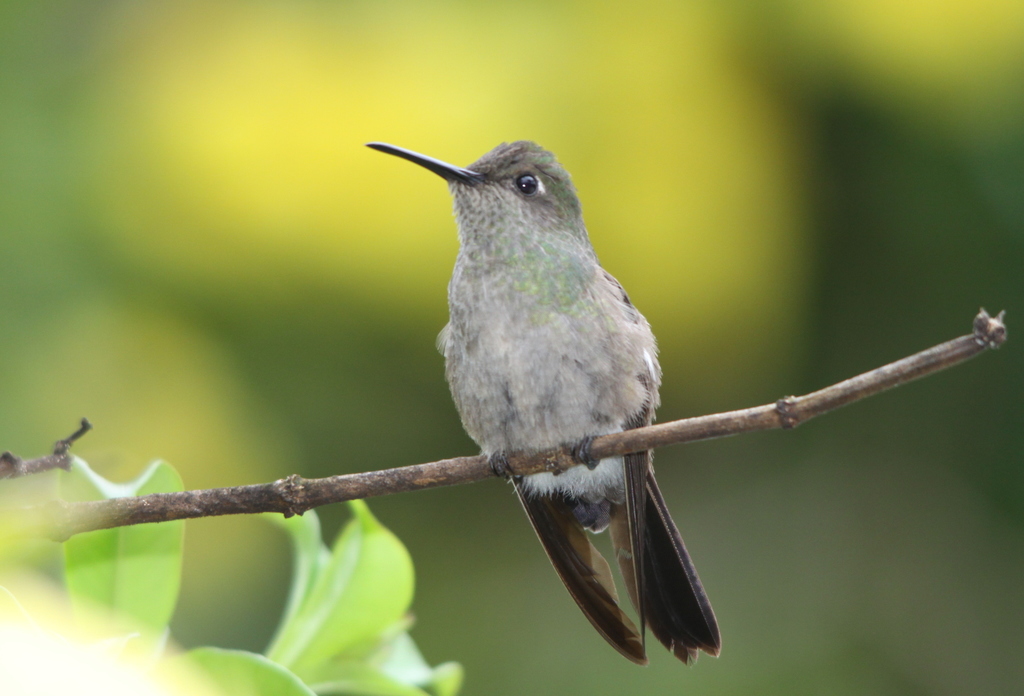
Sombre Hummingbird
Live sightings near you, the range map, bar charts of when it is seen, and Macaulay Library photos and recordings.
Sombre Hummingbird
Eupetomena cirrochloris
The sombre hummingbird (Eupetomena cirrochloris) is a species of hummingbird in the "emeralds", tribe Trochilini of subfamily Trochilinae. It is endemic to Brazil.
From the article Sombre hummingbird on Wikipedia (CC BY-SA), quoted section by section
Description
The sombre hummingbird is about 12 cm (4.7 in) long and weighs about 7.1 to 9 g (0.25 to 0.32 oz). The sexes are essentially the same though the female is slightly smaller than the male. They have a slightly decurved black bill. Their upperparts are bronzy green to blackish bronzy green with a coppery sheen to the uppertail coverts. Their underparts are dull gray with a few dull green spots on the throat. Their tail is square; its central feathers are shiny green and the rest black with a bronzy gloss.
Range & habitat
The sombre hummingbird is found in eastern Brazil from Pernambuco south into Rio Grande do Sul and west as far as Mato Grosso. It inhabits the edges and understory of humid primary and secondary forest, plantations, and gardens. The core of its habitat is the Atlantic Forest but it also occurs in the transition zone between cerrado and caatinga biomes.
Wikipedia: “Distribution and habitat”
What it does
The sombre hummingbird forages for nectar at a variety of flowering plants including introduced Eucalyptus. It does so from the understory to as high as 30 m (100 ft) above the ground. It is highly territorial and spends half its time aggressively defending flower patches from hummingbirds of its own and other species. In addition to nectar it feeds on arthropods captured by hawking from a perch.
Wikipedia: “Feeding”
Listen
Looking for field recordings…
Where it lives
Recorded sightings
—
geo-referenced records in GBIF, from museums, herbaria and field observers.
Drag the globe to turn it. Dots are where records exist, not a range map; darker means more records.
In the stacks
Searching the stacks…
Every page naming Eupetomena cirrochloris in the Biodiversity Heritage Library →
This page is assembled live from iNaturalist, GBIF, Wikipedia, the Source Library and the Internet Archive. It is not yet part of the hand-edited codex. iNaturalist taxon 1289663.