On eBird ↗
Fork-tailed Storm-Petrel
Live sightings near you, the range map, bar charts of when it is seen, and Macaulay Library photos and recordings.
Fork-tailed Storm-Petrel
Hydrobates furcatus
The fork-tailed storm petrel (Hydrobates furcatus) is a small seabird of the storm petrel family Hydrobatidae. It is the second-most abundant and widespread storm petrel (after Leach's storm petrel) and is the only bird in its family that is bluish-grey in colour.
The fork-tailed storm petrel is pelagic, spending up to 8 months in the northern Pacific Ocean. They only return to land to breed, where they nest in a single colony. Their nests can be found in a rock crevice or small burrow, where a single egg is laid. Their breeding range is along the coast of the northern Pacific Ocean, extending from northern California to northeast Asia.
From the article Fork-tailed storm petrel on Wikipedia (CC BY-SA), quoted section by section
Description
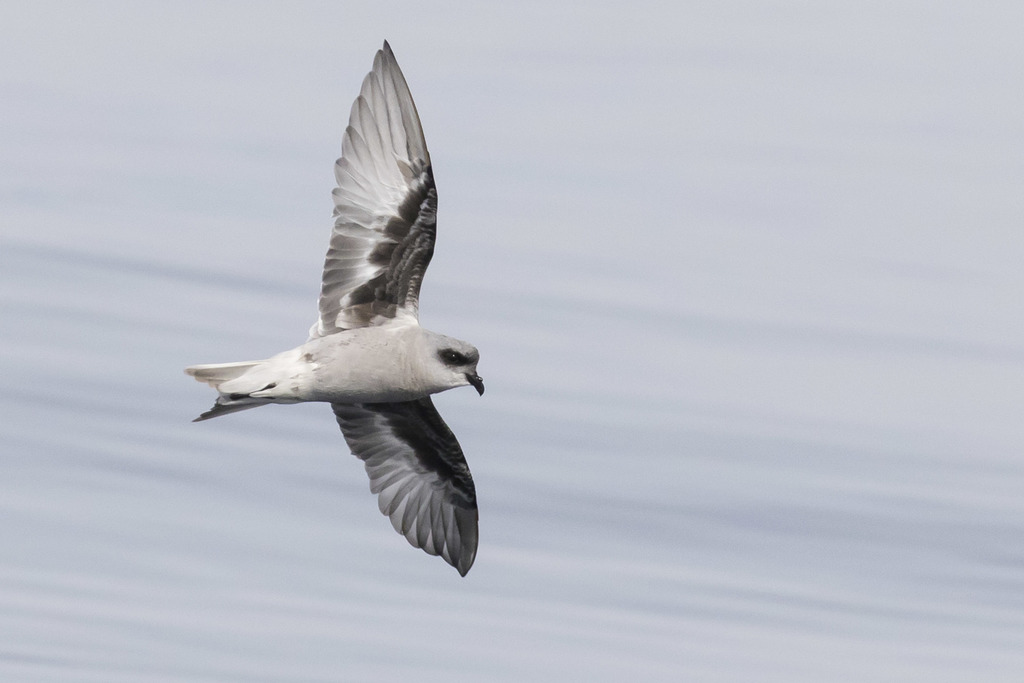
The fork-tailed storm petrel is small seabird that is 20 cm in length with a wingspan of 46 cm. Its foraging behaviour resembles other storm petrels, where it flies with short, stiff wingbeats close to the surface of the water. Despite its name, the forked tail in this bird is not always visible. The distinguishing feature of fork-tailed storm petrels is their overall bluish-gray plumage. They generally have a paler underside, which contrasts the darker colours under their wings. They also have a dark gray forehead, a black ear patch, and a small, black bill. Other storm petrels are significantly darker, such as the similar looking ashy storm petrel. However, fork-tailed storm petrels from southern populations are somewhat darker than those in the north. Males and females are generally very similar in colour and size. Juveniles also resemble adults with the exception of having a less noticeable notch in their tails. They are generally silent and only call when entering their breeding colony at night. Their most common call is a 3- to 5-note, raspy "ana-ana-ana", heard from both sexes. This is especially intense during courtship, where their calls are accompanied by elaborate aerial displays. A higher-pitched, single note call is typically emitted by males, and it is used to locate females in noisy colonies and to maintain the pair bond.
Range & habitat
The range of the fork-tailed storm petrel is estimated to cover 22,400,000 km2 with over 6,000,000 individuals occurring globally, making it the second-most widespread and abundant storm petrel. During the breeding season, the fork-tailed storm petrel form dense colonies on islands throughout northern California, Oregon, Washington, British Columbia, Alaska, and northeast Asia off the Kamchatka Peninsula. Most of their population is concentrated in Alaska, notably in the Bering Sea near the Aleutian Islands. Their southernmost colony is on Little River Rock in Humboldt County, with a population of 200 individuals. It was reported in July 1939 that fork-tailed storm petrels were breeding on the Flannan Isles, Na h-Eileanan Flannach, which are about 35 km west of the northern tip of the Outer Hebrides, Scotland. Their nesting habitat varies, ranging from bare rock to forests. They typically build their nests under rock crevices or roots, or burrow into soft ground with low-growing vegetation. As they frequent the open ocean, little is known about fork-tailed storm petrels outside of the breeding season. They have been frequently sighted off the Californian coast, making them the most northerly distributed storm petrel during the winter. Sparse sightings also indicate that they forage as far south as Hawaii.
Wikipedia: “Distribution and habitat”
What it does
Like other storm petrels, the fork-tailed storm petrel mainly feeds on crustaceans and fish near the surface of the ocean, including amphipods, myctophids, shallow-water fish (such as greenling and sablefish), copepods, decapods, and squid. They are also extremely opportunistic and can be seen scavenging on fatty tissue of dead marine mammals and also trailing behind fishing boats. Fork-tailed storm petrels have a well-developed olfactory system and heavily rely on odour to scout for food, so often they are the first birds to arrive at a pungent food source. When at the source, these birds seize their prey by fluttering across the water surface and may occasionally dive to depths of 0.6 m. Like other Procellariiformes, the fork-tailed storm petrel produces stomach oil from its digested food and stores it in its proventriculus, a section of the bird's digestive system. This oil permits these birds to go for a long time without food, but also allows them to transport nutrient-rich food back to their chicks from distant sources.
Wikipedia: “Food and feeding”
Listen
Looking for field recordings…
Where it lives
Recorded sightings
—
geo-referenced records in GBIF, from museums, herbaria and field observers.
Drag the globe to turn it. Dots are where records exist, not a range map; darker means more records.
In the stacks
Searching the stacks…
Every page naming Hydrobates furcatus in the Biodiversity Heritage Library →
This page is assembled live from iNaturalist, GBIF, Wikipedia, the Source Library and the Internet Archive. It is not yet part of the hand-edited codex. iNaturalist taxon 1289624.