On eBird ↗
Band-rumped Storm-Petrel
Live sightings near you, the range map, bar charts of when it is seen, and Macaulay Library photos and recordings.
Band-rumped Storm-Petrel
Hydrobates castro
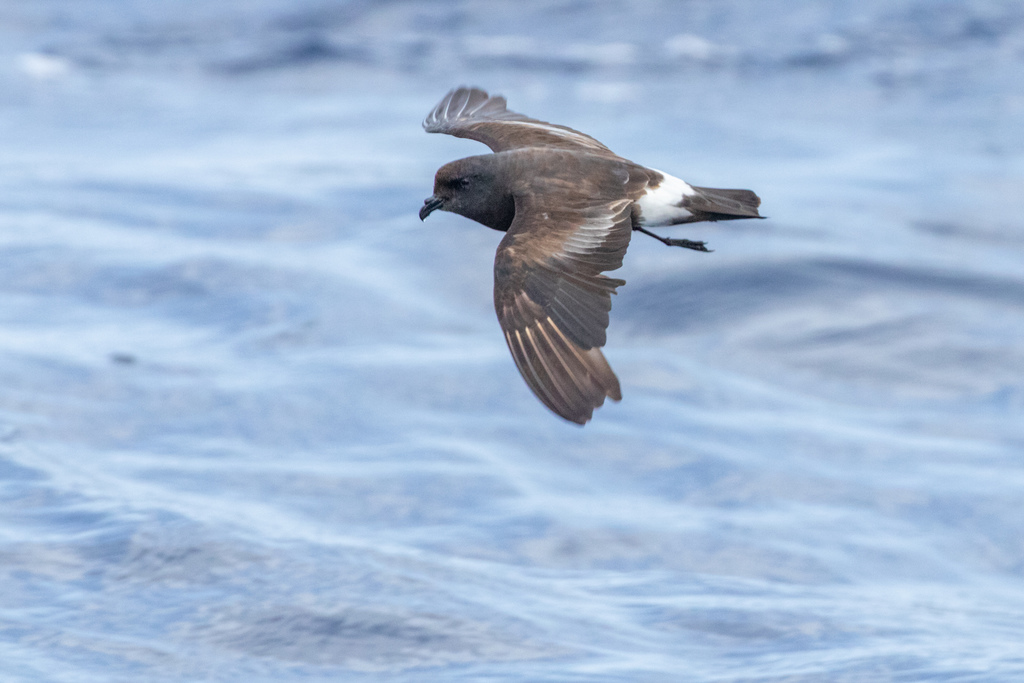
The band-rumped storm petrel, Madeiran storm petrel, or Harcourt's storm petrel (Hydrobates castro) is a species of storm petrel in the family Hydrobatidae.
From the article Band-rumped storm petrel on Wikipedia (CC BY-SA), quoted section by section
Description
The band-rumped storm petrel is 19–21 cm (7.5–8.3 in) in length with a 43–46 cm (17–18 in) wingspan, and weighs 44–49 g (1.6–1.7 oz). It is mainly brownish black with an extensive white rump. Similar to Leach's storm petrel with the forked tail, long wings, but Leach's has a more deeply forked tail, a differently shaped (V-shaped or triangular) white rump, and a 'tern-like' flight, whereas the band-rumped storm-petrel has a more 'shearwater-like' flight.
Range & habitat
The species breeds on islands in the warmer parts of the Atlantic and Pacific Oceans. These include the Berlengas (a few tens of kilometres off mainland Portugal), the Azores, Madeira, Canary Islands and Saint Helena in the Atlantic, and in the Pacific off eastern Japan, on Kauai, Hawaii, and on the Galápagos Islands. In 2016, the species was reported to have also started breeding on the Mauna Loa volcano on the island of Hawaii.
Wikipedia: “Distribution”
What it does
Individuals feed by picking up prey items (invertebrates, small vertebrates and sometimes carrion) from the water surface. A study aiming to determine the diving abilities of this species was actually conducted on the 'warm season' population from the Azores, which was later recognized as a distinct species (see below).
Wikipedia: “Feeding”
Listen
Looking for field recordings…
Where it lives
Recorded sightings
—
geo-referenced records in GBIF, from museums, herbaria and field observers.
Drag the globe to turn it. Dots are where records exist, not a range map; darker means more records.
In the stacks
Searching the stacks…
Every page naming Hydrobates castro in the Biodiversity Heritage Library →
This page is assembled live from iNaturalist, GBIF, Wikipedia, the Source Library and the Internet Archive. It is not yet part of the hand-edited codex. iNaturalist taxon 1289617.