- Animals
- ›Chordates
- ›Vertebrates
- ›Birds
- ›Gannets, Cormorants, and Allies
- ›Cormorants and Shags
- ›Poikilocarbo
On eBird ↗
Red-legged Cormorant
Live sightings near you, the range map, bar charts of when it is seen, and Macaulay Library photos and recordings.
Red-legged Cormorant
Poikilocarbo gaimardi
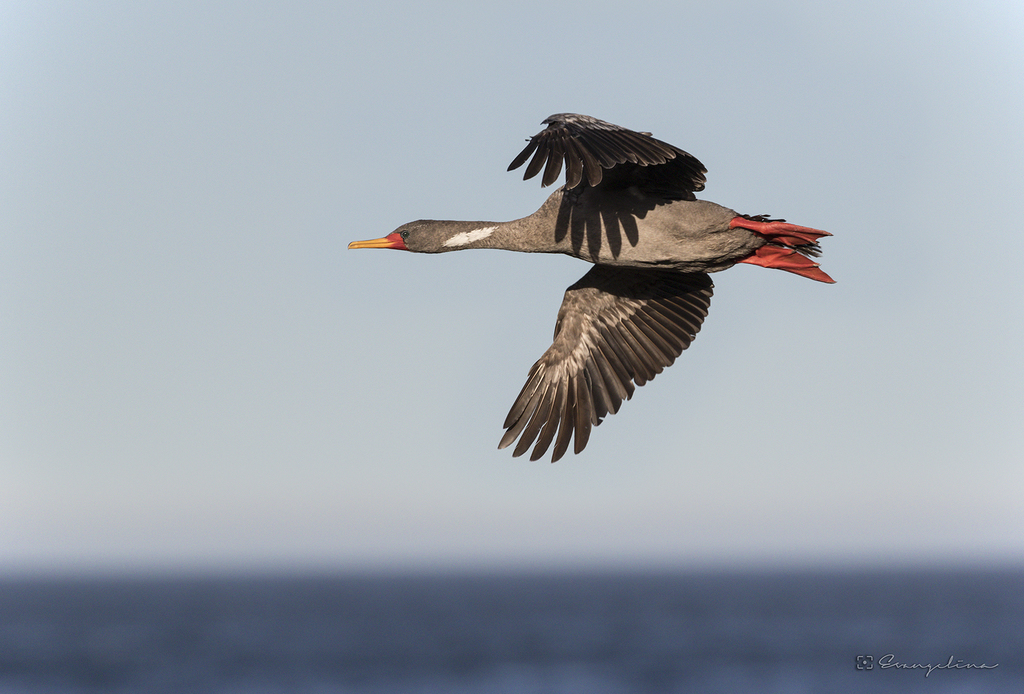
The red-legged cormorant (Poikilocarbo gaimardi), also known as the red-legged shag, red-footed cormorant, red-footed shag, Gaimard's cormorant and grey cormorant, is a species of cormorant resident to the coastline of South America. It is the only member of the genus Poikilocarbo. It is non-colonial unlike most seabirds. The red-legged cormorant has not been observed wing-spreading, which is unusual among cormorant species.
From the article Red-legged cormorant on Wikipedia (CC BY-SA), quoted section by section
Description
The red-legged cormorant is a medium-sized seabird, with a long neck, streamlined body, webbed feet and a long, thin hooked bill. Its body length is 71–76 centimetres (28–30 in), with an average wingspan of 91 cm (36 in). It weighs 1.3–1.5 kilograms (2.9–3.3 lb). There is no sexual dimorphism between the male and female birds. The red-legged cormorant's appearance is unmistakable. Breeding adults have a smoky grey body, with a slightly paler underside. They have scattered areas of white filoplumes behind the eyes and down the neck. The wing coverts have a speckled, silvery grey appearance, followed by broad black wing tips. The tail is also black. The eyes are green, surrounded by sixteen tiny blue marks. The bill is yellow, shading to orange toward the base, the gular skin is a vibrant orange or red. The legs and feet are a striking coral red. Non-breeding adults look similar to breeding adults. They lack the white filoplumes, the wing coverts appear less silvery, but more dark grey, and the bill and gular skin are duller in colouration. Juvenile red-legged cormorants usually possess paler, brown plumage with a speckling of white around the throat. Juvenile plumage colouration can be highly variable between the Atlantic and Pacific coasts. Their eyes are grey and their bills and gular skin range from black to orange. The legs and feet can be a dull orange to a reddish black.
Range & habitat
The red-legged cormorant is native to the coast of South America. On the Pacific coast it ranges from Macabi Island, Peru to Chiloe Island, Chile. There are small isolated populations on the Atlantic coast scattered across Santa Cruz, Argentina. It rarely occurs further south than the Strait of Magellan. Red-legged cormorants nest sparsely on steep rock faces, including coastal cliffs, rocky islets, and sea caverns. They become virtually undetectable against these rocky outcrops by their speckled grey plumage, with the exception of their colourful bills and feet. They forage within inshore bodies of water and in shallow offshore waters.
Wikipedia: “Distribution and habitat”
What it does
Red-legged cormorants are generally solitary foragers, but hunting in pairs or small flocks may occur. Most red-legged cormorants forage no further than 3 km away from their nest. They hunt in inshore waters, including estuaries, and in shallow offshore waters. They never enter exclusively fresh water. Many red-legged cormorants forage at low tide, presumably to minimize their travel time to and from the surface and to maximize time searching for food. They can dive 8–10 metres (26–33 ft) below the surface in pursuit of prey. Their diet mainly consists of fish, specifically including eels, sprat, and anchovies, as well as planktonic crustaceans and squid.
Wikipedia: “Feeding”
Listen
Looking for field recordings…
Where it lives
Recorded sightings
—
geo-referenced records in GBIF, from museums, herbaria and field observers.
Drag the globe to turn it. Dots are where records exist, not a range map; darker means more records.
In the stacks
Searching the stacks…
Every page naming Poikilocarbo gaimardi in the Biodiversity Heritage Library →
This page is assembled live from iNaturalist, GBIF, Wikipedia, the Source Library and the Internet Archive. It is not yet part of the hand-edited codex. iNaturalist taxon 1289608.