On eBird ↗
Brandt's Cormorant
Live sightings near you, the range map, bar charts of when it is seen, and Macaulay Library photos and recordings.
Brandt's Cormorant
Urile penicillatus
Brandt's cormorant (Urile penicillatus) is a strictly marine bird of the cormorant family of seabirds that inhabits the Pacific coast of North America. It ranges, in the summer, from Alaska to the Gulf of California, but the population north of Vancouver Island migrates south during the winter. Its specific name, penicillatus is Latin for a painter's brush (pencil of hairs), in reference to white plumes on its neck and back during the early breeding season. The common name honors the German naturalist Johann Friedrich von Brandt of the Academy of Sciences at St. Petersburg, who described the species from specimens collected on expeditions to the Pacific during the early 19th century.
From the article Brandt's cormorant on Wikipedia (CC BY-SA), quoted section by section
Description
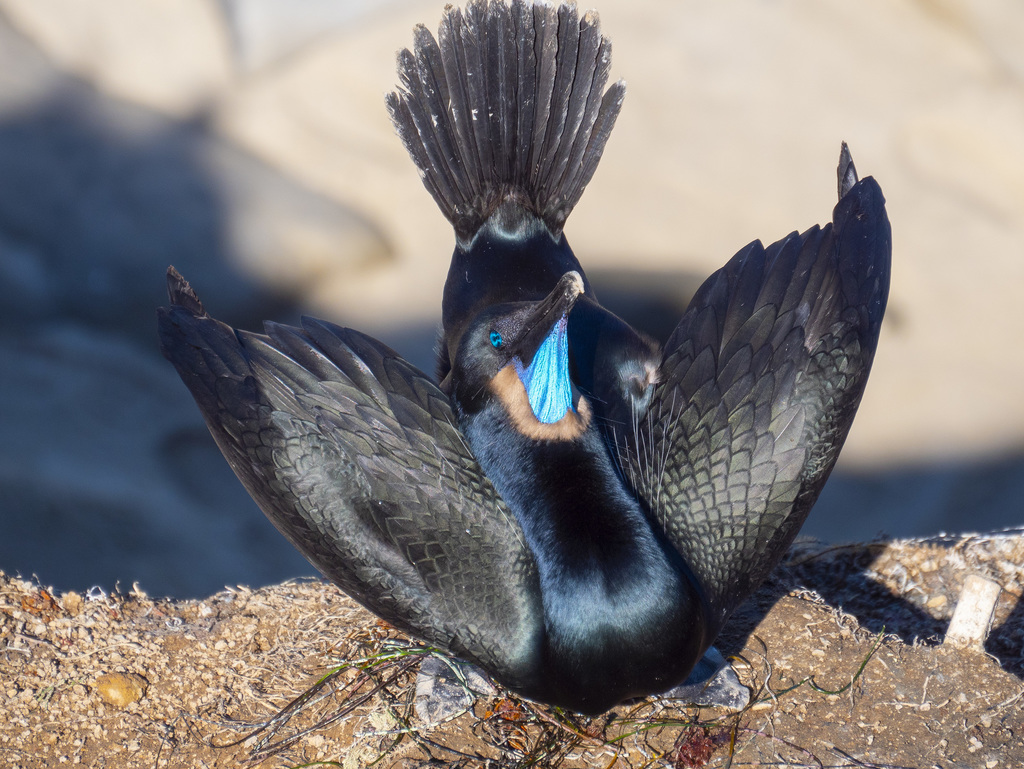
The average size of a Brandt's cormorant is 4.6 lb (2.1 kg). It is about 34 in (86 cm) long and its wingspan is 4 ft (1.2 m). During the breeding season, adults have a blue throat patch.
Range & habitat
Brandt's cormorants live on the Pacific coast of North America, in habitats such as bays, estuaries, and lagoons. This species nests on the ground or on rocky outcroppings. Año Nuevo Island is an important seabird breeding colony in the Monterey Bay National Marine Sanctuary, hosting Brandt's cormorants among other species of seabirds. During the breeding season their range settles from Vancouver Island to the Baja California peninsula, solely relying on the food fertility of the California Current. In the non-breeding season, as the current diminishes, their range extends southwards, but also northwards to southern Alaska.
Wikipedia: “Distribution and habitat”
What it does
They typically live in groups. They breed between March and August, and usually have four eggs. Young birds are cared for by both parents.
Wikipedia: “Behavior”
Listen
Looking for field recordings…
Where it lives
Recorded sightings
—
geo-referenced records in GBIF, from museums, herbaria and field observers.
Drag the globe to turn it. Dots are where records exist, not a range map; darker means more records.
In the stacks
Searching the stacks…
Every page naming Urile penicillatus in the Biodiversity Heritage Library →
This page is assembled live from iNaturalist, GBIF, Wikipedia, the Source Library and the Internet Archive. It is not yet part of the hand-edited codex. iNaturalist taxon 1289607.