On eBird ↗
Imperial Cormorant
Live sightings near you, the range map, bar charts of when it is seen, and Macaulay Library photos and recordings.
Imperial Shag
Leucocarbo atriceps
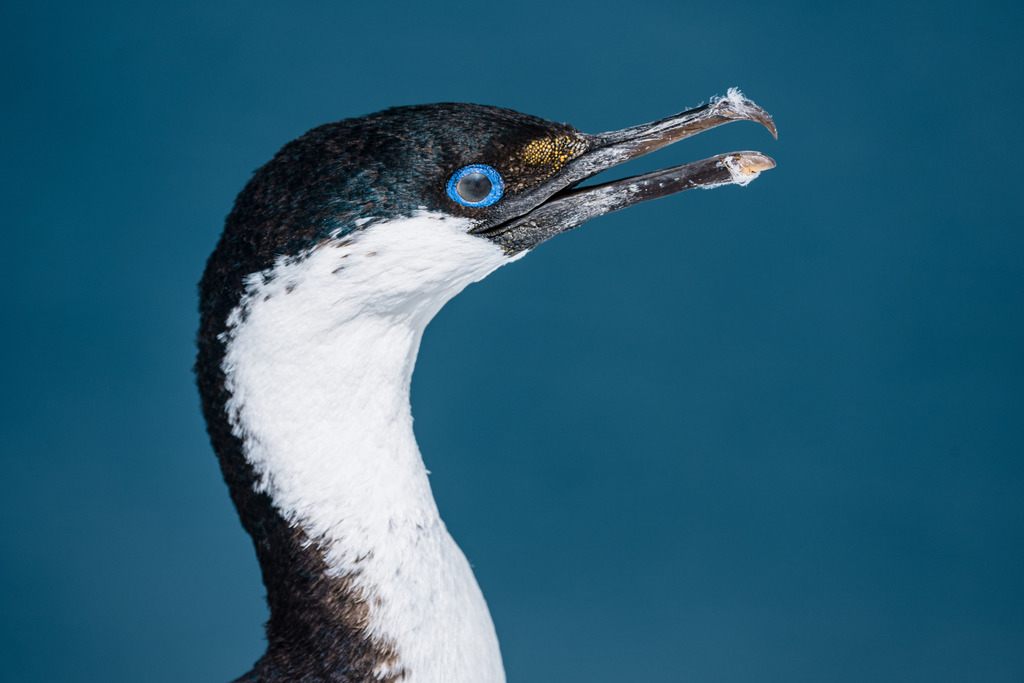
The imperial shag or imperial cormorant (Leucocarbo atriceps) is a black-and-white cormorant native to southern South America, islands of the Subantarctic, and the Antarctic Peninsula, primarily in rocky coastal regions, but locally also at large inland lakes. Some taxonomic authorities, including the International Ornithologists' Union, place it in the genus Leucocarbo, others in the genus Phalacrocorax. It is also known as the blue-eyed shag, blue-eyed cormorant and by many other names, and is one of a larger group of cormorants called blue-eyed shags. The taxonomy is complex, and several types are treated as either subspecies or separate species.
From the article Imperial shag on Wikipedia (CC BY-SA), quoted section by section
Description
The imperial shag has a total length of 70–79 cm (28–31 in) and weighs 1.8–3.5 kg (4.0–7.7 lb), with males usually larger than females. It is endowed with glossy black feathers covering most of its body, with a white belly and neck. It possesses a distinctive ring of blue skin around its eyes, an orange-yellow nasal knob, pinkish legs and feet, and an erectile black crest. During the non-breeding season, adults lack the crest, have a duller facial area, and less or no white to the back and wings. It has a serrated bill used for catching fish. The group varies primarily in the amount of white on the cheeks/ear-coverts, wing-coverts and back. Most taxa have white cheeks and ear-coverts, but these are black in albiventer, purpurascens and melanogenis. Chicks are uniform brownish, and immatures are brownish and white (instead of black and white), have dull facial skin, and lack the orange-yellow nasal knob and blue eye-ring.
What it does
The diet of this species consists of small benthic fish, crustaceans, polychaetes, gastropods and octopuses. They primarily feed on fish, especially Argentine anchoita,. Mean diving depth is almost 25 m (82 ft), and they have been filmed diving as deep as 60 m (200 ft) to forage on the sea floor. Most feeding takes place in inshore regions, but at least some populations will travel some distance from the shore to fish.
Wikipedia: “Feeding”
Listen
Looking for field recordings…
Where it lives
Recorded sightings
—
geo-referenced records in GBIF, from museums, herbaria and field observers.
Drag the globe to turn it. Dots are where records exist, not a range map; darker means more records.
In the stacks
Searching the stacks…
Every page naming Leucocarbo atriceps in the Biodiversity Heritage Library →
This page is assembled live from iNaturalist, GBIF, Wikipedia, the Source Library and the Internet Archive. It is not yet part of the hand-edited codex. iNaturalist taxon 1289591.