- Fungi Including Lichens
- ›Basidiomycete Fungi
- ›Higher Basidiomycetes
- ›Mushrooms, Bracket Fungi, Puffballs, and Allies
- ›Agaricomycetidae
- ›Common Gilled Mushrooms and Allies
- ›Agaricineae
- ›puffballs
- ›Calbovista
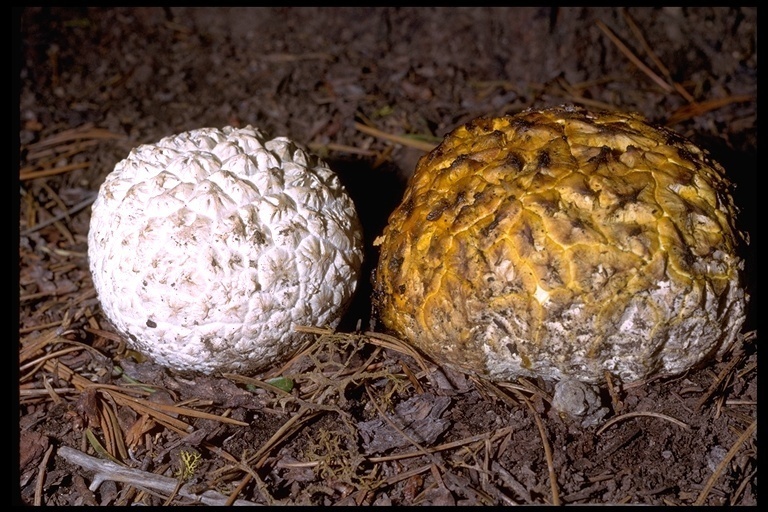
Sculptured Puffball
Calbovista subsculpta
Calbovista is a fungal genus containing the single species Calbovista subsculpta, commonly known as the sculptured puffball, sculptured giant puffball, and warted giant puffball. Although originally described as new to science by Elizabeth Eaton Morse in 1935, the species was not published validly until 60 years later. The species is named for its resemblance to Calvatia sculpta.
Calbovista subsculpta is more or less round with a diameter of up to 15 cm (6 in), white becoming brownish in age, and covered with shallow pyramid-shaped plates or scales. As the puffball matures, its insides become dark brown and powdery from mature spores. It can be usually distinguished from Calvatia sculpta by its less prominent pyramidal warts and microscopically by the antler-like branches of its capillitium (threadlike matter among the spores).
From the article Calbovista on Wikipedia (CC BY-SA), quoted section by section
Description
The fruit bodies are irregularly top-shaped to roughly spherical, measuring 8–15 cm (3–6 in) wide and 6–9 cm (2+1⁄2–3+1⁄2 in) high. It has a two-layered peridium. The outer layer of the peridium (the exoperidium) is thick and leathery (except where it thins toward the base), measuring 5–10 mm (3⁄16–3⁄8 in) thick. It is divided into irregular three- to six-sided, low pyramids that are usually blunt, but sometimes pointed. The pyramids are 5–8 mm (3⁄16–5⁄16 in) thick. They have parallel markings, a feature Morse attributed to the differences in growth rate caused by variations in daytime and nighttime temperatures. The pyramid centers have short brownish hairs. The pyramids cover the entire peridium except for near the base, where it is smooth. Warts on the surface of young fruit bodies may be disproportionately thick. The inner peridium is a thin shiny tissue that is depressed into areas demarcated by the pyramidal plates. The puffball base, which occupies about a third to a quarter of the bottom of the fruit body, consists of moderately-sized chambers that persist even after the gleba has matured and the spores have dispersed. The base can assume a purplish hue after weathering. The base is rooted into the soil with rhizomorphs. Initially white, the gleba turns color from yellow to golden brown to dark brown as the spores mature. …
Range & habitat
Calbovista is a saprobic species, decomposing dead plant material. Its fruit bodies grow singly, in groups, or occasionally in clusters. Fruiting occurs from April to August in areas with broken rocks mixed with soil, or in open coniferous forest at elevations ranging from 900 to 3,400 m (3,000 to 11,000 ft). Another usual habitat is on road sides. Calbovista is a common mountain puffball. Its distribution covers the Rocky Mountains and Pacific Coast ranges of the western U.S. On the eastern side of the Cascade Range, the puffball is often found growing under ponderosa pine. It has been collected from California, Colorado, Idaho, Washington, Wyoming, and Oregon. Its range extends north to British Columbia and Alaska. The puffball is often found by morel hunters in the spring, as it grows in similar habitats.
Wikipedia: “Habitat and distribution”
Where it lives
Recorded sightings
—
geo-referenced records in GBIF, from museums, herbaria and field observers.
Drag the globe to turn it. Dots are where records exist, not a range map; darker means more records.
In the stacks
Searching the stacks…
Every page naming Calbovista subsculpta in the Biodiversity Heritage Library →
This page is assembled live from iNaturalist, GBIF, Wikipedia, the Source Library and the Internet Archive. It is not yet part of the hand-edited codex. iNaturalist taxon 128574.