On eBird ↗
Northern Bobwhite
Live sightings near you, the range map, bar charts of when it is seen, and Macaulay Library photos and recordings.
Northern Bobwhite
Colinus virginianus
The northern bobwhite (Colinus virginianus), also known as the Virginia quail or (in its home range) bobwhite quail, is a ground-dwelling bird native to Canada, the United States, Mexico, and Cuba, with introduced populations elsewhere in the Caribbean, Europe, and Asia. It is a member of the group of species known as New World quail (Odontophoridae). They were initially placed with the Old World quail in the pheasant family (Phasianidae), but are not particularly closely related. The name "bobwhite" is an onomatopoeic derivation from its characteristic whistling call. Despite its secretive nature, the northern bobwhite is one of the most familiar quails in eastern North America, because it is frequently the only quail in its range. Habitat degradation has contributed to the northern bobwhite population in eastern North America declining by roughly 85% from 1966 to 2014. This population decline is apparently range-wide and continuing.
There are 20 subspecies of northern bobwhite, many of which are hunted extensively as game birds. One subspecies, the masked bobwhite (Colinus virginianus ridgwayi), is listed as critically endangered with wild populations located in the northern Mexican state of Sonora and a reintroduced population in Buenos Aires National Wildlife Refuge in southern Arizona.
From the article Northern bobwhite on Wikipedia (CC BY-SA), quoted section by section
Description
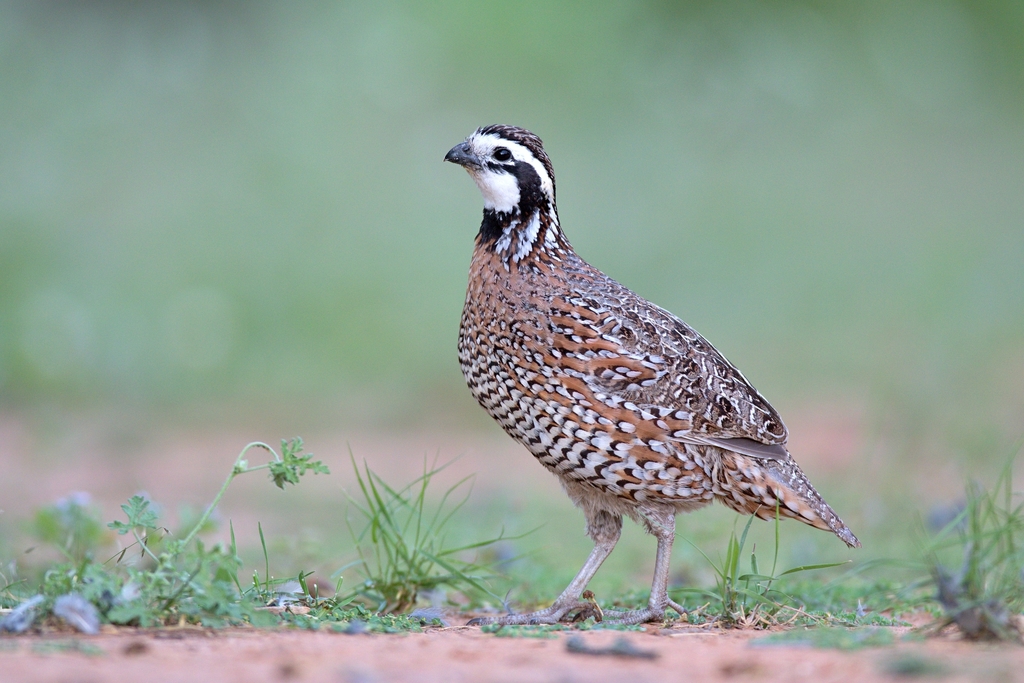
The northern bobwhite is a moderately-sized quail, and is the only small galliform native to eastern North America. The bobwhite can range from 24 to 28 cm (9.4 to 11.0 in) in length with a 33 to 38 cm (13 to 15 in) wingspan. As indicated by body mass, weights increase in birds found further north, as corresponds to Bergmann's rule. In Mexico, northern bobwhites weigh from 129 to 159 g (4.6 to 5.6 oz) whereas in the north they average 170 to 173 g (6.0 to 6.1 oz) and large males can attain as much as 255 g (9.0 oz). Among standard measurements, the wing chord is 9.7 to 11.7 cm (3.8 to 4.6 in), the tail is 5 to 6.8 cm (2.0 to 2.7 in) the culmen is 1.3 to 1.6 cm (0.51 to 0.63 in) and the tarsus is 2.7 to 3.3 cm (1.1 to 1.3 in). It has the typical chunky, rounded shape of a quail. The bill is short, curved and brown-black in color. This species is sexually dimorphic. Males have a white throat and brow stripe bordered by black. The overall rufous plumage has gray mottling on the wings, white scalloped stripes on the flanks, and black scallops on the whitish underparts. The tail is gray. The clear whistle "bob-WHITE" or "bob-bob-WHITE" call is very recognizable. The syllables are slow and widely spaced, rising in pitch a full octave from beginning to end. Other calls include lisps, peeps, and more rapidly whistled warning calls.
Range & habitat
The northern bobwhite can be found year-round in agricultural fields, grassland, open woodland areas, roadsides and wood edges. Its range covers the southeastern quadrant of the United States from the Great Lakes and southern Minnesota east to New York State and southern Massachusetts, and extending west to southern Nebraska, Kansas, Oklahoma, Colorado front-range foothills to 7,000 feet, and all but westernmost Texas. It is absent from the southern tip of Florida (where the extinct Key West bobwhite subspecies once lived) and the highest elevations of the Appalachian Mountains, but occurs in eastern Mexico and in Cuba, and has been introduced to Hispaniola (both the Dominican Republic and Haiti), the Bahamas, the Turks and Caicos Islands, the U.S. Virgin Islands (formerly), Puerto Rico, France, China, Portugal, and Italy. Isolated populations also have been introduced in the US states of Oregon and Washington. The northern bobwhite has also been introduced to New Zealand. There is no self-sustaining population in Pennsylvania, where the bird is considered regionally extinct; it is also considered extirpated in the states of New Hampshire and Connecticut. Its distribution in New York has been limited to Suffolk and Nassau Counties on Long Island, as well as potential population pockets in Upstate New York. …
Wikipedia: “Distribution and habitat”
What it does
Like most game birds, the northern bobwhite is shy and elusive. When threatened, it will crouch and freeze, relying on camouflage to stay undetected, but will flush into low flight if closely disturbed. It is generally solitary or paired early in the year, but family groups are common in the late summer and winter roosts may have two dozen or more birds in a single covey.
Breeding. The species was once considered monogamous, but with the advent of radio telemetry, the sexual behavior of bobwhites has better been described as ambisexual polygamy. The eggs measure 3 cm (1.2 in) in length and 2.5 cm (0.98 in) in width. Either parent may incubate a clutch for 23 days, and the precocial young leave the nest shortly after hatching. The main source of nest failure is predation, with nest success averaging 28% across their range. However, the nest success of stable populations is typically much higher than this average, and the aforementioned estimate includes values for declining populations. Brooding behavior varies in that amalgamation (kidnapping, adopting, creching, gang brooding) may occur. An incubating parent may alternatively stay with its young. A hen may re-nest up to four times until she has a successful nest. However, it is extremely rare for bobwhites to hatch more than two successful nests within one nesting season.
Food and feeding. …
Wikipedia: “Behavior and ecology”
In human culture
In 2023, the masked bobwhite subspecies was featured on a United States Postal Service Forever stamp as part of the Endangered Species set, based on a photograph from Joel Sartore's Photo Ark. The stamp was dedicated at a ceremony at the National Grasslands Visitor Center in Wall, South Dakota.
Wikipedia: “In popular culture”
Listen
Looking for field recordings…
Where it lives
Recorded sightings
—
geo-referenced records in GBIF, from museums, herbaria and field observers.
Drag the globe to turn it. Dots are where records exist, not a range map; darker means more records.
In the old herbals & bestiaries

In the stacks
Searching the stacks…
Every page naming Colinus virginianus in the Biodiversity Heritage Library →
This page is assembled live from iNaturalist, GBIF, Wikipedia, the Source Library and the Internet Archive. It is not yet part of the hand-edited codex. iNaturalist taxon 1280.