- Fungi Including Lichens
- ›Basidiomycete Fungi
- ›Higher Basidiomycetes
- ›Mushrooms, Bracket Fungi, Puffballs, and Allies
- ›Shelf Fungi
- ›Bracket Fungi
- ›Fomes
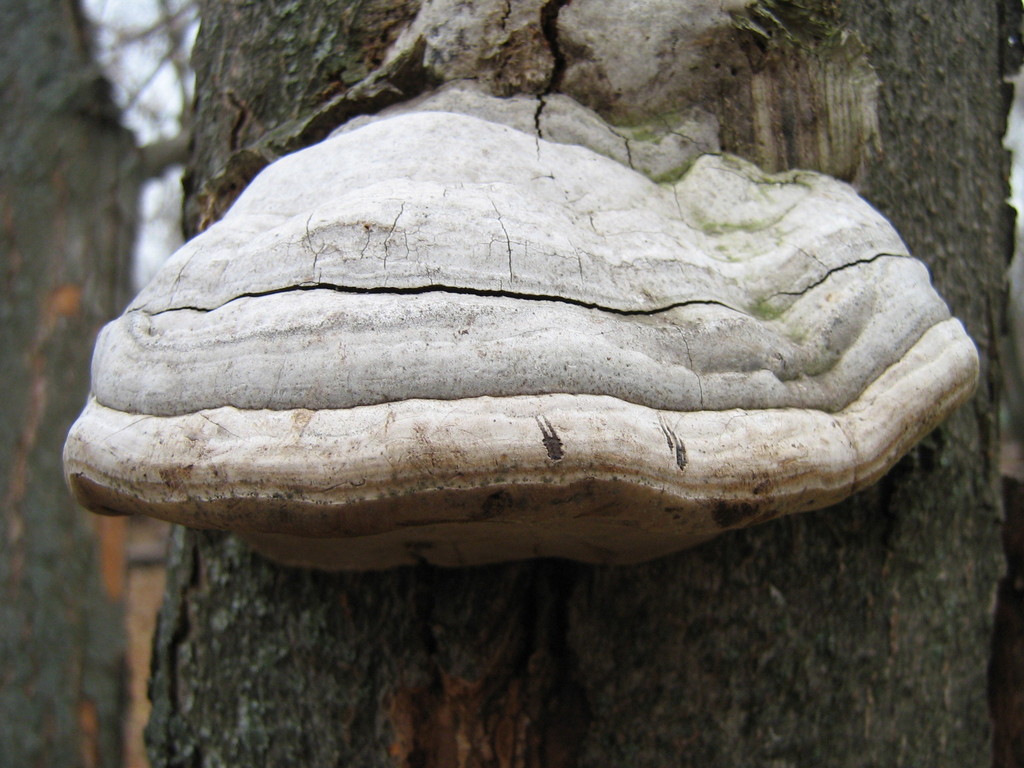
Hoof Fungus
Fomes fomentarius
Fomes fomentarius (commonly known as the tinder fungus, false tinder fungus, hoof fungus, tinder conk, tinder polypore or ice man fungus) is a perennial wood-decay basidiomycete found in Europe, Asia, Africa and North America. The species produces large, hoof-shaped polypore fruit bodies which vary in colour from silvery grey to almost black, though they are normally brown. It develops on the trunks of various hardwood species and is associated with the development of white rot in the underlying wood. It has traditionally been described as a plant pathogen, but experimental studies have also reported its occurrence as a latent stem endophyte within apparently healthy trees.
Though inedible, F. fomentarius has traditionally seen use as the main ingredient of amadou, a material used primarily as tinder, but also used to make clothing and other items. The 5,000-year-old Ötzi carried four pieces of F. fomentarius, supposedly for tinder.
From the article Fomes fomentarius on Wikipedia (CC BY-SA), quoted section by section
Description
Fomes fomentarius has a fruit body of between 5 and 45 centimetres (2.0 and 17.7 in) across, 3 and 25 cm (1.2 and 9.8 in) wide and 2 and 25 cm (0.8 and 9.8 in) thick, which attaches broadly to the tree on which the fungus is growing. While typically shaped like a horse's hoof, it can also be more bracket-like with an umbonate attachment to the substrate. The species typically has broad, concentric ridges, with a blunt and rounded margin. The flesh is hard and fibrous, and a cinnamon brown colour. The upper surface is tough, bumpy, hard and woody, varying in colour, usually a light brown or grey. The margin is whitish during periods of growth. The hard crust is from 1 to 2 mm (0.04 to 0.08 in) thick, and covers the tough flesh. The underside has round pores of a cream colour when new, maturing to brown, though they darken when handled. The pores are circular, and there are 2–3 per millimetre. The tubes are 2 to 7 mm (0.08 to 0.28 in) long and a rusty brown colour. The colouration and size of the fruit body can vary based on where the specimen has grown. Silvery-white, greyish and nearly black specimens have been known. The darkest fruit bodies were previously classified as Fomes nigricans, but this is now recognised as a synonym of Fomes fomentarius. …
Range & habitat
Fomes fomentarius has a circumboreal distribution as well as being found in both northern and southern Africa, throughout Asia and into eastern North America, and throughout Europe, and is frequently encountered. The optimal temperature for the species's growth is between 27 and 30 °C (81 and 86 °F) and the maximum is between 34 and 38 °C (93 and 100 °F). F. fomentarius typically grows alone, but multiple fruit bodies can sometimes be found upon the same host trunk. The species most typically grows upon hardwoods. In northern areas, it is most common on birch, while, in the south, beech is more typical. In the Mediterranean, oak is the typical host. The species has also been known to grow upon maple, cherry, hickory, lime tree, poplar, willow, alder, hornbeam, sycamore, and even, exceptionally, softwoods, such as conifers.
Wikipedia: “Habitat and distribution”
What it does
Fomes fomentarius is a stem-associated white-rot fungus that degrades both lignin and cellulose in hardwood tissues, resulting in pale, fibrous wood. Although long regarded primarily as a pathogen of living trees, its ecological strategy has been reassessed. The species has been described as apparently unable to colonise freshly wounded sapwood directly, instead requiring prior wood colonisation by other microorganisms. In experimental studies of European beech (Fagus sylvatica), the fungus was not recovered from freshly cut healthy wood, but was frequently isolated after incubation under drying conditions, suggesting the presence of latent mycelia within living stem tissues. In these studies, F. fomentarius was isolated predominantly from stem tissues rather than branches, corresponding to the typical position of basidiocarps on mature trees. Microscopic examination revealed fungal hyphae within xylem lumina following incubation, consistent with activation of previously quiescent thalli. These findings have led some authors to interpret F. …
Wikipedia: “Ecology”
At the table
The species is inedible; the flesh has an acrid taste, with a slightly fruity smell. The fungus has economic significance; it depreciates timber value as the parasitic infection advances. Fomes fomentarius infects trees through damaged bark.
Amadou. This species, as well as others such as Phellinus igniarius, can be used to make amadou, a material used as tinder, among other purposes. Amadou is produced from the flesh of the fungus fruit bodies. The young fruit bodies are soaked in water before being cut into strips, and are then beaten and stretched, separating the fibres. The resulting material is referred to as "red amadou". The addition of gunpowder or nitre produces an even more potent tinder. The flesh has further been used to produce clothing, including caps, gloves and breeches. Amadou is used in fly fishing for drying flies. Other items of clothing and even picture frames and ornaments may be made from the fungus, particularly Bohemia. The fungus is known to have been used as a firestarter in Hedeby, and it is known that the fungus was used as early as 3000 BCE. When found, the 5,000-year-old Ötzi the Iceman was carrying four pieces of F. fomentarius fruit body. Chemical tests led to the conclusion that he carried it for use as tinder.
Wikipedia: “Uses”
Where it lives
Recorded sightings
—
geo-referenced records in GBIF, from museums, herbaria and field observers.
Drag the globe to turn it. Dots are where records exist, not a range map; darker means more records.
In the old herbals & bestiaries

In the stacks
Searching the stacks…
Every page naming Fomes fomentarius in the Biodiversity Heritage Library →
This page is assembled live from iNaturalist, GBIF, Wikipedia, the Source Library and the Internet Archive. It is not yet part of the hand-edited codex. iNaturalist taxon 127510.