- Animals
- ›Arthropods
- ›Chelicerates
- ›Arachnids
- ›Spiders
- ›Typical Spiders
- ›Entelegyne Spiders
- ›Orbweavers and Allies
- ›Orbweavers
- ›Typical Orbweavers
- ›Larinioides
- ›Larinioides cornutus
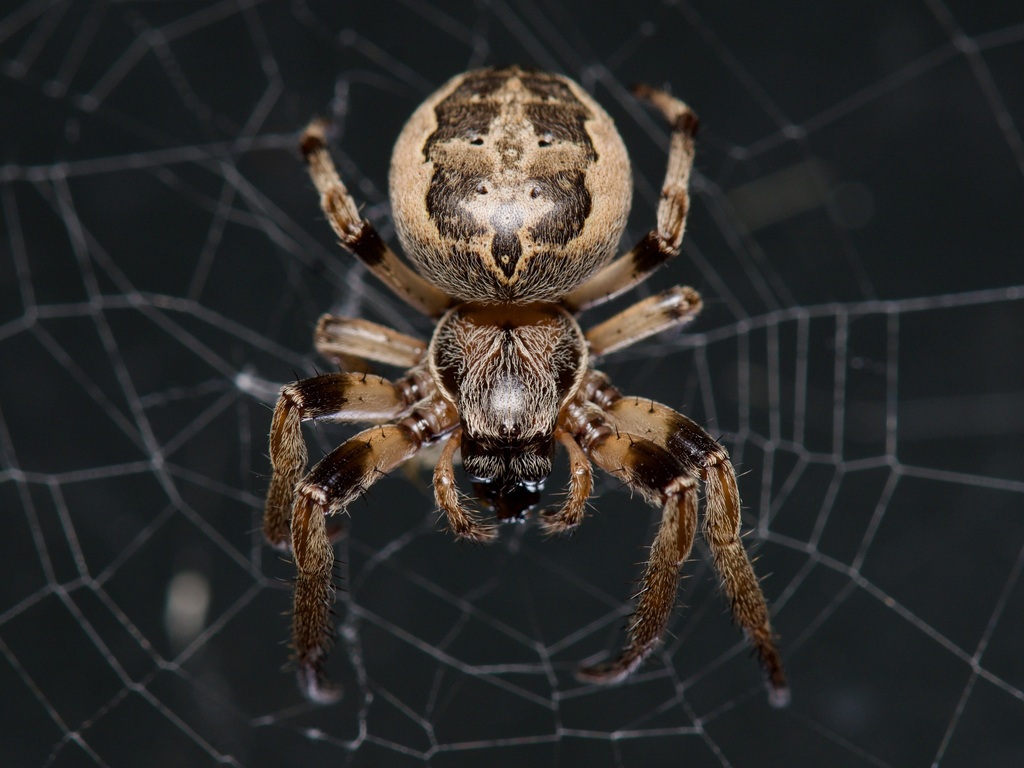
Furrow Orbweaver
Larinioides cornutus
Larinioides cornutus, the furrow spider, furrow orb spider, or foliate spider is an orb-weaver spider with Holarctic distribution.
Orb weaver bites are not especially dangerous for humans, though symptoms include mild pain, numbness, and swelling. Rarely, nausea and dizziness may occur.
From the article Larinioides cornutus on Wikipedia (CC BY-SA), quoted section by section
Range & habitat
These spiders are most often found in moist areas, especially near water. The web is built between grass or in low shrubbery. They hide during the day in a silken retreat that opens at the bottom, masked with plant and animal matter and leave it during the night. The web is remade in the evening. Unlike many other species of animal and spider, the cornutus does not hibernate in winter, and instead has an annual cycle of seasonal resistance. While their supercooling point in summer is −8 °C, in winter it drops to −20 °C.
Wikipedia: “Habitat”
What it does
Like mating in many other spiders, the females create a silk cocoon for copulation. The females reside in the cocoon, and emit pheromones to lure males, who can sense them through chemoreceptors. The males insert sperm using their pedipalps, and fertilize the eggs of the female. These become yellow egg sacs. Like many other types of spiders, males typically die after mating, oftentimes by being eaten by the female. This evolutionary trait of spiders still remains partially unknown. The male lives with the female during mating time, which is in autumn and again in spring. The female produces three to five yellow egg sacs during the summer. There is possibly a distinct species L. folium, which is very similar but occurs in dry habitat.
Wikipedia: “Reproduction”
Where it lives
Recorded sightings
—
geo-referenced records in GBIF, from museums, herbaria and field observers.
Drag the globe to turn it. Dots are where records exist, not a range map; darker means more records.
In the stacks
Searching the stacks…
Every page naming Larinioides cornutus in the Biodiversity Heritage Library →
This page is assembled live from iNaturalist, GBIF, Wikipedia, the Source Library and the Internet Archive. It is not yet part of the hand-edited codex. iNaturalist taxon 126513.