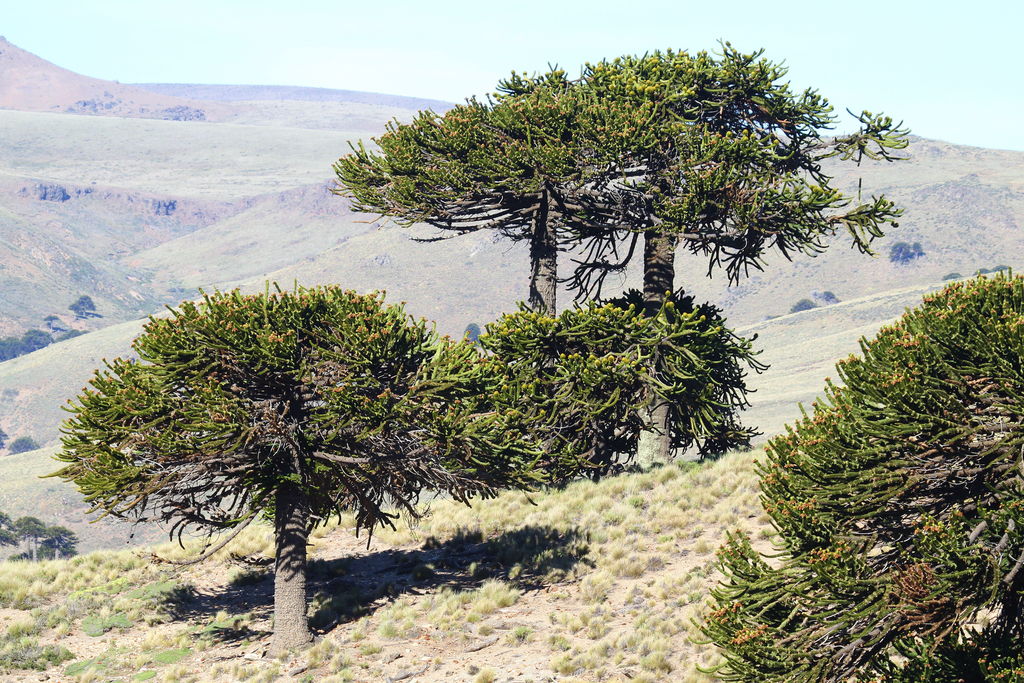
monkey-puzzle
Araucaria araucana
Araucaria araucana, commonly called the pewen, monkey-puzzle tree, pehuen or piñonero or Chile pine, is a species of conifer in the family Araucariaceae. It is a tree that grows to a height of 30–40 m (98–131 ft) and a trunk diameter of 1–1.5 m (3.3–4.9 ft). Native to central and southern Chile and western Argentina, it is the hardiest species in the conifer genus Araucaria.
It is the national tree of Chile and of the neighboring Argentine province of Neuquén. The IUCN changed its conservation status to Endangered in 2013, because logging, forest fires, and grazing have caused its population to dwindle.
From the article Araucaria araucana on Wikipedia (CC BY-SA), quoted section by section
Description
The leaves are thick, tough, and scale-like, triangular, 3–4 cm (1+1⁄4–1+1⁄2 in) long, 1–3 cm (1⁄2–1+1⁄4 in) broad at the base, and with sharp edges and tips. According to Lusk (2001), the leaves remain attached and live for up to 24 years, and so cover almost all of the tree except for the older branches. It is usually dioecious, with the male and female cones on separate trees, though occasional individuals bear cones of both sexes. The male (pollen) cones are oblong and cucumber-shaped, 4 cm (1+1⁄2 in) long at first, expanding to 8–12 cm (3–4+1⁄2 in) long by 5–6 cm (2–2+1⁄2 in) broad at pollen release. It is wind-pollinated. The female (seed) cones, which mature in autumn about 18 months after pollination, are globose, large, 12–20 cm (4+1⁄2–8 in) diameter, and hold about 200 seeds. The cones disintegrate at maturity to release the 3–4 cm (1+1⁄4–1+1⁄2 in) long nut-like seeds.
The thick bark of Araucaria araucana, up to 15 cm thick, may be an adaptation to wildfire.
Range & habitat
The tree's native habitat is the lower slopes of the Chilean and Argentine south-central Andes, between approximately 1,000 m (3,300 ft) and 1,700 m (5,600 ft) elevation. In the Chilean Coast Range, A. araucana can be found as far south as Villa Las Araucarias (latitude 38° 30' S) at an altitude of 640 m. Juvenile trees exhibit a broadly pyramidal or conical habit, which naturally develops into the distinctive umbrella form of mature specimens as the tree ages. It prefers well-drained, slightly acidic, volcanic soil, but will tolerate almost any soil type provided it drains well. Seedlings are often not competitive enough to survive unless grown in a canopy gap or an exposed, isolated area. It is almost never found together with Chusquea culeou, Nothofagus dombeyi, or Nothofagus pumilio because they typically outcompete A. araucana.
Wikipedia: “Distribution and Habitat”
What it does
Araucaria araucana is a masting species producing seed crops that vary greatly between years, but are broadly synchronized across populations. A nine-year study found cone production was intermittent and highly synchronized over a large region. Heavy, synchronized crops may improve wind-pollination efficiency and temporarily overwhelm animals that consume the seeds, allowing a greater portion of the total to survive. The large, heavy seeds, generally fall close to the parent tree, though some seeds are dispersed by animals. Rodents are important consumers and dispersers of its seeds. In Neuquén Province, the llong haired grass mouse was observed carrying seeds more than 40 m (130 ft) and burying seeds intact in soils and leaf litter in sites favorable to seedling establishment. Another important seed dispersal agent is the austral parakeet. Although it frequently eats the seeds, partially eaten seeds remain capable of germination. In one study, partially eaten seeds germinated as successfully as intact seeds and did so more quickly than intact seeds in lab conditions suggesting a mutualistic relationship between the parrot and the tree. …
Wikipedia: “Ecology”
At the table
Araucaria araucana is a popular garden tree, planted for the unusual effect of its thick, "reptilian" branches with a very symmetrical appearance. It prefers temperate oceanic climates with abundant rainfall, tolerating temperatures down to about −20 °C (−4 °F). It is far and away the hardiest member of its genus. It can grow well in western and central Europe (north to the Faroe Islands and Smøla in western Norway), in North America on the West Coast north to Baranof Island in Alaska and on the East Coast as far north as Long Island, in the southern hemisphere south of its native range to southern Chile, and also in New Zealand and southeastern Australia. It is tolerant of coastal salt spray but not air pollution. Once valued because of its long, straight trunk, its current rarity and vulnerable status mean its wood is now rarely used; it is also sacred to some indigenous Mapuche. Timber from these trees was used for railway sleepers to access many industrial areas around the port of Chile. …
Wikipedia: “Cultivation and uses”
In human culture
First identified by Europeans in Chile in the 1780s, it was named Pinus araucana by J.I. Molina in 1782. In 1789, de Jussieu described a new genus called Araucaria based on the species, and in 1797, Pavón published a new description of the species which he called Araucaria imbricata (an illegitimate name, as it did not use Molina's older species epithet). Finally, in 1873, after several further redescriptions, Koch published the combination Araucaria araucana, validating Molina's species epithet in the genus. The name araucana is derived from the native Araucanians who used the nuts (seeds) of the tree in Chile. A group of Araucanians living in the Andes, the Pehuenches, owe their name to their diet based on the harvesting of the A. araucaria seeds: from pewen or its Hispanic spelling pehuén, which means Araucaria, and che, which means people in Mapudungun. They believe the pewen was given by a deity or gwenachen to nourish their offspring; many pewen gathering festivals (ngillatun) are celebrated in both Chile and Argentina in gratitude to the tree's sustenance. The origin of the popular English language name "monkey puzzle" lies in its early cultivation in Britain c. 1850, when the species was still very rare in gardens and not widely known. …
Wikipedia: “Etymology”
Where it lives
Recorded sightings
—
geo-referenced records in GBIF, from museums, herbaria and field observers.
Drag the globe to turn it. Dots are where records exist, not a range map; darker means more records.
In the stacks
Searching the stacks…
Every page naming Araucaria araucana in the Biodiversity Heritage Library →
This page is assembled live from iNaturalist, GBIF, Wikipedia, the Source Library and the Internet Archive. It is not yet part of the hand-edited codex. iNaturalist taxon 126404.