- Fungi Including Lichens
- ›Ascomycete Fungi
- ›Sac Fungi and Lichens
- ›Common Lichens
- ›Shield Lichens, Sunburst Lichens, Rosette Lichens, and Allies
- ›shield lichens, rim lichens, and allies
- ›spindles and structured lichens
- ›Cladonia
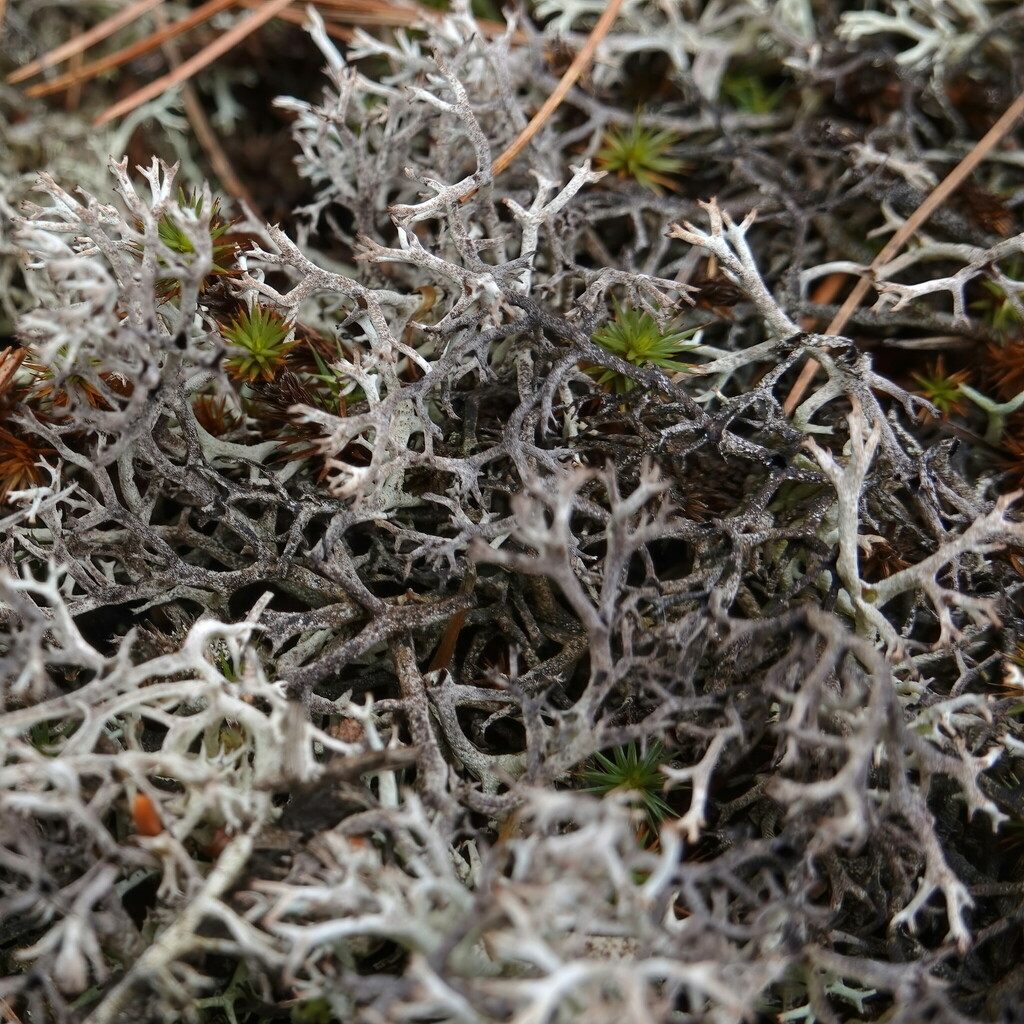
Black-footed Reindeer Lichen
Cladonia stygia
Cladonia stygia, commonly known as the black‐footed reindeer lichen, is a species of fruticose lichen in the family Cladoniaceae. It is distributed across boreal, arctic and temperate regions of the Northern Hemisphere. Originally described by Elias Magnus Fries in 1826 as a form of Cladonia rangiferina, subsequent studies on its morphology and chemistry led to its elevation to full species status in 1985. The lichen is recognised by its dark, ash-grey to black base and its distinctive, uneven branching pattern, often accompanied by small red reproductive structures. It typically grows in wet, acidic bogs and montane areas, where it contributes to local ecosystem functions and serves as a winter food source for reindeer.
Molecular studies have confirmed C. stygia as distinct from C. rangiferina, supported by structural and chemical differences. This lichen contributes to soil insulation and serves as a host for various lichenicolous fungi. Although C. stygia is widespread in boreal regions, it is considered endangered in some areas, for example in parts of Germany, where habitat loss and ecological changes pose significant threats. Conservation efforts, including habitat management and lichen transplantation, have been implemented to safeguard this ecologically important species.
From the article Cladonia stygia on Wikipedia (CC BY-SA), quoted section by section
Description
Like other members of its genus, C. stygia has a two-part (dimorphic) structure: it begins life with a crust-like layer growing on the substrate, but this eventually disappears as the more prominent upright, branching structures (the podetia) develop. The lichen is distinguished by several characteristic features of its structure. The podetia typically reach heights of 5–15 cm tall, occasionally reaching 30 cm, with the living (active) portion measuring up to 10 cm. The main stem is about 1 mm thick, with segments between branches about 5 mm long. The branching pattern is distinctive, typically dividing into three unequal branches (anisotomic trichotomous), though sometimes splitting into four or two branches. Where the branches divide, they form small holes or perforations called axils. The base of its branches shows a distinctive ash-grey to black colouration on the inside. This dark background is dotted with irregular patches of greenish-white outer tissue (known as the ectal layer), creating a distinctive speckled appearance. These patches often have uneven edges and can sometimes appear almost scale-like. While this mottled, darkened area typically covers the lower half of the branches, in some specimens it may be limited to just the very base. When wet, the lichen can take on an olive-grey colouration. The podetia of C. …
Range & habitat
Cladonia stygia is widespread across the Northern Hemisphere but has a fragmented distribution in some regions. In Germany, although the species was recorded in Lower Saxony as early as 1908, it was not observed again until 2012—when new populations were discovered in the lichen‐rich pine forests of the Carrenziener Dünen. Since then, conservation efforts, including experimental lichen reintroduction, have successfully established additional populations within the dune system, where C. stygia co-occurs with other reindeer lichens such as C. portentosa, C. arbuscula, and C. rangiferina. It has also been confirmed in parts of Central Europe – including Germany (with recent reports from the federal state of Hesse) and the Czech Republic – as well as in Canada, Finland, and parts of Asia, suggesting a broad boreal or circumboreal distribution. In the Alps, it occurs from valley bottoms to the subalpine belt (mainly between 300 and 2400 m elevation), but is relatively rare and restricted to raised bogs. It has been documented across multiple Alpine regions, including parts of Austria, Germany, Switzerland, France, Italy, and Slovenia. Although primarily a boreal species, C. …
Wikipedia: “Habitat and distribution”
What it does
In boreal and subarctic regions, Cladonia stygia is ecologically significant. Like other reindeer lichens, Cladonia stygia often dominates groundcover and is a key winter food source for reindeer. The species shows a strong preference for treeless, ombrotrophic bogs, where it may outnumber species such as C. rangiferina. It is tolerant of wet conditions – able to survive prolonged periods of inundation during spring and autumn – and in such consistently moist habitats, growth can reach up to 2 cm per year. In Austrian high moor/bog habitats, C. stygia typically occurs in relatively undisturbed areas dominated by Mountain Pine (Pinus mugo), where it grows alongside characteristic bog vegetation. Common vascular plant associates include the dwarf shrubs Calluna vulgaris (heather) and Andromeda polifolia (bog rosemary), the sedge Eriophorum vaginatum (tussock cottongrass), and Rhynchospora alba (white beak-sedge). Other lichens found in these communities include Cladonia pyxidata, C. coniocraea, and C. fimbriata, while typical bryophyte associates are Pleurozium schreberi, Aulacomnium palustre, Sphagnum rubellum, and Leucobryum glaucum. Although C. …
Wikipedia: “Ecology”
Where it lives
Recorded sightings
—
geo-referenced records in GBIF, from museums, herbaria and field observers.
Drag the globe to turn it. Dots are where records exist, not a range map; darker means more records.
In the stacks
Searching the stacks…
Every page naming Cladonia stygia in the Biodiversity Heritage Library →
This page is assembled live from iNaturalist, GBIF, Wikipedia, the Source Library and the Internet Archive. It is not yet part of the hand-edited codex. iNaturalist taxon 125631.