- Fungi Including Lichens
- ›Ascomycete Fungi
- ›Sac Fungi and Lichens
- ›Common Lichens
- ›Shield Lichens, Sunburst Lichens, Rosette Lichens, and Allies
- ›shield lichens, rim lichens, and allies
- ›shield lichens and allies
- ›typical shield lichens
- ›Parmotrema
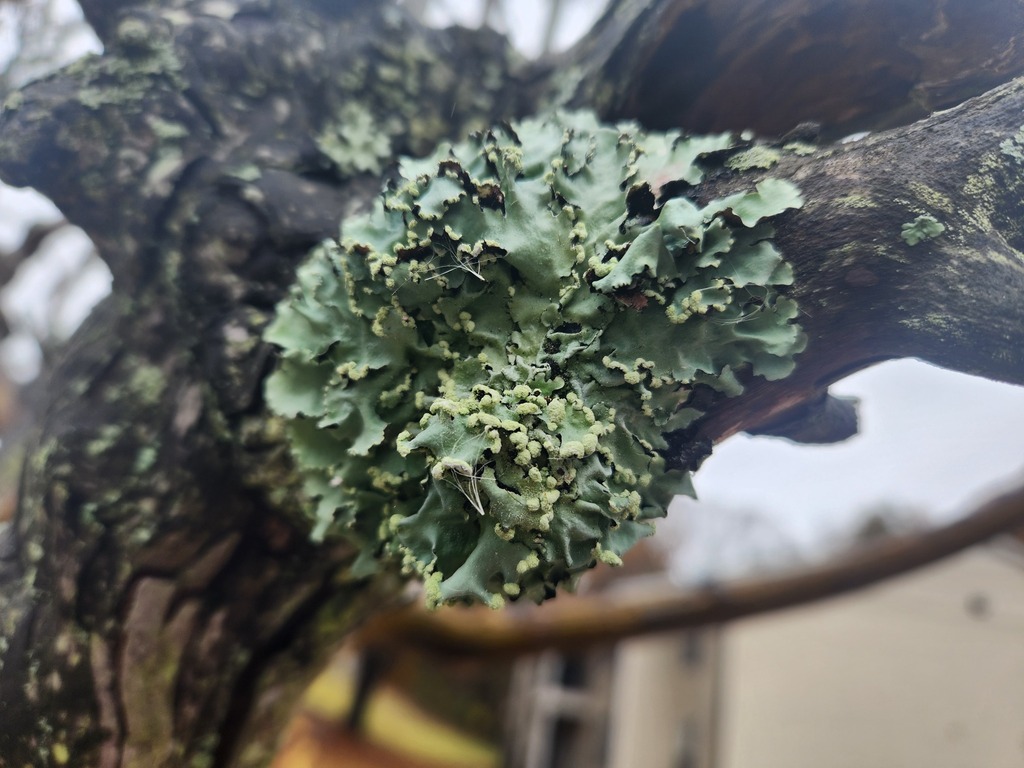
Black Stone Flower
Parmotrema perlatum
Parmotrema perlatum, commonly known as the powdered ruffle lichen, is a common species of foliose lichen in the family Parmeliaceae. The species has a cosmopolitan distribution and occurs throughout the Northern and Southern Hemispheres. Parmotrema perlatum is a prominent and widely recognised species within its genus across primarily temperate zones, preferring humid, oceanic-suboceanic habitats. It is found in diverse geographic areas including Africa, North and South America, Asia, Australasia, Europe, and islands in the Atlantic and Pacific oceans. It usually grows on bark, but occasionally occurs on siliceous rocks, often among mosses.
The thallus of Parmotrema perlatum is large, light-grey to pale-blue patch-shaped with rounded and ruffled lobes and often with black hair-cilia at the edges. Distinguishing features of the lichen include its conspicuous soralia (reproductive structures) near the lobe edges, curled leaf-like lobes, and a narrow, shiny, and sometimes wrinkly area on the underside near the margin. This species is known for producing certain secondary metabolites, namely atranorin and a group of substances known as the stictic acid complex, which includes stictic and constictic acids, among other related compounds. These morphological and chemical characteristics help distinguish P. perlatum from several other potential lookalikes.
From the article Parmotrema perlatum on Wikipedia (CC BY-SA), quoted section by section
Description
Parmotrema perlatum has a thallus that ranges from loosely to tightly attached to the surface it grows on, forming expansive, spreading colonies that often merge together. Individual thalli typically measure up to 10–15 cm (4–6 in) in diameter. The upper thallus surface is greenish-grey, blue-grey, or yellowish-grey in colour, lacking pruina and either free of spots (maculae), or with few maculae. This species develops soredia, a type of asexual reproductive structure, aiding in its propagation. The lobes of this lichen vary from 1.5 to 10 mm in width, with a wave-like (undulate) or ruffled pattern and overlapping (imbricate) arrangement. The tips and edges of these lobes are generally smooth and round, sometimes notched (crenate) or incised, often curling up or inward, revealing the paler brown to black underside adorned with hair-like structures (cilia) up to 2.5 mm in length. Rhizines are common on the underside of the thallus, except for a brown border near the edges. The soredia found in this species are granular and appear white or may become grey due to wear. They are located within specifically structured groups called soralia, which can be linear to oval in shape, often positioned at the edges of the lobes. The presence of soredia causes the lobe margins to curl back and form capitate soralia. …
Range & habitat
Parmotrema perlatum typically grows in areas with ample light, favouring neutral to slightly acidic-barked broad-leaved trees. It is commonly found on siliceous rocks and walls, as well as mossy coastal rocks, generally growing in places with moderate to strong sunlight. In the Great Smoky Mountains National Park in the United States, Parmotrema perlatum is especially abundant on branches in humid, high-elevation habitats. Similarly, in East Africa, it grows in the misty environments of inselbergs, montane forests, and Erica-dominated habitats, typically found between 1,400 and 3,100 m (4,600 and 10,200 ft) above sea level. The species is globally distributed, found in both temperate and tropical regions. It has been reported across numerous European countries including Austria, Belgium, the Czech Republic, France, Germany, Great Britain, Ireland, Italy, Luxembourg, the Netherlands, Portugal, Scandinavia, Slovakia, Spain, and Ukraine. Although it is rare in Eastern Europe, it is widely distributed in both the Asian and European parts of Russia. Beyond Europe, it is also present in Macaronesia, Africa, Australia, North America, and South America. Its Asian distribution includes India, Japan, Taiwan, and South Korea. …
Wikipedia: “Habitat and distribution”
What it does
Parmotrema perlatum is an important species within specific lichen communities in British woodlands, particularly those in late successional mesotrophic settings in oceanic or humid microclimates. It is associated with the Type K Lobaria pulmonaria-Isothecium myosuroides ecological community. This community type is characterised by its occurrence in mature mesotrophic environments, which are often warmer in winter climates or specific microhabitats. This community includes, in addition to P. perlatum, dominant foliose lichens like Lobaria pulmonaria, Hypotrachyna taylorensis, and Parmotrema crinitum, as well as bryophytes such as Isothecium myosuroides. A 2017 study investigated the physiological responses of Parmotrema perlatum along an aridity gradient in Southern Portugal. The researchers transplanted thalli of P. perlatum to rural and forested sites characterised by varying levels of aridity and measured several physiological parameters, including photosynthetic performance, pigment content, ergosterol content, and sample viability, both before and after a six-month exposure period. The study found that P. perlatum showed lower photosynthetic performance (measured as FV/FM and the performance index on an absorption basis, PIABS) in drier sites compared to more humid sites. …
Wikipedia: “Ecology”
In medicine
Parmotrema perlatum is used as a component of a herbal mixture in Ayurvedic medicine, one of several parmelioid lichen species used as charila. Referenced in ancient Ayurvedic texts and first mentioned in the Atharvaveda around 1500 BCE, charila is a lichen mixture traditionally used in India for its purported medicinal properties. It has been employed to treat various ailments, including digestive and respiratory issues, skin conditions, and reproductive health concerns, and it also serves as an ingredient in treatments for infertility. For chronic ulcers, a powder made from dried lichen, infused in pork suet, is applied externally.
Wikipedia: “Traditional medicines”
Where it lives
Recorded sightings
—
geo-referenced records in GBIF, from museums, herbaria and field observers.
Drag the globe to turn it. Dots are where records exist, not a range map; darker means more records.
In the stacks
Searching the stacks…
Every page naming Parmotrema perlatum in the Biodiversity Heritage Library →
This page is assembled live from iNaturalist, GBIF, Wikipedia, the Source Library and the Internet Archive. It is not yet part of the hand-edited codex. iNaturalist taxon 123348.