- Animals
- ›Chordates
- ›Vertebrates
- ›Ray-finned Fishes
- ›Spiny-rayed fishes
- ›Puffers and Filefishes
- ›Pufferfishes, Porcupinefishes, and Molas
- ›Porcupinefishes
- ›Diodon
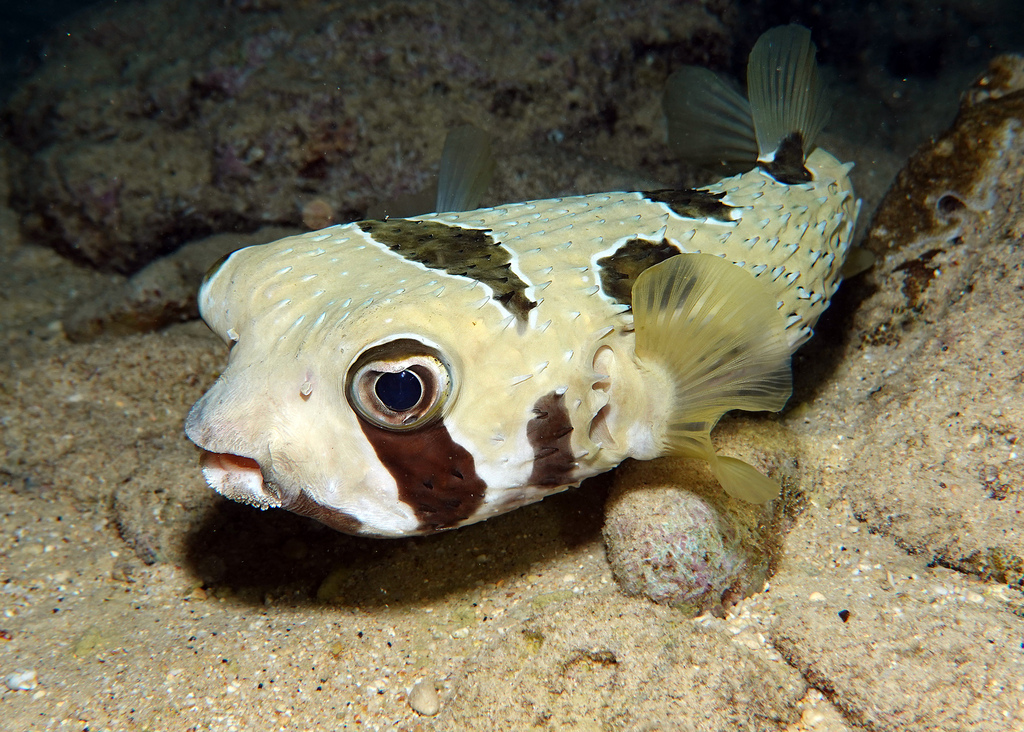
Blackblotched Porcupinefish
Diodon liturosus
The black-blotched porcupinefish (Diodon liturosus), also known as shortspine porcupinefish, is a member of the family Diodontidae. It is found in the tropical and subtropical waters of the Indo-Pacific on coral and rocky reefs and in inshore waters. Other names are the blotched porcupinefish and the brown-backed porcupinefish.
From the article Black-blotched porcupinefish on Wikipedia (CC BY-SA), quoted section by section
Description
The Black-blotched porcupinefish is a medium-sized fish which grows up to 65 cm (26 in), but the average size most likely to be observed is 45 cm (18 in). Its body is elongated with a spherical head with big round protruding eyes and a large mouth that is rarely closed. The pectoral fins are large, the pelvic fins are absent, the anal and dorsal fins are close to the caudal peduncle. The latter move simultaneously during swimming. All fins are a uniform tint of white or yellowish without any spotting. The skin is smooth and firm, the scales are modified into spines directed towards the back. The body coloration is light brown to sandy-yellowwith dark blotches circled with a white line and pale ventral surface. The only other fish with which it might be confused is the long-spine porcupinefish, (Diodon holocanthus) but it has much shorter spines and it lacks a dark streak running between the eyes. In case of danger, the porcupinefish can inflate itself by swallowing water to deter the potential predator with its larger volume and it can raise its spines defensively. The porcupinefish concentrates a poison, called tetrodotoxin, in certain parts of its body such as the liver, skin, gonads and the viscera. Tetrodotoxin is a powerful neurotoxin. This defensive system constitutes an additional device to dissuade the potential predators.
Range & habitat
The Black-blotched porcupinefish is found in the tropical and subtropical waters of the Indo-Pacific area from eastern coasts of Africa to Japan, the Society Islands and Western Australia, and also the southeast of the Atlantic Ocean on the coast of South Africa. Adults favour lagoons, top reefs and seaward coral or rocky reefs from one to 90 m depth, but it is usually found between 15 and 30 m.
Wikipedia: “Distribution and habitat”
Where it lives
Recorded sightings
—
geo-referenced records in GBIF, from museums, herbaria and field observers.
Drag the globe to turn it. Dots are where records exist, not a range map; darker means more records.
In the stacks
Searching the stacks…
Every page naming Diodon liturosus in the Biodiversity Heritage Library →
This page is assembled live from iNaturalist, GBIF, Wikipedia, the Source Library and the Internet Archive. It is not yet part of the hand-edited codex. iNaturalist taxon 123268.