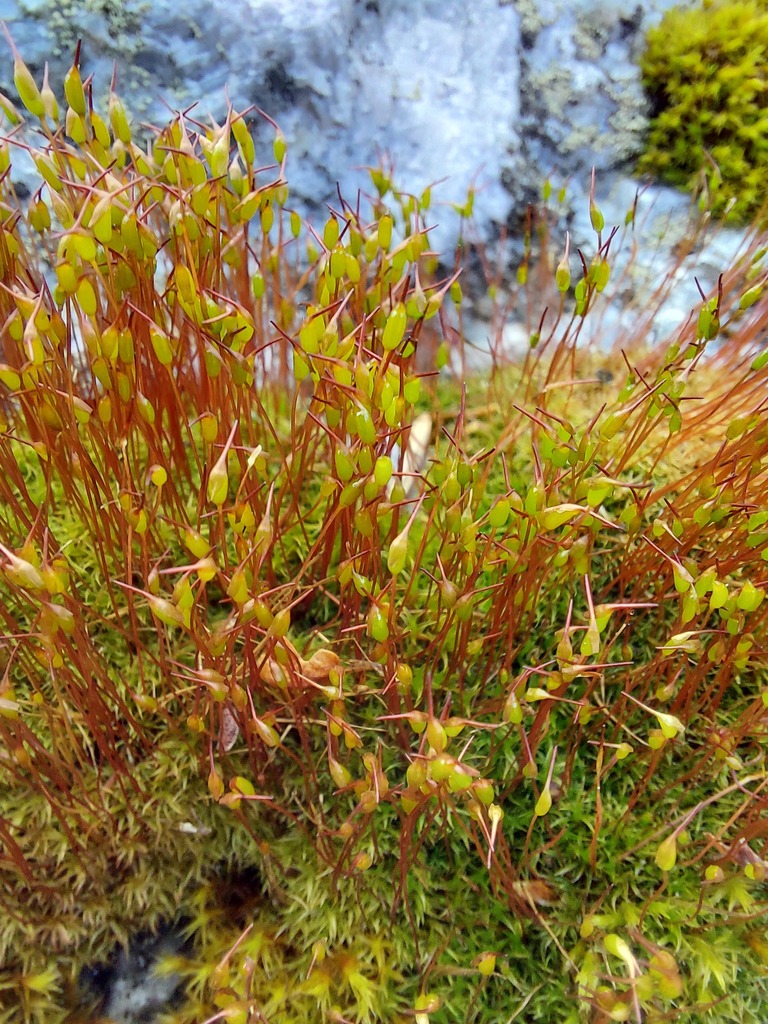
Redshank
Ceratodon purpureus
Ceratodon purpureus is a dioicous moss with a color ranging from yellow-green to red. The height amounts to 3 centimeters. It is found worldwide, mainly in urban areas and next to roads on dry sand soils. It can grow in a very wide variety of habitats, from polluted highway shoulders and mine tailings to areas recently denuded by wildfire to the bright slopes of Antarctica. Its common names include fire moss, redshank, purple forkmoss, ceratodon moss, and purple horn toothed moss.
From the article Ceratodon purpureus on Wikipedia (CC BY-SA), quoted section by section
Description
Fire moss is a short moss that forms dense tufts or sometimes cushions. The stems are erect, usually about 0.5 inch (1.3 cm) long. The upper 0.19 inch (0.5 cm) is current year's growth; often slightly branched by forking at the tip of the old growth. The stems sometimes become 2.4 to 3.1 inches (7–8 cm) long in shaded places. Leaves are short and hairlike, spreading when moist; somewhat folded or twisted when dry. Fire moss contains photoprotective pigments, which are a useful adaptation for the bright Antarctic environment. Leaf pigment varies from green to ginger.
Range & habitat
Fire moss likely occurs in every country but is possibly replaced by closely related taxa in tropical latitudes. It is widespread throughout Canada, where it occurs in every province and territory. It occurs in every state in the United States. Fire moss can tolerate much higher pollution levels than other mosses. It is common in urban and industrial environments subjected to a variety of pollutants, along highways, and on the tailings and refuse associated with both coal and heavy-metal mining activities. Fire moss is often found on disturbed sites. It occurs on a wide range of substrates including soil, rock, wood, humus, old roofs, sand, and cracks of sidewalks. It is most abundant on exposed, compact, mineral, dry, gravelly or sandy soils but tolerates a wide range of soil textures. Sand dunes close to water in Scotland are colonized by fire moss, which grows between the shoots of grasses.
Wikipedia: “Distribution and habitat”
What it does
Fire moss is dioecious, reproducing generatively with spores and vegetatively through protonemata. The capsules are held horizontally on the end of a long seta (fruit stalk). Fire moss generally fruits abundantly. Wind is the main method of spore dispersal. Spore germination in fire moss is a two-phase process. Spores first swell then distend. Usually the setae are present in great numbers in the colony; with changes in humidity they twist and untwist. This movement helps to jerk the capsules, helping in spore discharge. Possibly the contraction of the grooves in the capsule at maturity also helps to squeeze out the spores. Spores of fire moss have remained viable even after drying for 16 years. Fire moss reproduces vegetatively via protonemata (threadlike or platelike growths). Fire moss sporophytes appear early in the spring, as soon as the snow melts. In March, the setae reach their full height and begin to turn from green to red. Capsules mature by late spring. By midsummer the capsules often decay, and the setae break from the moss.
Microarthropod-mediated fertilization. A 2012 study found that male and female fire moss emit different and complex volatile organic scents. Female plants emit more compounds than male plants. Springtails were found to choose female plants preferentially, and the study found that the springtails enhance moss fertilization. …
Wikipedia: “Life cycle”
Where it lives
Recorded sightings
—
geo-referenced records in GBIF, from museums, herbaria and field observers.
Drag the globe to turn it. Dots are where records exist, not a range map; darker means more records.
In the old herbals & bestiaries


In the stacks
Searching the stacks…
Every page naming Ceratodon purpureus in the Biodiversity Heritage Library →
This page is assembled live from iNaturalist, GBIF, Wikipedia, the Source Library and the Internet Archive. It is not yet part of the hand-edited codex. iNaturalist taxon 123117.