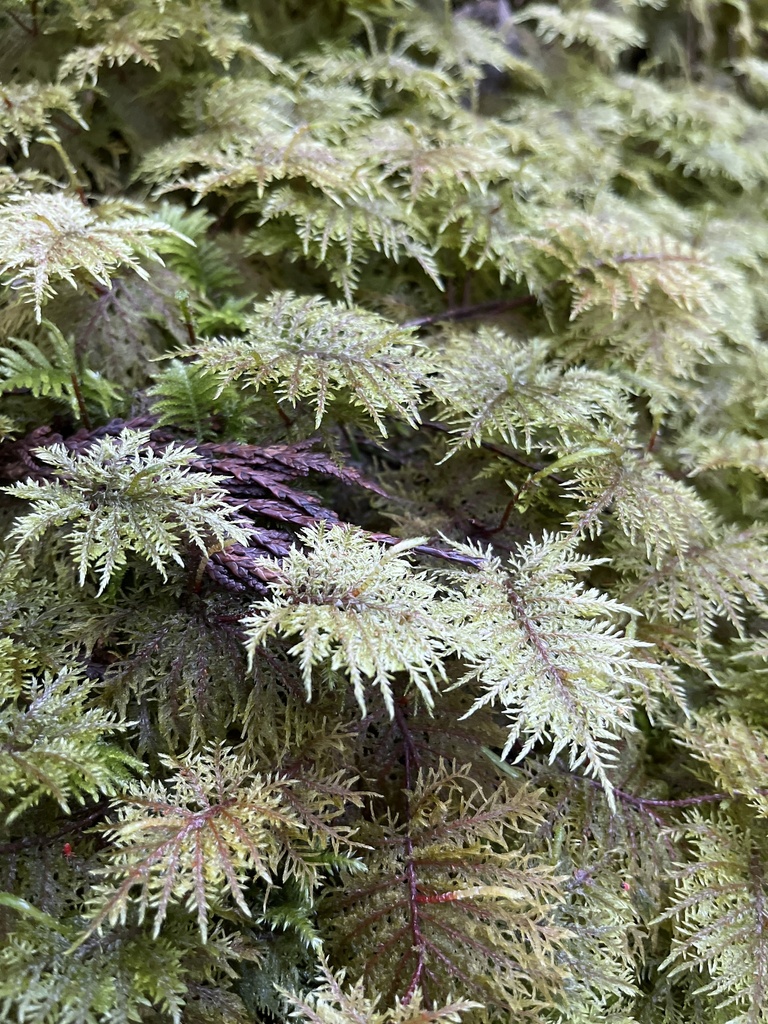
stairstep moss
Hylocomium splendens
Hylocomium splendens, commonly known as glittering woodmoss, splendid feather moss, stairstep moss, and mountain fern moss, is a perennial clonal moss with a widespread distribution in Northern Hemisphere boreal forests. It is commonly found in Europe, Russia, Alaska and Canada, where it is often the most abundant moss species. It also grows in the Arctic tundra and further south at higher elevations in, for example, northern California, western Sichuan, East Africa, Australia, New Zealand and the West Indies. In Scotland it is a characteristic species of the Caledonian Forest. Under the UK's national vegetation classification system, pinewood community W18 is named as "Pinus sylvestris-Hylocomium splendens woodland", indicating its significance in this ecosystem.
From the article Hylocomium splendens on Wikipedia (CC BY-SA), quoted section by section
Description
It is generally olive green, yellowish or reddish green in colour, with reddish stems and branches. These often form branches up to 20 cm (7.9 in) long, with current year's growth starting from near the middle of the previous year's branch. This produces feathery fronds in steps. It is possible to estimate the age of a plant by counting the steps – a new level being produced each year. This form of growth enables the species to "climb" over other mosses and forest debris that falls on it. It is shade-loving, grows in soil and humus and on decaying wood and often forms mats with living parts growing on top of older, dead or dying sections. Further south, the plants are larger with several steps; further north, in the arctic tundra, the plants are smaller with few steps.
Wikipedia: “Morphology”
What it does
Occurring widely in the boreal forests, this plant is often found on forest floors even in relatively harsh northern latitudes. In Canada, for example, according to C. Michael Hogan the black spruce/feathermoss climax forest often occurs with moderately dense canopy featuring a forest floor of feathermosses that include H. splendens, Pleurozium schreberi and Ptilium crista-castrensis. Experiments simulating global change with increased nutrient deposits and warming indicate that increased nutrient deposits and climate warming may have negative impact on growth of Hylocomium splendens.
Wikipedia: “Ecology”
Where it lives
Recorded sightings
—
geo-referenced records in GBIF, from museums, herbaria and field observers.
Drag the globe to turn it. Dots are where records exist, not a range map; darker means more records.
In the stacks
Searching the stacks…
Every page naming Hylocomium splendens in the Biodiversity Heritage Library →
This page is assembled live from iNaturalist, GBIF, Wikipedia, the Source Library and the Internet Archive. It is not yet part of the hand-edited codex. iNaturalist taxon 122555.