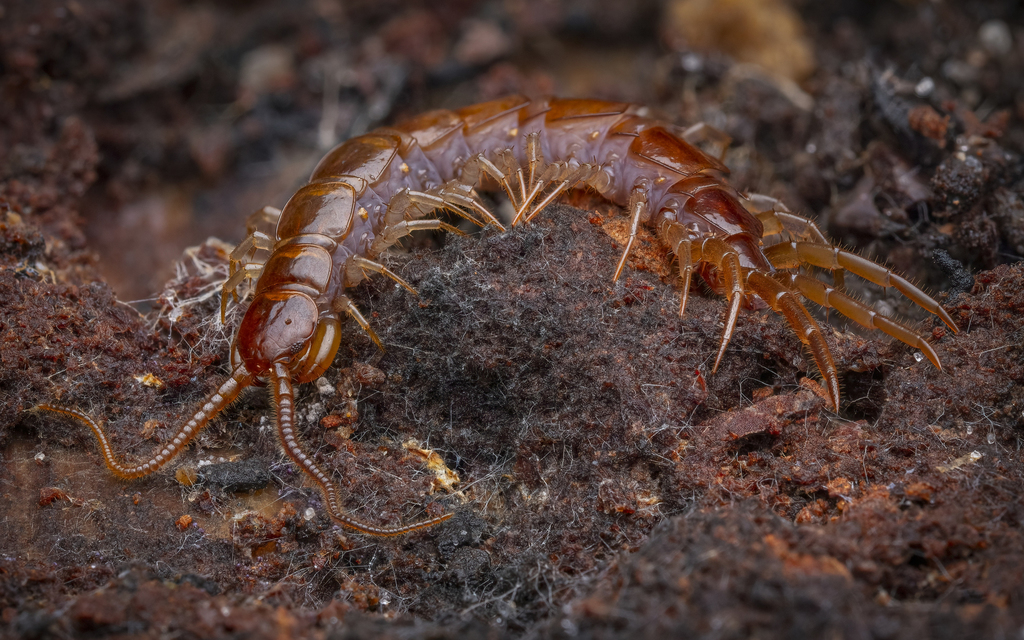
Brown Centipede
Lithobius forficatus
Lithobius forficatus, most commonly known as the brown centipede or stone centipede, is a common European centipede of the family Lithobiidae, although its distribution is not exclusive to Europe. It is between 18 and 30 mm long and up to 4 mm broad and is a chestnut brown color.
From the article Lithobius forficatus on Wikipedia (CC BY-SA), quoted section by section
Description
The species is between 18 and 30 mm (0.71 and 1.18 in) long and up to 4 mm broad and is a chestnut brown coloration. It is similar to a variety of other European lithobiid centipedes, particularly the striped centipede, Lithobius variegatus, but L. forficatus does not have stripes on its legs. Lithobiids leave the egg with seven pairs of legs, and each time they molt, they develop additional body segments with a new pair of legs on each. An adult will have a maximum of 15 pairs of legs.
Range & habitat
The species is found mainly in Europe and North America, as well as the Hawaiian Islands. Like most lithobiids, it is found in the upper layers of soil, particularly under rocks and rotting logs.
Wikipedia: “Distribution and habitat”
What it does
Lithobius forficatus may live for as long as five to six years. It can be fairly easily identified by its reaction to being revealed, which is to run extremely quickly for cover. This is different from many of the other species of large lithobiid, which tend to be less extreme in their evasion behaviour.
Feeding. It is a predator, and its main diet consists of insects and invertebrates, including spiders, slugs, worms and flies. It has specially-adapted front legs which have evolved to resemble 'fangs' and they contain venom that allows the centipede to overpower its prey. Despite possessing venom, L. forficatus is considered harmless to humans; its small size means it rarely breaks the skin, and bites cause at most brief localised pain.
Wikipedia: “Behaviour”
Where it lives
Recorded sightings
—
geo-referenced records in GBIF, from museums, herbaria and field observers.
Drag the globe to turn it. Dots are where records exist, not a range map; darker means more records.
In the stacks
Searching the stacks…
Every page naming Lithobius forficatus in the Biodiversity Heritage Library →
This page is assembled live from iNaturalist, GBIF, Wikipedia, the Source Library and the Internet Archive. It is not yet part of the hand-edited codex. iNaturalist taxon 122234.