- Animals
- ›Echinoderms
- ›Sea Stars and Brittle Stars
- ›Sea Stars
- ›Valvatacean Sea Stars
- ›Valvatidan Sea Stars
- ›Cushion Stars and Allies
- ›Choriaster
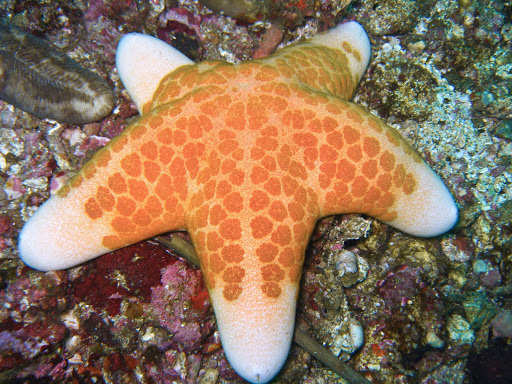
Granulated Sea Star
Choriaster granulatus
Choriaster is a monotypic genus in the family Oreasteridae, containing the single species Choriaster granulatus, commonly known as the granulated sea star. Other common names include big-plated sea star, hunter-five sea star and doughboy starfish.
From the article Choriaster on Wikipedia (CC BY-SA), quoted section by section
Description
Choriaster granulatus has a convex body and five short arms with rounded tips. Relatively large in comparison with other sea stars, its maximum radius is about 27 cm (11 in). It is most commonly pale pink in colour with brown papillae radiating out from the centre but can also be colours ranging from grey to yellow and even red.
Range & habitat
Choriaster granulatus live individually or in groups along coral reefs in the Indo-West Pacific region, from East Africa all the way to Fiji. They have been found in the Indian Ocean, Red Sea and the Great Barrier Reef. The sandy habitat where it tends to live is characterized by rubble slopes and detritus, also being found living among corals and sea sponges. Choriaster granulatus prefer shallow waters ranging from 1.5 to 53 m (5 to 174 ft) deep and above average temperatures of 24 to 29 °C (75 to 84 °F).
Wikipedia: “Habitat”
What it does
Choriaster granulatus is a carnivore that, like other sea stars, has its mouth on the underside of its body. Food is digested and absorbed outside of its body by forcing its stomach out of its mouth onto the food. Its food includes small invertebrates such as coral polyps as well as carrion.
Wikipedia: “Diet”
Where it lives
Recorded sightings
—
geo-referenced records in GBIF, from museums, herbaria and field observers.
Drag the globe to turn it. Dots are where records exist, not a range map; darker means more records.
In the stacks
Searching the stacks…
Every page naming Choriaster granulatus in the Biodiversity Heritage Library →
This page is assembled live from iNaturalist, GBIF, Wikipedia, the Source Library and the Internet Archive. It is not yet part of the hand-edited codex. iNaturalist taxon 122003.