- Fungi Including Lichens
- ›Basidiomycete Fungi
- ›Higher Basidiomycetes
- ›Mushrooms, Bracket Fungi, Puffballs, and Allies
- ›Agaricomycetidae
- ›Common Gilled Mushrooms and Allies
- ›Agaricineae
- ›Bolbitiaceae
- ›Conocybe
- ›Conocybe
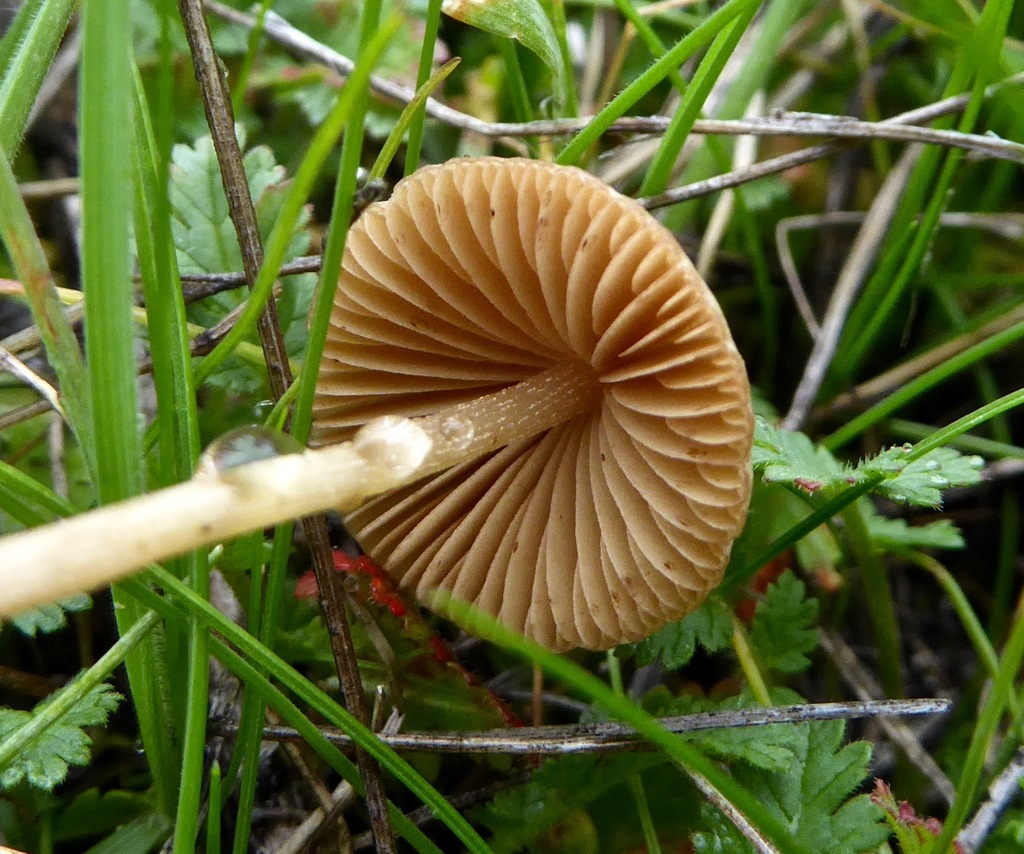
common conecap
Conocybe tenera
Conocybe tenera, commonly known as the brown dunce cap or common cone head, is a widely distributed member of the genus Conocybe, for which it serves as the type species.
From the article Conocybe tenera on Wikipedia (CC BY-SA), quoted section by section
Description
Conocybe tenera is a small saprotrophic mushroom with a conic to convex cap which is smooth and orangish brown. It is up to 2.5 centimetres (1 in) wide and is striate almost to the center. The stem is 3 to 9 cm (1+1⁄4 to 3+1⁄2 in) long, 1–4 mm thick, and is equal width for the whole length, sometimes with some swelling at the base. It lacks an annulus (ring), is hollow and pruinose near the top. The gills are adnexed and pale brown, darkening in age. The spore print is rusty brown. The spores are yellowish brown, smooth and elliptical with a germ pore, measuring 12 x 6 μm.
Similar species. The species requires microscopy to identify. It resembles members of Galerina, Pholiotina, and Psathyrella, as well as Parasola conopilea. The related C. filaris is poisonous.
Range & habitat
Common in disturbed areas in North America, it is widely distributed across the world.
Wikipedia: “Distribution and habitat”
At the table
The species is inedible, and is related to at least one species which contains the deadly amatoxin.
Wikipedia: “Edibility”
Where it lives
Recorded sightings
—
geo-referenced records in GBIF, from museums, herbaria and field observers.
Drag the globe to turn it. Dots are where records exist, not a range map; darker means more records.
In the old herbals & bestiaries

In the stacks
Searching the stacks…
Every page naming Conocybe tenera in the Biodiversity Heritage Library →
This page is assembled live from iNaturalist, GBIF, Wikipedia, the Source Library and the Internet Archive. It is not yet part of the hand-edited codex. iNaturalist taxon 121765.