- Animals
- ›Chordates
- ›Vertebrates
- ›Ray-finned Fishes
- ›Spiny-rayed fishes
- ›Jacks, Flounders, Barracudas, and Allies
- ›Jacks, Remoras, and Allies
- ›Remoras
- ›Remora
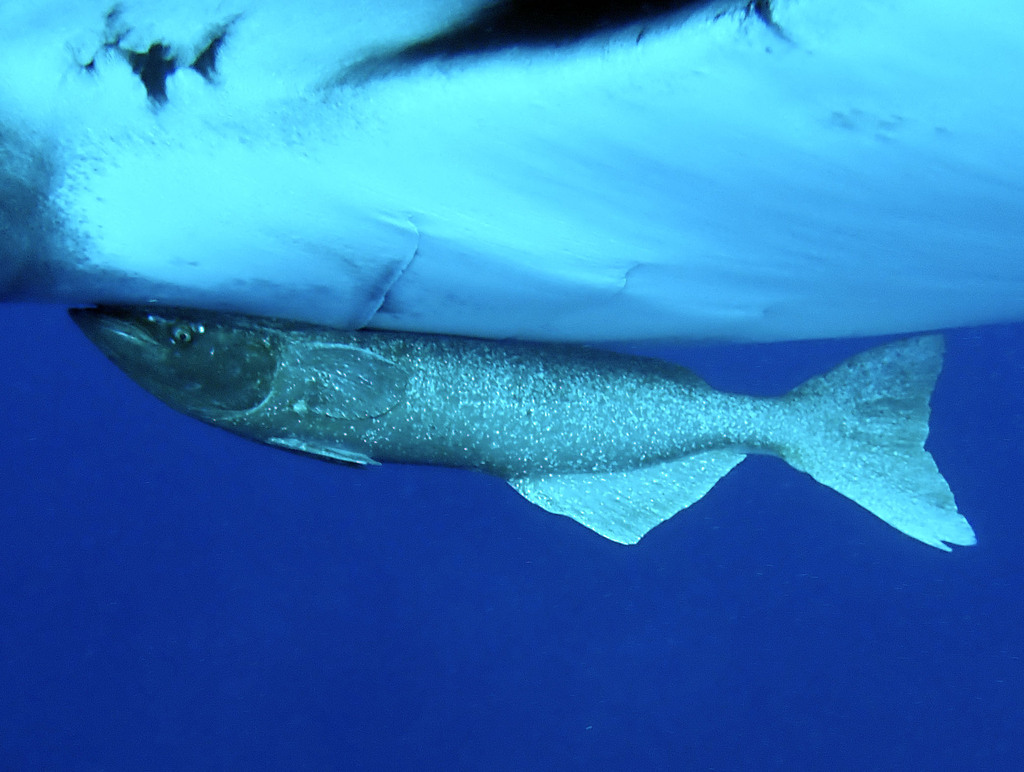
Common Remora
Remora remora
The common remora (Remora remora) is a pelagic marine fish belonging to family Echeneidae. R. remora is different from other remoras in the family Echeneidae by the modification of its dorsal fin. The dorsal fin, which has 22 to 26 soft rays, acts as a suction cup, creating a vacuum to allow it to attach to larger marine animals, such as whales, dolphins, sharks, and sea turtles.
From the article Common remora on Wikipedia (CC BY-SA), quoted section by section
Range & habitat
This remora is commonly found in warm marine waters and has been seen in the western Mediterranean and the Atlantic, as well as the North Sea.
Wikipedia: “Habitat”
What it does
R. remora and its host seem to partake in a symbiotic relationship; the common remora does not seem to have a negative overall effect on its host. The host provides the remora with fast-moving water for respiration, a steady flow of food, transportation, and protection. The remora benefits the host by feeding in part on some of its parasites, but increases its hydrodynamic drag. The common remora's attachment to one host can last for up to three months. During this time, the remora can move its attachment site if it feels threatened. The common remora cannot survive in still water; it needs water flow over its gills to breathe.
Wikipedia: “Biology and behavior”
At the table
The remora consumes food scraps from its host, as well as plankton and parasitic copepods.
Wikipedia: “Food and diet”
Where it lives
Recorded sightings
—
geo-referenced records in GBIF, from museums, herbaria and field observers.
Drag the globe to turn it. Dots are where records exist, not a range map; darker means more records.
In the stacks
Searching the stacks…
Every page naming Remora remora in the Biodiversity Heritage Library →
This page is assembled live from iNaturalist, GBIF, Wikipedia, the Source Library and the Internet Archive. It is not yet part of the hand-edited codex. iNaturalist taxon 120697.