- Animals
- ›Arthropods
- ›Chelicerates
- ›Arachnids
- ›Spiders
- ›Typical Spiders
- ›Entelegyne Spiders
- ›Orbweavers and Allies
- ›Orbweavers
- ›Micratheninae
- ›Micrathena
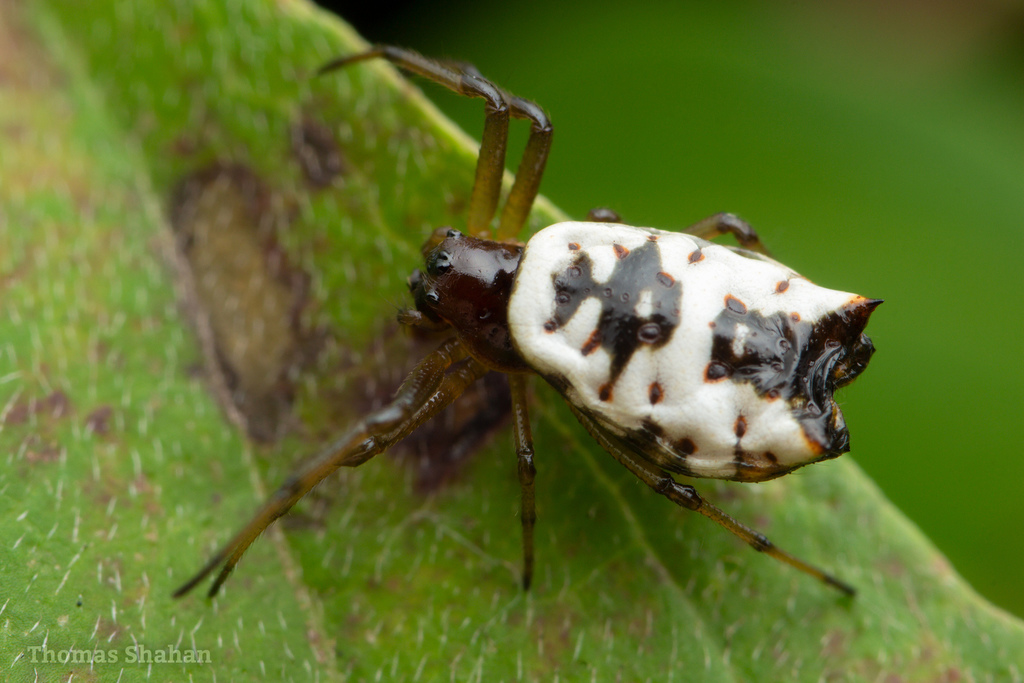
White Micrathena
Micrathena mitrata
Micrathena mitrata, the white micrathena, is a species of orb weaver in the spider family Araneidae. It is found in a range from the United States to Brazil. The spider has a distinctive appearance with a shiny, black abdomen and spiky, yellowish-brown legs. Its body length ranges from 4 to 9 mm in females and 3 to 4 mm in males. The species is known for its elaborate web, which it uses to capture insects for food. Micrathena mitrata is not considered dangerous to humans and is generally regarded as a harmless spider.
From the article Micrathena mitrata on Wikipedia (CC BY-SA), quoted section by section
Range & habitat
Micrathena mitrata is commonly found in North America, particularly in the eastern and central regions of the United States, as well as in Canada. The spider prefers wooded areas, especially near streams and other bodies of water, where it can build its web low to the ground, often near shrubs or trees. They are also known to inhabit fields and meadows, especially in grassy areas. Micrathena mitrata is a versatile species that can adapt to a range of habitats, from rural to urban areas. However, the spider is most commonly found in natural environments with plenty of vegetation and insect prey. Overall, Micrathena mitrata is a habitat generalist that can thrive in a range of environments, as long as it has access to prey and suitable places to build its web.
Wikipedia: “Habitat”
What it does
Micrathena mitrata follows a typical reproductive process seen in many spider species. Male spiders initiate courtship by tapping the female's web to get her attention. Once the female has accepted the male's advances, he will transfer sperm into her reproductive organs using his pedipalps. The female may become aggressive after mating, and may even kill and consume the male, a behavior known as sexual cannibalism. The male's sacrifice is thought to increase the chances of his sperm fertilizing the female's eggs, and provide a source of nutrition for the developing offspring. After mating, the female will create an egg sac and fill it with fertilized eggs. The egg sac is usually attached to a nearby surface, and the female will guard it until the spider lings hatch. She may also provide food for them by regurgitating liquid prey. Overall, the reproductive process of Micrathena mitrata involves courtship, mating, egg-laying, and protection of the offspring. The behavior of sexual cannibalism is not unique to this species.
Wikipedia: “Reproduction”
Where it lives
Recorded sightings
—
geo-referenced records in GBIF, from museums, herbaria and field observers.
Drag the globe to turn it. Dots are where records exist, not a range map; darker means more records.
In the stacks
Searching the stacks…
Every page naming Micrathena mitrata in the Biodiversity Heritage Library →
This page is assembled live from iNaturalist, GBIF, Wikipedia, the Source Library and the Internet Archive. It is not yet part of the hand-edited codex. iNaturalist taxon 120440.