- Fungi Including Lichens
- ›Basidiomycete Fungi
- ›Higher Basidiomycetes
- ›Mushrooms, Bracket Fungi, Puffballs, and Allies
- ›Agaricomycetidae
- ›Common Gilled Mushrooms and Allies
- ›Agaricineae
- ›bird's nest fungi
- ›Cyathus
- ›Cyathus
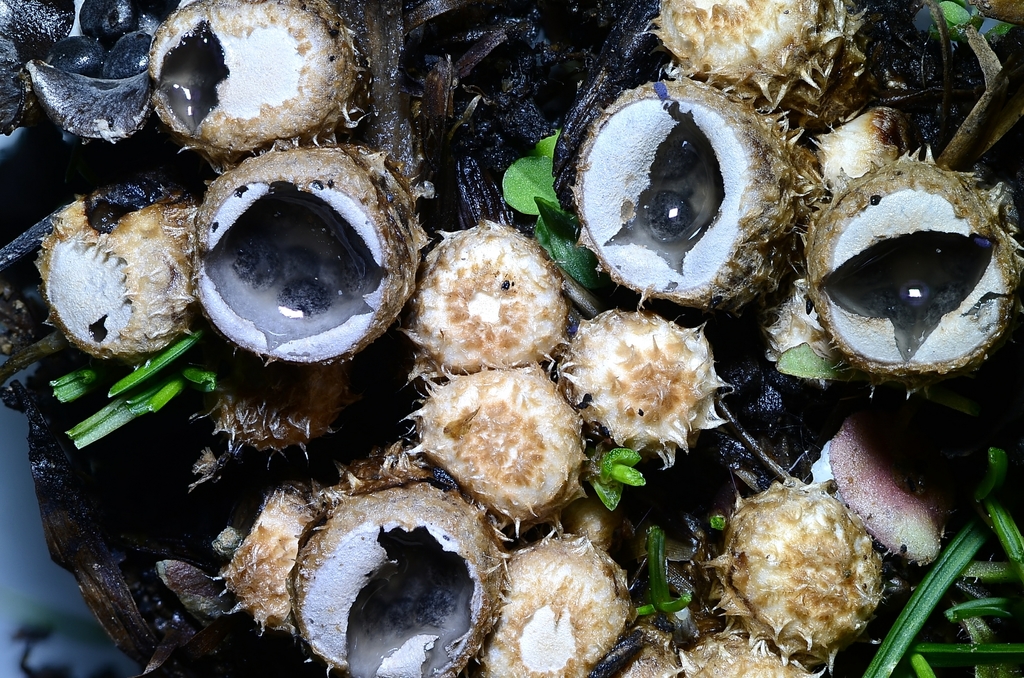
dung-loving bird's nest fungus
Cyathus stercoreus
Cyathus stercoreus, commonly known as the dung-loving bird's nest or the dung bird's nest, is a species of fungus in the genus Cyathus, family Nidulariaceae. Like other species in the Nidulariaceae, the fruiting bodies of C. stercoreus resemble tiny bird's nests filled with eggs. The fruiting bodies are referred to as splash cups, because they are developed to use the force of falling drops of water to dislodge and disperse their spores. The species has a worldwide distribution, and prefers growing on dung, or soil containing dung; the specific epithet is derived from the Latin word stercorarius, meaning "of dung".
From the article Cyathus stercoreus on Wikipedia (CC BY-SA), quoted section by section
Description
The fruiting bodies, or perida, are funnel- or barrel-shaped, 6–15 mm tall, 4–8 mm wide at the mouth, sometimes short-stalked, golden brown to blackish brown in age. The outside wall of the peridium, the ectoperidium, is covered with tufts of fungal hyphae that resembles shaggy, untidy hair. However, in older specimens this outer layer of hair (technically a tomentum) may be completely worn off. The internal wall of the cup, the endoperidium, is smooth and grey to bluish-black. The 'eggs' of the bird's nest – the peridioles – are blackish, 1–2 mm in diameter, and there are typically about 20 in the cup. Peridioles are often attached to the fruiting body by a funiculus, a structure of hyphae that is differentiated into three regions: the basal piece, which attaches it to the inner wall of the peridium, the middle piece, and an upper sheath, called the purse, connected to the lower surface of the peridiole. In the purse and middle piece is a coiled thread of interwoven hyphae called the funicular cord, attached at one end to the peridiole and at the other end to an entangled mass of hyphae called the hapteron. However, Brodie reports that sometimes C. stercoreus is found without a funiculus, which has led some authors to misidentify this species with the genus Nidula.
The spores of C. …
Range & habitat
Being coprophilous, C. stercoreus grows on dung, in soil with dung, and bonfire sites; it has also been recorded growing on sand dunes. The fungus is known to have a worldwide distribution, and Curtis Gates Lloyd, in his monograph on the Nidulariaceae, wrote that it "probably occurs in every country where manure occurs".
Wikipedia: “Habitat and distribution”
In medicine
In Traditional Chinese medicine, a decoction of this fungus is used to help relieve the symptoms of gastralgia, or stomach ache.
Wikipedia: “Traditional medicine”
How it is grown
Cyathus stercoreus has been investigated for its ability to break down lignin and cellulose in agricultural byproducts, like wheat straw or grasses. It selectively breaks down lignin, leaving much of the cellulose intact, which increases the amount of digestible carbohydrate for ruminant mammals, and enhances both its value as a food source and its biodegradability. The enzymes responsible, laccase and manganese peroxidase, also have industrial applications for lignin degradation and removal in the pulp and paper industry. Liquid cultures of C. stercoreus have also been shown to biodegrade the explosive compound 2,4,6-trinitrotoluene (TNT).
Wikipedia: “Agricultural and industrial”
Where it lives
Recorded sightings
—
geo-referenced records in GBIF, from museums, herbaria and field observers.
Drag the globe to turn it. Dots are where records exist, not a range map; darker means more records.
In the stacks
Searching the stacks…
Every page naming Cyathus stercoreus in the Biodiversity Heritage Library →
This page is assembled live from iNaturalist, GBIF, Wikipedia, the Source Library and the Internet Archive. It is not yet part of the hand-edited codex. iNaturalist taxon 120037.