- Animals
- ›Chordates
- ›Vertebrates
- ›Ray-finned Fishes
- ›Spiny-rayed fishes
- ›Gobies, cardinalfishes and allies
- ›Gobies and allies
- ›Gobies
- ›Sea Gobies
- ›Gobius
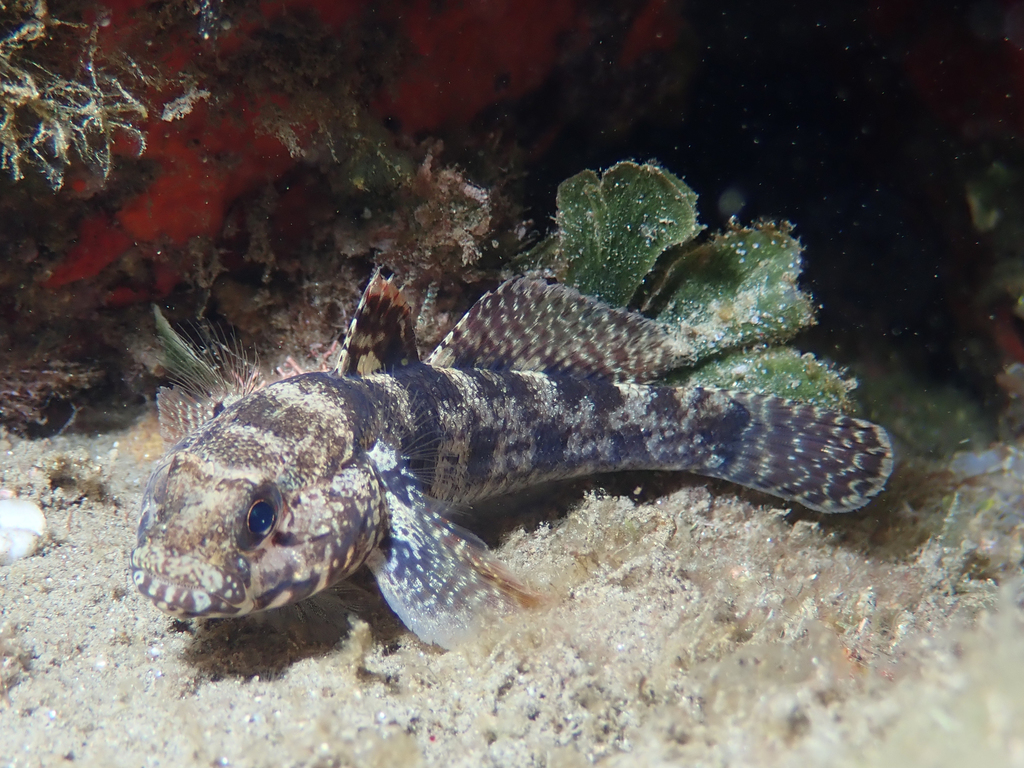
Rock Goby
Gobius paganellus
The rock goby (Gobius paganellus) is a small coastal goby of eastern Atlantic waters, from Scotland to Senegal. It is also reported from the Mediterranean and Black Seas, and is an anti-Lessepsian migrant in the Gulf of Aqaba and the Red Sea. There are unconfirmed records from the area around Pointe Noire in Congo-Brazzaville.
From the article Rock goby on Wikipedia (CC BY-SA), quoted section by section
Description
The rock goby is usually black with white blotches, but they can change color, and males are much more black when guarding the eggs. The neck area lacks scales and there is a pale band on the top of the first dorsal fin. Both dorsal fins lack black spots on their leading edges. This species can reach a length of 12 centimetres (4.7 in) TL and has been known to live for ten years.
Range & habitat
The rock goby is found in the temperate East Atlantic and the Mediterranean Sea. Its range extends from western Scotland southwards to the Azores and Senegal, most of the Mediterranean Sea and the Black Sea. It sometimes migrates through the Suez Canal to the Red Sea and the Gulf of Aqaba. It prefers rocky sea floors below the low tidemark, although it can be found in larger rock pools in Summer. It may also live in fresh or brackish water. It can be found at depths of from 0 to 15 metres (0 to 49 ft).
Wikipedia: “Distribution and habitat”
What it does
The rock goby eats small crabs and amphipods, polychaetes, larva, small fish, Calanus, copepod, and mites.
Wikipedia: “Behaviour”
Where it lives
Recorded sightings
—
geo-referenced records in GBIF, from museums, herbaria and field observers.
Drag the globe to turn it. Dots are where records exist, not a range map; darker means more records.
In the stacks
Searching the stacks…
Every page naming Gobius paganellus in the Biodiversity Heritage Library →
This page is assembled live from iNaturalist, GBIF, Wikipedia, the Source Library and the Internet Archive. It is not yet part of the hand-edited codex. iNaturalist taxon 118706.