- Animals
- ›Chordates
- ›Vertebrates
- ›Ray-finned Fishes
- ›Spiny-rayed fishes
- ›Butterflyfishes, Angelfishes, and Allies
- ›Seabreams and Porgies
- ›Diplodus
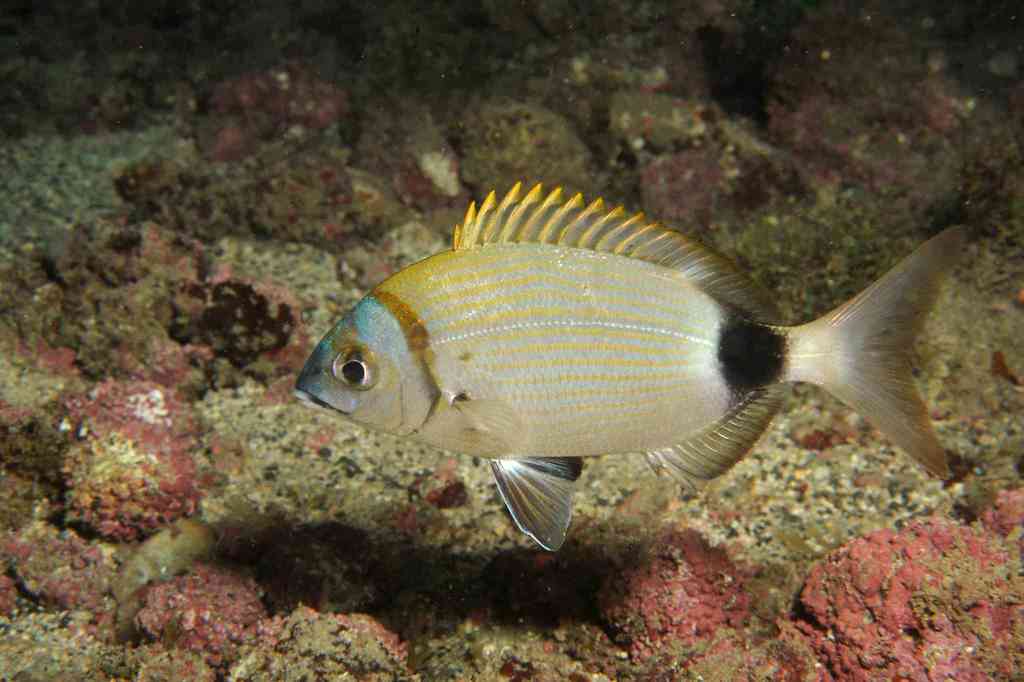
Two-banded Seabream
Diplodus prayensis
Diplodus prayensis, the two-banded seabream, is a species of marine ray-finned fish belonging to the family Sparidae, which includes the seabreams and porgies. This species is endemic to the Cape Verde Islands.
From the article Diplodus prayensis on Wikipedia (CC BY-SA), quoted section by section
Description
Diplodus prayensis has an oval shaped, compressed body with a slightly protrusible mouth which has moderately fleshy lips. There are 8 brown coloured incisor-like teeth in the front of both the upper and lower jaw with 3 or 4 rows of smaller molar-like teeth set out in a horseshoe pattern behind them and 4 larger molar-like teeth on the sides of the jaws. The dorsal fin is supported by 12 spines and between 13 and 15 soft rays, while the anal fin contains 3 spines and 12 or 13 soft rays. The caudal fin is forked. The overall colour is brownish to greenish with alternating gold and grey horizontal lines along the scale rows. The head is dark with a pale oval patch on the nape, a black line along the edge of the gill cover, a black spot at the base of the pectoral fin. There is a dark bar on the caudal peduncle which is more extensive in adults, reaching the base of the rearmost rays of the dorsal and anal fins. The two-banded seabream has a maximum published total length of 35 cm (14 in), although 25 cm (9.8 in) is more typical.
Range & habitat
Diplodus prayensis is found in the eastern Atlantic Ocean where it is endemic to the Cape Verde Islands. It replaces the closely related D. vulgaris in the waters off these islands. It occurs ate depths as deep as 100 m (330 ft) over rocky substrates and even deeper over muddy substrates.
Wikipedia: “Distribution and habitat”
In human culture
Diplodua prayensis has the specific name prayensis, this suffixes the placename Praia, the capital of Cape Verde and the type locality, with ensis meaning "of".
Wikipedia: “Etymology”
Where it lives
Recorded sightings
—
geo-referenced records in GBIF, from museums, herbaria and field observers.
Drag the globe to turn it. Dots are where records exist, not a range map; darker means more records.
In the stacks
Searching the stacks…
Every page naming Diplodus prayensis in the Biodiversity Heritage Library →
This page is assembled live from iNaturalist, GBIF, Wikipedia, the Source Library and the Internet Archive. It is not yet part of the hand-edited codex. iNaturalist taxon 118666.