- Animals
- ›Chordates
- ›Vertebrates
- ›Mammals
- ›Therians
- ›Placental Mammals
- ›Ungulates, Carnivorans, and Allies
- ›Carnivorans
- ›Felids
- ›Small Cats
- ›Felis
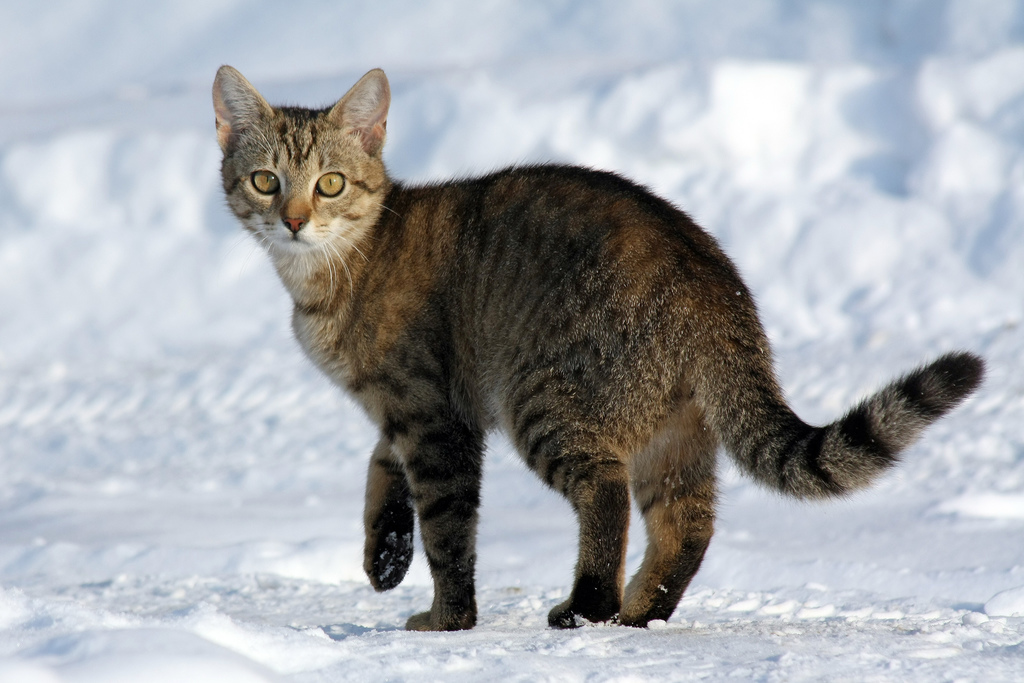
Domestic Cat
Felis catus
The cat (Felis catus), also called domestic cat and house cat, is a small domesticated carnivorous mammal. It is a member of Felidae, the family of mammals in the order Carnivora also colloquially referred to as cats. An obligate carnivore requiring a predominantly meat-based diet, it has retractable claws adapted to killing small prey species such as mice and rats. It has a strong, flexible body, quick reflexes, and sharp teeth, and its night vision and sense of smell are well developed. It is a social species, but a solitary hunter and a crepuscular predator.
Cat communication includes meowing, purring, trilling, hissing, growling, grunting, body language, and scent marking. It can hear sounds too faint or too high in frequency for human ears, such as those made by small mammals. It secretes and perceives pheromones. Cat intelligence is evident in its ability to adapt, learn through observation, and solve problems. The domestic cat is the only domesticated species of the family Felidae.
From the article Cat on Wikipedia (CC BY-SA), quoted section by section
Range & habitat
The domestic cat is a cosmopolitan species and occurs across much of the world. It is adaptable and now present on all continents except Antarctica, and on 118 of the 131 main groups of islands, even on the remote Kerguelen Islands. Due to its ability to thrive in almost any terrestrial habitat, it is among the world's most invasive species. It lives on small islands with no human inhabitants. Feral cats can live in forests, grasslands, tundra, coastal areas, agricultural land, scrublands, urban areas, and wetlands. The unwantedness that leads to the domestic cat being treated as an invasive species is twofold. As it is little altered from the wildcat, it can readily interbreed with the wildcat. This hybridization poses a danger to the genetic distinctiveness of some wildcat populations, particularly in Scotland and Hungary, possibly also the Iberian Peninsula, and where protected natural areas are close to human-dominated landscapes, such as Kruger National Park in South Africa. However, its introduction to places where no native felines are present also contributes to the decline of native species.
Wikipedia: “Habitats”
What it does
The cat is an obligate carnivore and has adapted to a low-fibre highly digestible meat diet. Cats have fewer enzymes capable of metabolising carbohydrates compared to omnivores. The cat lacks the ability to convert carotenoids to vitamin A; has an inability to synthesise enough vitamin D; inability to synthesise niacin from tryptophan; inability to synthesise cysteine, citrulline, and methionine; lacks glucokinase activity; and an intolerance to glutamic acid (which is low in animal tissue and high in plant matter). Taurine and arginine are essential for cats. Due to the inability to synthesise adequate amounts of citrulline a single meal lacking in arginine can be fatal to a cat. Cats cannot produce enough taurine and require dietary taurine; a lack of taurine will cause a cat to develop dilated cardiomyopathy. Commercial cat diets historically were lacking in taurine and dilated cardiomyopathy was a common issue until it was linked to taurine deficiency in a 1987 study.
Wikipedia: “Diet”
In human culture
The origin of the English word cat, Old English catt, is thought to be the Late Latin word cattus, which was first used at the beginning of the 6th century. The Late Latin word may be derived from an unidentified African language. The Nubian word kaddîska 'wildcat' and Nobiin kadīs are possible sources or cognates. The forms might also have derived from an ancient Germanic word that was absorbed into Latin and then into Greek, Syriac, and Arabic. The word may be derived from Germanic and Northern European languages, and ultimately be borrowed from Uralic, cf. Northern Sámi gáđfi 'female stoat', and Hungarian hölgy 'lady, female stoat'; from Proto-Uralic *käďwä 'female (of a furred animal)'. The English puss, extended as pussy and pussycat, is attested from the 16th century and may have been introduced from Dutch poes or from Low German puuskatte, related to Swedish kattepus, or Norwegian pus, pusekatt. Similar forms exist in Lithuanian puižė and Irish puisín or puiscín. The etymology is unknown, but it may be an onomatopoeia from using a sound to attract a cat. A male cat is called a tom, tommy or tomcat (or a gib, if neutered). A female is called a queen (or sometimes a molly, if spayed). Some sources write that queen refers solely to unspayed cats that are in an estrous cycle. …
Wikipedia: “Etymology and naming”
Listen
Looking for field recordings…
Where it lives
Recorded sightings
—
geo-referenced records in GBIF, from museums, herbaria and field observers.
Drag the globe to turn it. Dots are where records exist, not a range map; darker means more records.
In the old herbals & bestiaries

In the stacks
Searching the stacks…
Every page naming Felis catus in the Biodiversity Heritage Library →
This page is assembled live from iNaturalist, GBIF, Wikipedia, the Source Library and the Internet Archive. It is not yet part of the hand-edited codex. iNaturalist taxon 118552.