- Fungi Including Lichens
- ›Basidiomycete Fungi
- ›Higher Basidiomycetes
- ›Mushrooms, Bracket Fungi, Puffballs, and Allies
- ›Agaricomycetidae
- ›Common Gilled Mushrooms and Allies
- ›Tricholomatineae
- ›Lyophyllaceae
- ›Lyophyllum
- ›Lyophyllum decastes
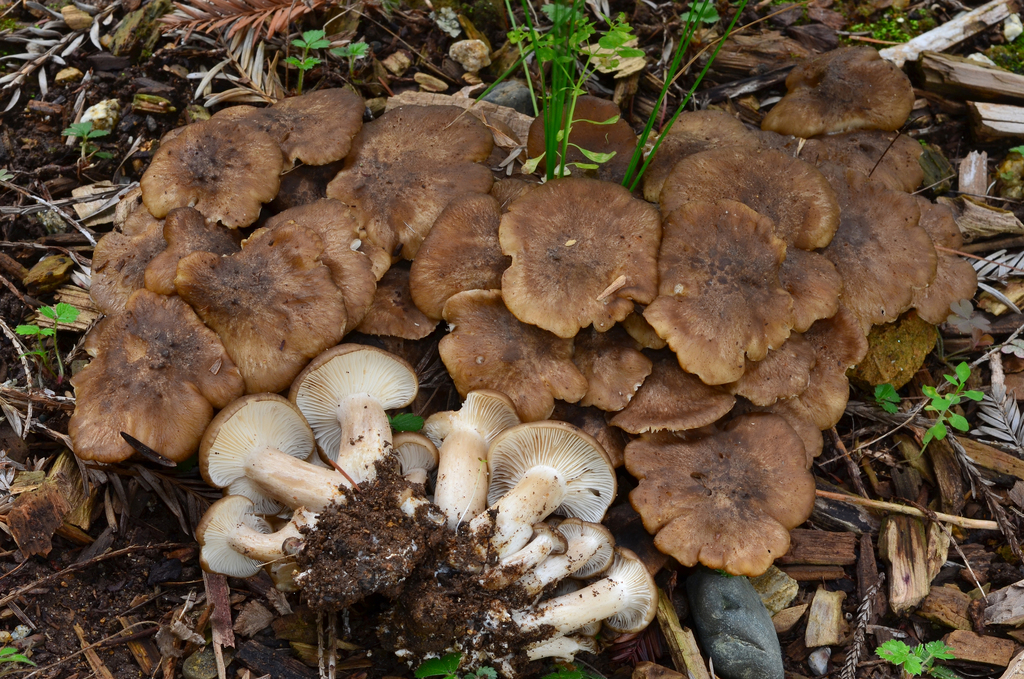
Fried Chicken Mushroom
Lyophyllum decastes
Lyophyllum decastes is a species of fungus in the family Lyophyllaceae. It is known as the clustered domecap in the United Kingdom and the fried chicken mushroom in North America. The basidiocarps (fruit bodies) are agaricoid (gilled mushrooms). It forms large clusters on the ground. Considered edible, it is cultivated in Asia.
From the article Lyophyllum decastes on Wikipedia (CC BY-SA), quoted section by section
Description
The caps are smooth, varied in color, and range from 4–12 cm (1+1⁄2–4+3⁄4 in) wide. The whitish-grayish stalks are 5–10 cm (2–4 in) long and 1–3 cm (3⁄8–1+1⁄8 in) wide. The gills are white but may yellow slightly with age. The firm flesh remains white on exposure. The spores are white.
Similar species. Lyophyllum semitale and Pluteus petasatus are similar in appearance, as is L. fumosum; it and L. loricatum are sometimes grouped with L. decastes as a species complex, lacking distinct differentiating features.
Range & habitat
The species was originally described from Sweden and is widespread throughout Europe and north temperate regions. It is prolific in summer and fall until spring on the West Coast of the United States and is widely distributed in North America. It also occurs in eastern temperate Asia. Growing in dense, often huge clusters on the ground, the mushrooms are usually found where the ground has been disturbed such as roadbeds, gravel, paths, landscaping areas, and sometimes in woods. It is variously considered saprotrophic or ectomycorrhizal.
Wikipedia: “Distribution and habitat”
At the table
In North America, the species is considered edible and occasionally collected in the wild, but there are some reports of gastric upset and possible confusion with poisonous Entoloma species or Clitocybe dilatata. The species is commercially cultivated in Japan, where it is known as hatake shimeji, and in China, where it is known as luronggu. The fungus is considered to be both a food and a health supplement and is grown on sawdust or bark compost.
Wikipedia: “Uses”
Where it lives
Recorded sightings
—
geo-referenced records in GBIF, from museums, herbaria and field observers.
Drag the globe to turn it. Dots are where records exist, not a range map; darker means more records.
In the stacks
Searching the stacks…
Every page naming Lyophyllum decastes in the Biodiversity Heritage Library →
This page is assembled live from iNaturalist, GBIF, Wikipedia, the Source Library and the Internet Archive. It is not yet part of the hand-edited codex. iNaturalist taxon 118243.