- Fungi Including Lichens
- ›Basidiomycete Fungi
- ›Higher Basidiomycetes
- ›Mushrooms, Bracket Fungi, Puffballs, and Allies
- ›Agaricomycetidae
- ›Common Gilled Mushrooms and Allies
- ›Agaricineae
- ›Strophariaceae
- ›Pyrrhulomyces
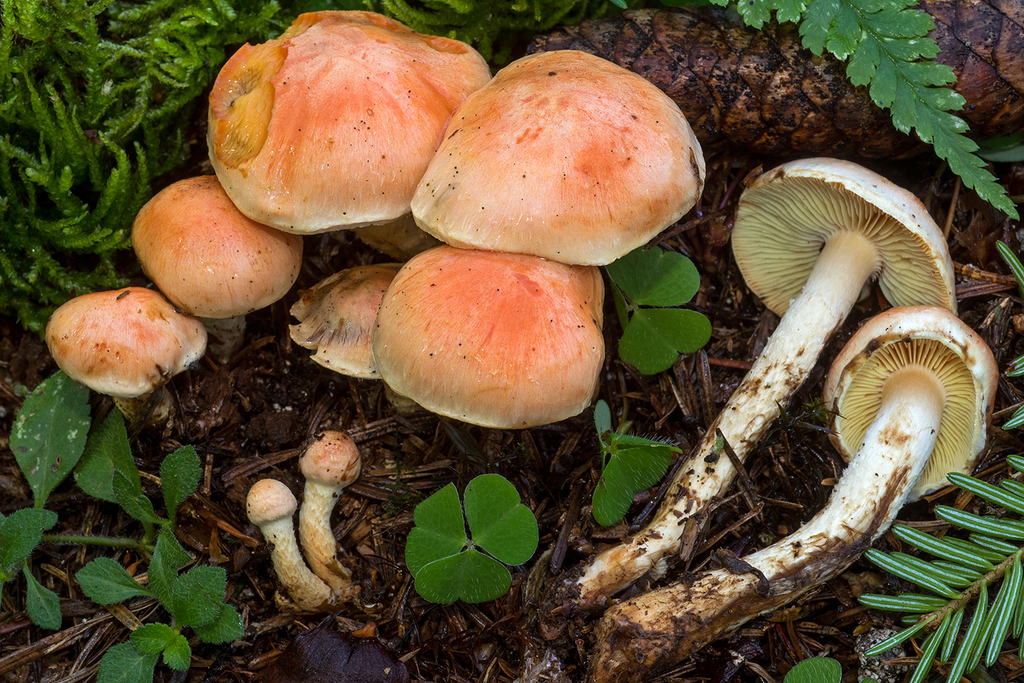
conifer scalycap
Pyrrhulomyces astragalinus
Pyrrhulomyces astragalinus, commonly known as the pinkish-orange pholiota, is a species of fungus in the family Strophariaceae, originally described by Elias Fries in 1821 as Agaricus astragalinus. After being moved to Pholiota, the species was reassigned to the newly established genus Pyrrhulomyces in 2020 based on molecular phylogenetics evidence showing it belongs to a distinct lineage.
The species is characterized by its pink-orange cap and stem that blacken when bruised, smooth spores lacking a germ pore, and bitter taste. Found throughout temperate regions of the Northern Hemisphere, this saprotroph grows on decaying conifer wood and though non-poisonous, is considered inedible.
From the article Pyrrhulomyces astragalinus on Wikipedia (CC BY-SA), quoted section by section
Description
The cap is 2–6 centimetres (3⁄4–2+1⁄4 in) broad, hemispheric to convex with a blunt umbo, viscid when moist and brilliant pink‑orange to salmon that fades and blackens with age; the margin is fibrillose, often bearing fleeting veil remnants. The gills are adnexed to adnate, close, yellowish‑brown, the edges paler and fimbriate. The stipe is 4–12 cm long and 4–8 mm thick, cylindrical and flexuous, fibrillose or scaly, often with a cobwebby annulus when young; flesh is orange, staining black on exposure, with a mild odour and bitter taste. The spore print is reddish‑brown to cinnamon. Under the microscope, basidiospores measure 6–6.8–8 by 4–4.4–5 μm, ellipsoid to somewhat ovate in shape, thin‑walled, without a germ pore, pale yellowish‑brown in KOH, and brown in deposit. The basidia are narrowly clavate (club-shaped), 20–28 by 7–8 μm, four‑spored. Pleurocystidia are chrysocystidia—fusiform‑ventricose to clavate with golden inclusions—and measure 42–55 by 12–18 μm; cheilocystidia are narrow, with a long neck and obtuse apex. The pileipellis is an ixocutis of gelatinous hyphae, and clamp connections are present. Though nonpoisonous, the species is regarded as inedible. DNA sequencing may be required to distinguish Pyrrhulomyces astragalinus from P. amariceps.
Range & habitat
Pyrrhulomyces astragalinus is saprotrophic on decaying wood, primarily of conifers, occurring on logs and stumps in late stages of decay. Fruiting usually occurs solitary or in small clusters, from late summer through autumn and, in mild coastal climates, into winter. This species is widespread across temperate regions of the Northern Hemisphere: in Europe (e.g. Italy, Sweden, Switzerland), in East Asia (provinces of Jilin and Jiangxi in China) and in North America—from Alaska, British Columbia, Washington and Idaho eastward to Newfoundland and Maine, southward along the Pacific coast and in high‑elevation conifer forests of the southern Appalachians (North Carolina, Tennessee).
== References ==
Wikipedia: “Habitat and distribution”
Where it lives
Recorded sightings
—
geo-referenced records in GBIF, from museums, herbaria and field observers.
Drag the globe to turn it. Dots are where records exist, not a range map; darker means more records.
In the stacks
Searching the stacks…
Every page naming Pyrrhulomyces astragalinus in the Biodiversity Heritage Library →
This page is assembled live from iNaturalist, GBIF, Wikipedia, the Source Library and the Internet Archive. It is not yet part of the hand-edited codex. iNaturalist taxon 1179671.