- Animals
- ›Arthropods
- ›Crustaceans
- ›Typical Crustaceans
- ›Malacostracans
- ›Decapods, Isopods, and allies
- ›Amphipods, Isopods, and Allies
- ›Isopods
- ›Woodlice, Pillbugs, and Rock Slaters
- ›Rock Slaters
- ›Rock Lice, Sea Slaters, and Allies
- ›Ligia
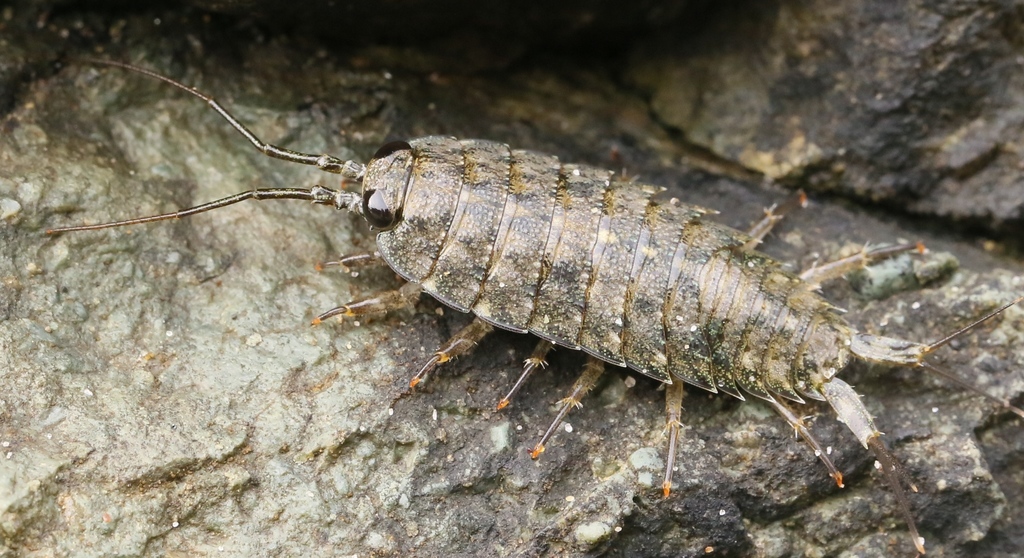
Western Sea Slater
Ligia occidentalis
Ligia occidentalis, the western sea slater, is a species of isopod in the family Ligiidae. It lives on rocky shores along the Pacific coast of North America, in the splash zone just above the high tide line. It breathes through gills but spends almost all of its time out of the water. There has been DNA studies that have found evidence that shows there are multiple lineages within Ligia occidentalis meaning there could be multiple species that look alike instead of it just being one.
From the article Ligia occidentalis on Wikipedia (CC BY-SA), quoted section by section
Description
L. occidentalis looks a lot like Ligia pallasi, but the two species can be told apart by Ligia occidentalis’ longer uropods (the pair of tail appendages), its larger eyes set closer together, its skinnier body, and its tendency to jerk its body when messed with. It can also change color. The color comes from pigment cells called chromatophores, and Armitage (1960) studied how these cells behave in this species.
Range & habitat
Genetic surveys have sampled L. occidentalis on rocky shores from central California south to central Mexico, including the Gulf of California. BugGuide also lists an introduced population around Vancouver, British Columbia. It stays in a thin strip of the supralittoral zone and cannot survive long underwater, which limits its ability to spread across sandy beaches or open water to new rocky areas they haven't stepped foot on, which Hurtado et al. (2010) suggest is a reason why its populations drifted apart due to genetic changes from not mixing with other populations creating families. Because L. occidentalis lives south and L. pallasii lives north, where they meet there's a mix of both. Eberl (2012) surveyed both along the coast. L. occidentalis was slightly less abundant toward the northern end of its range, but the drop was not statistically significant.
Wikipedia: “Distribution and habitat”
What it does
During the day it hides in rock crevices or under stones just above the high tide line. It comes out to forage through the intertidal zone at night, and at low tide in cool weather. It is a scavenger and also eats microscopic algae. To breathe, it has to keep its gills wet, which it does by dipping the back of its abdomen into water. It handles water loss well, but it drowns if held underwater.
== References ==
Wikipedia: “Behavior and diet”
Where it lives
Recorded sightings
—
geo-referenced records in GBIF, from museums, herbaria and field observers.
Drag the globe to turn it. Dots are where records exist, not a range map; darker means more records.
In the stacks
Searching the stacks…
Every page naming Ligia occidentalis in the Biodiversity Heritage Library →
This page is assembled live from iNaturalist, GBIF, Wikipedia, the Source Library and the Internet Archive. It is not yet part of the hand-edited codex. iNaturalist taxon 117674.