- Fungi Including Lichens
- ›Ascomycete Fungi
- ›Sac Fungi and Lichens
- ›Common Lichens
- ›wart lichens, script lichens, and allies
- ›wart lichens, water lichens, and allies
- ›water lichens, whiteworm lichens, and allies
- ›Dibaeis
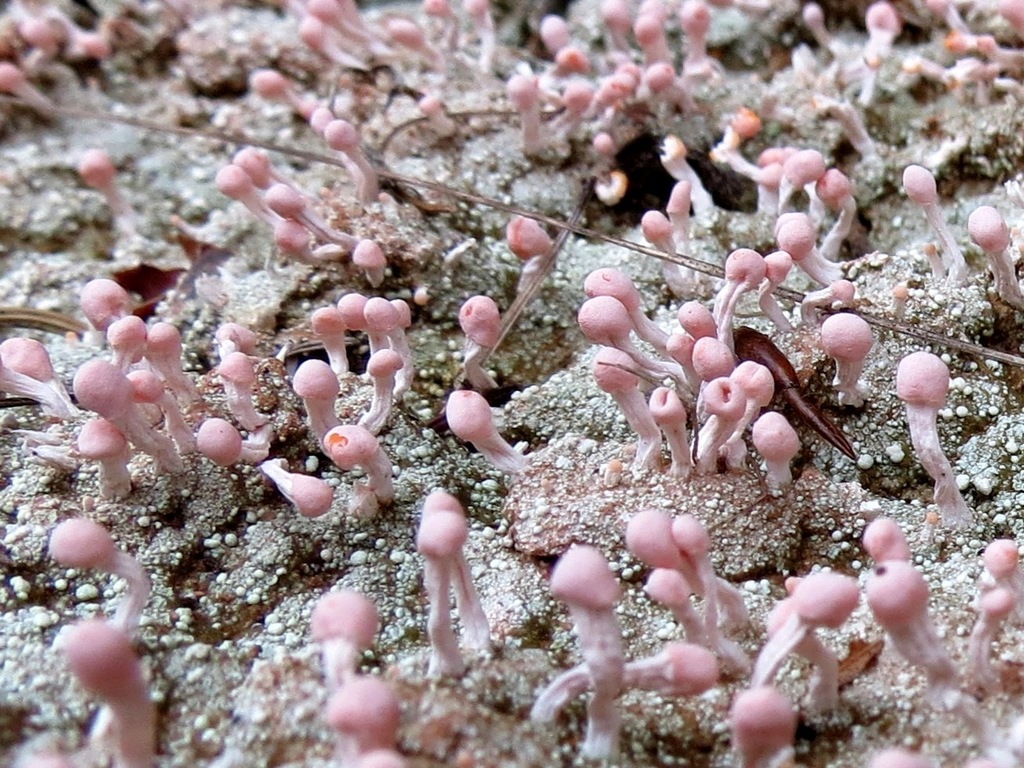
Pink Earth Lichen
Dibaeis baeomyces
Dibaeis baeomyces, commonly known as pink earth lichen, is a fruticose lichen belonging to the family Icmadophilaceae. The species was first described by Linnaeus.
From the article Dibaeis baeomyces on Wikipedia (CC BY-SA), quoted section by section
Description
D. baeomyces is characterized by bulbous pink apothecia, 1–4 mm in diameter, atop stalks no taller than 6 mm. The thallus may be grey or white, and may have a pinkish tinge.
Similar species. D. baeomyces is related to Icmadophila ericetorum, the candy lichen, and the two species superficially resemble one another. In some parts of North America where ranges overlap, both D. baeomyces and I. ericetorum are colloquially referred to as "fairy puke" lichen, leading to further confusion between the species. Its appearance is also superficially similar to some Cladonia species, particularly Cladonia cristatella (common name British soldiers), which has red tips rather than pink; and to multiple Baeomyces species, which typically have brown tips. B. rufus, as mentioned above, has pinkish bulbs atop its stalks, like D. baeomyces, but like other Baeomyces species it has been established as not being closely related to D. baeomyces.
Range & habitat
This lichen is found throughout eastern North America, from Alabama and Georgia in the south to the Arctic Circle in the north. While rare there, it does occur in both Alaska and the Northwest Territories. It prefers to grow directly on unstable soils such as loose sand or dry clay, and in full sun. It also prefers acid soils to neutral or alkaline. On disturbed ground, a preferred habitat type, it is able to spread quickly for a lichen.
== References ==
Wikipedia: “Distribution and habitat”
Where it lives
Recorded sightings
—
geo-referenced records in GBIF, from museums, herbaria and field observers.
Drag the globe to turn it. Dots are where records exist, not a range map; darker means more records.
In the stacks
Searching the stacks…
Every page naming Dibaeis baeomyces in the Biodiversity Heritage Library →
This page is assembled live from iNaturalist, GBIF, Wikipedia, the Source Library and the Internet Archive. It is not yet part of the hand-edited codex. iNaturalist taxon 117422.