On eBird ↗
Tanimbar Corella
Live sightings near you, the range map, bar charts of when it is seen, and Macaulay Library photos and recordings.
Tanimbar Corella
Cacatua goffiniana
The Tanimbar corella (Cacatua goffiniana), also known as Goffin's cockatoo or Tanimbar cockatoo, is a species of cockatoo endemic to forests of Yamdena, Larat, and Selaru, all islands in the Tanimbar Islands archipelago in Indonesia. It has been introduced to the Kai Islands, Indonesia; Puerto Rico; and Singapore. This species was only formally described in 2004, after it was discovered that the previous formal descriptions pertained to individuals of a different cockatoo species, Ducorps' or Solomons cockatoo (Cacatua ducorpsii). Tanimbar corellas are the smallest of the white cockatoos. It is classified as near threatened due to deforestation and cage-bird trade. It breeds well in captivity and a large avicultural population exists.
From the article Tanimbar corella on Wikipedia (CC BY-SA), quoted section by section
Description
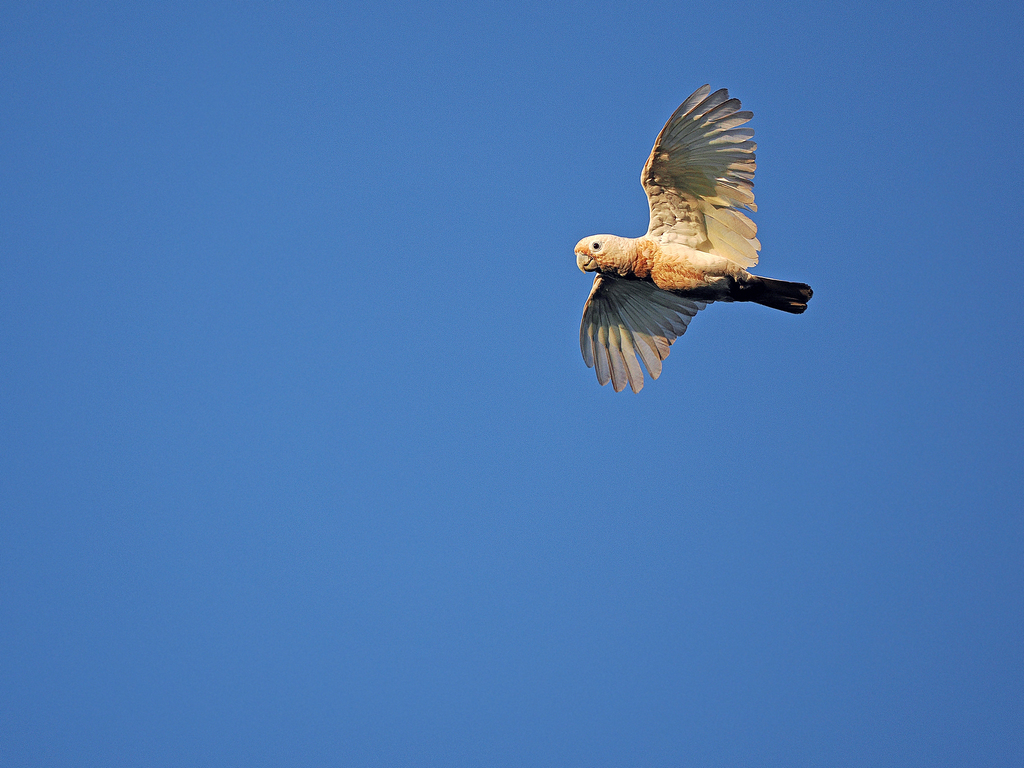
Tanimbar corellas weigh, on average, about 250 g (9 oz) for females and 300 g (11 oz) for males. They are about 31 cm (12 in) from head to tail. Like all members of the family Cacatuidae, the Tanimbar corella is crested, meaning it has a collection of feathers on its head that it can raise or lower. Its body is mainly covered with white feathers, with salmon- or pink-coloured feathers between the beak and eyes. The deeper (proximal) parts of the crest feathers and neck feathers are also a salmon colour, but the coloration here is hidden by the white colour of the more superficial (distal) areas of these feathers. The underside of its wing and tail feathers exhibit a yellowish tinge. The beak is pale grey and the eye colour is brown in females and black in males. The males are slightly larger, but otherwise look similar to the females. In captivity, Tanimbar corellas live up to 30 years, making them one of the shorter-lived cockatoo species.
In human culture
In aviculture, the parrot is widely known as Goffin's cockatoo. Pet birds hand reared from hatching can imitate human speech, but generally they are not good talkers. They are generally quieter than the "large cockatoos", but can still be quite loud, and they have a sharp screech that some find irritating. Tanimbar corellas learn by watching and copying. Just by opening the cage door, a Tanimbar corella's attention can be drawn to the latch on its cage and it can learn by trial and error how to open the latch with its beak and escape the cage in seconds. Tanimbar corellas can destroy furniture with their beaks and can chew through wires and cause potentially dangerous electrical incidents. Hand-reared Tanimbar corellas tend to demand a lot of attention. Occasionally, captive birds of this species (like many cockatoos) develop self-destructive behaviours such as feather-plucking, or stereotypy if they do not have an interesting and enriching environment. Caged Tanimbar corellas require a frequent change of toys to play with so they do not become bored. They need time out of their cage for one-on-one social contact of at least four hours daily and also to exercise their wings and fly. Even very tame birds can bite humans when irritated or even when being excessively playful. Their droppings are semisolid and can be messy. …
Wikipedia: “In aviculture”
Listen
Looking for field recordings…
Where it lives
Recorded sightings
—
geo-referenced records in GBIF, from museums, herbaria and field observers.
Drag the globe to turn it. Dots are where records exist, not a range map; darker means more records.
In the stacks
Searching the stacks…
Every page naming Cacatua goffiniana in the Biodiversity Heritage Library →
This page is assembled live from iNaturalist, GBIF, Wikipedia, the Source Library and the Internet Archive. It is not yet part of the hand-edited codex. iNaturalist taxon 117152.