On eBird ↗
White-eared Barbet
Live sightings near you, the range map, bar charts of when it is seen, and Macaulay Library photos and recordings.
White-eared Barbet
Stactolaema leucotis
The white-eared barbet (Stactolaema leucotis) is a species of bird in the family Lybiidae (African barbets). It is found in Kenya, Malawi, Mozambique, South Africa, Swaziland, Tanzania, and Zimbabwe.
From the article White-eared barbet on Wikipedia (CC BY-SA), quoted section by section
Description
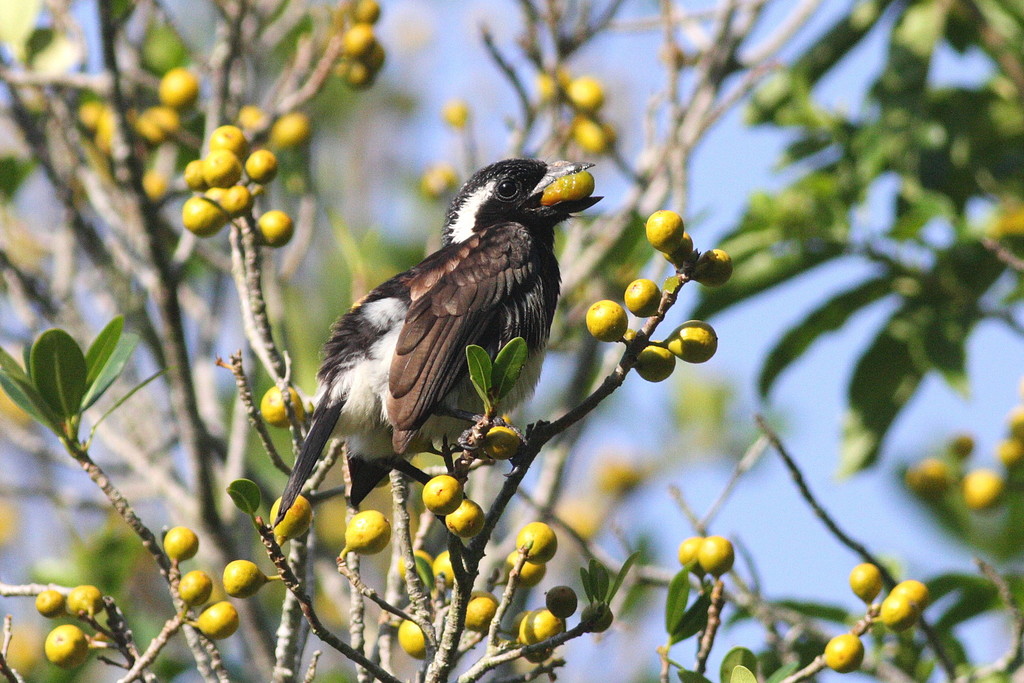
Size is 17–18 cm. Weight 48–63 g. Dark brown woodland barbet with white belly and dark head; eyes brown with grey-black orbital skin, legs and feet black to grey-brown, with grey soles, and black bill. The amount of white on the face, rump, and wings varies geographically, but there is always a white stripe behind the eye. Sexes alike. Immature blacker than adult.
Range & habitat
Highland forest and moist primary and secondary forest and some forest edge, also nearby gardens and plantations where fruiting trees present, and where dead trees and limbs are available for excavation; appears able to use Eucalyptus plantations in some areas, including for breeding, provided some native trees and understory remain. In Malawi, can be found up to elevations of 2600 m in the north and to at least 1600 m in the south, often on forested slopes.
Wikipedia: “Habitat”
What it does
Diet comprises fruits, including figs, guavas, pawpaws, mangoes, juniper, Celtis gomphophylla, and other berries. Also consumes insects, including hornets, wasps, roaches, dragonflies, crickets, moths, grasshoppers and armored locusts (Phymaetus spp.), and spiders. Uses special sites as "anvils" for killing and disarming insects. Gleans, works over bark, and flycatches for termites and other aerial insects. Aggressive and dominant at food sources, e.g. over other barbets.
Wikipedia: “Diet and Feeding”
Listen
Looking for field recordings…
Where it lives
Recorded sightings
—
geo-referenced records in GBIF, from museums, herbaria and field observers.
Drag the globe to turn it. Dots are where records exist, not a range map; darker means more records.
In the stacks
Searching the stacks…
Every page naming Stactolaema leucotis in the Biodiversity Heritage Library →
This page is assembled live from iNaturalist, GBIF, Wikipedia, the Source Library and the Internet Archive. It is not yet part of the hand-edited codex. iNaturalist taxon 117115.