- Animals
- ›Chordates
- ›Vertebrates
- ›Reptiles
- ›Snakes and Lizards
- ›Lizards
- ›Iguanas and Allies
- ›Iguanas, Anoles, and Allies
- ›Anoles
- ›Anolis
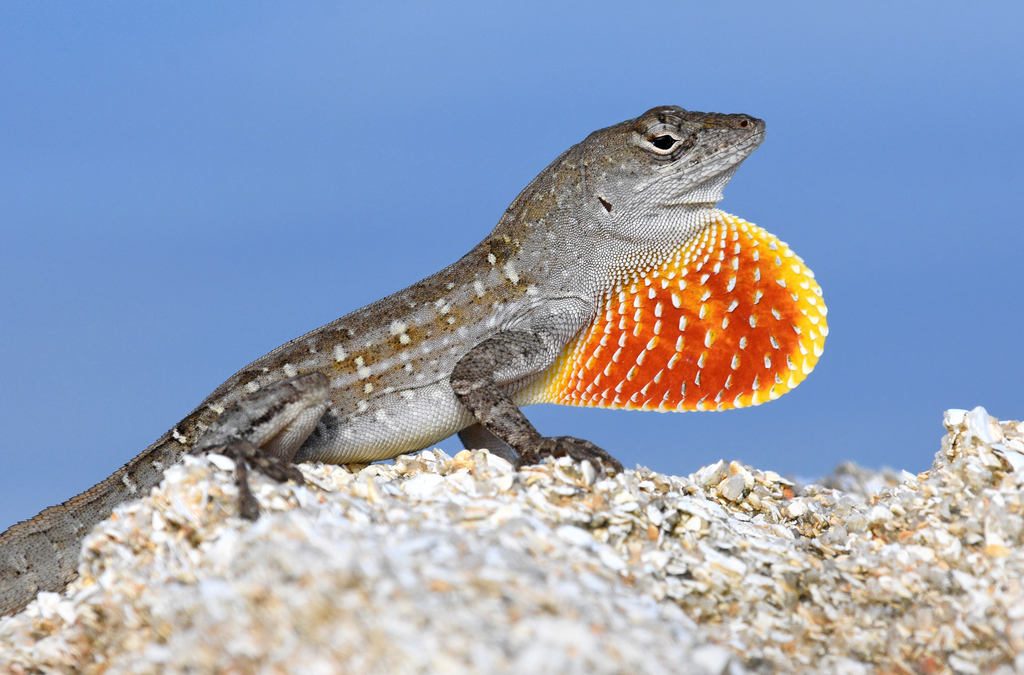
Brown Anole
Anolis sagrei
The brown anole (Anolis sagrei), also known commonly as the Bahaman anole, Cuban brown anole, and de la Sagra's anole, is a species of lizard in the family Anolidae. The species is native to Cuba, the Bahamas, Little Cayman, Cayman Brac, Jamaica, the Swan Islands, the Yucatán Peninsula, Belize, and the Caribbean coast of Guatemala and Honduras. It has been widely introduced elsewhere, via the importation and exportation of plants in pots in which brown anoles laid eggs in the soil, and is now found in Florida and other regions of the United States including southern Georgia, Texas, Louisiana, Tennessee, Mississippi, Alabama, Hawaii, North Carolina, and Southern California. It has also been introduced to other Caribbean islands, Mexico, Singapore, and Taiwan.
This species is highly invasive. It is also much more wary of humans than most other anole species.
From the article Brown anole on Wikipedia (CC BY-SA), quoted section by section
Description
The brown anole is normally a light brown color with darker brown to black markings on its back, and several tan to light color lines on its sides. Like other anoles, it can change color; individuals can change their general body coloration to shades of brown, black, or gray, and some display yellowish dots when excited. Color shifts can be rapid in response to threats.
The brown anole usually has a total length (tail included) of 5.0–8.5 in (13–22 cm). Males can grow as large as their male Carolina anole counterparts, around 17.8–20.3 cm (7.0–8.0 in) long, with some individuals exceeding 22.9 cm (9.0 in). Females are also about the size of female Carolina anoles, which range from 7.6–15 cm (3.0–5.9 in). The male brown anole's head is smaller than that of the male Carolina anole. The brown anole's tail has a ridge that continues to the head, a feature that the Carolina anole lacks. Female Anolis lizards exhibit heritable polymorphism in dorsal patterning. A study in Gainesville, Florida reported that one third of Anolis sagrei females displayed a male-like chevron dorsal pattern, while other females had a striped dorsal pattern with continuous variation.
Range & habitat
The native range of the brown anole extends over much of the Caribbean, including Jamaica, Cuba, the Cayman Islands, and other countries. It was considered an invasive species in parts of Florida in the United States, including the Florida Keys, Dade County, Broward County, and Palm Beach County as of 1985. As of 2021, its range had extended as far as Georgia and through Texas to parts of Mexico. It is believed that the brown anole was unintentionally brought to the area in cargo shipments for the Caribbean, as well as an intentional release of approximately 100 individuals in 1941. The species is also established in parts of Honduras. The brown anole tends to live on the ground, avoiding trees and preferring to live in smaller plants and shrubs and is found in both urban and suburban areas. When the weather is warm, the brown anole can be found basking. When it is cold, it prefers sheltered areas. Juvenile brown anoles have been found to use perches closer to the ground when exhibiting high body temperatures, a behavior not seen in adults. The brown anole is less arboreal than the green anole which is frequently found living in trees, on the ground, or in low vegetation. Although the brown anole was initially found in the Caribbean and then introduced to southern Florida, the species is now moving north. …
Wikipedia: “Habitat and distribution”
What it does
The brown anole feeds on small arthropods such as crickets, moths, ants, grasshoppers, cockroaches, mealworms, beetles, flies, earwigs, butterflies, spiders, waxworms, amphipods, and isopods. The brown anole also feed on other types of invertebrates such as earthworms and snails. It may also eat other lizards, such as skinks, geckos, curly-tailed lizards, the Carolina anole, lizard eggs and hatchlings (including members of its species), and its own molted skin and detached tail. If near water, it eats aquatic arthropods or small fishes – nearly any prey that will fit in its mouth. Occasionally, individuals will also consume figs and plant material; it may be interpreted as a hydration mechanism or accidental ingestion.
Wikipedia: “Diet”
Where it lives
Recorded sightings
—
geo-referenced records in GBIF, from museums, herbaria and field observers.
Drag the globe to turn it. Dots are where records exist, not a range map; darker means more records.
In the stacks
Searching the stacks…
Every page naming Anolis sagrei in the Biodiversity Heritage Library →
This page is assembled live from iNaturalist, GBIF, Wikipedia, the Source Library and the Internet Archive. It is not yet part of the hand-edited codex. iNaturalist taxon 116461.