- Animals
- ›Chordates
- ›Vertebrates
- ›Reptiles
- ›Snakes and Lizards
- ›Lizards
- ›Iguanas and Allies
- ›Iguanas, Anoles, and Allies
- ›Anoles
- ›Anolis
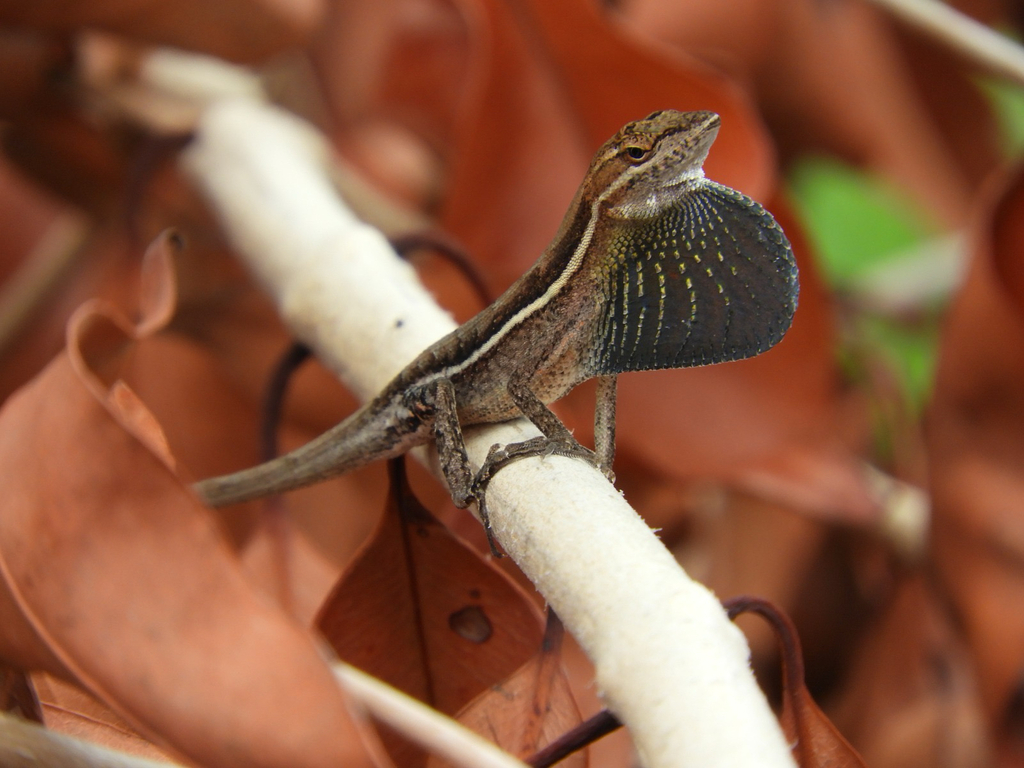
Grass Anole
Anolis auratus
Anolis auratus, the grass anole, is a species of lizard in the family Dactyloidae. The species is found in Costa Rica, Panama, Venezuela, Colombia, French Guiana, Guyana, and Brazil.
From the article Anolis auratus on Wikipedia (CC BY-SA), quoted section by section
Description
Though A. auratus presents a variety of physical characteristics based on geographic location, maturity, and sex, a common feature is a tan-coloured back with cream or dark brown to black lateral stripes, copper orange spots on the posterior thigh, a bright orange tongue, as well as an overall tan tail with light gray or black streaks, blotches, or stripes on the dorsal surface but orange coloration underneath. The female has a smaller dewlap with gray to blue skin in between cream scales, while the male possesses a larger dewlap, similar in skin color to that of the female but with yellow scales at the center and base of the structure.
In general, male and female A. auratus exhibit differences in pelvis width, trunk length, and head size, and thus, are sexually dimorphic with females possessing bigger pelvises and trunks and males having larger heads. As females play a more important role in reproduction, their larger trunks and wider pelvises allow them to carry more eggs as well as oviposit, or lay, heavier and bigger eggs respectively. On the other hand, males exhibit larger head dimensions than females, which may be attributable to their participation in male-to-male competitive interactions for female mates, resources, and/or territories. …
Range & habitat
A. auratus is widely distributed throughout Central America as well as northern regions of South America, extending from Costa Rica and spanning through much of Colombia, Venezuela, Brazil, Surinam, and the Guyanas. Unlike other Anolis species, A. auratus inhabits moderately verdant grasslands rather than arboreal, or branchy, environments, which researchers presume may have given rise to its unique social organization. It prefers to live in fields, roadsides, or river edge marshes, and avoid shaded, brushy, as well as second growth regions. These grassy habitats are extremely short-lived, as they develop from some kind of disturbance to the area, like flooding, burning, or clearing by humans, and eventually become uninhabitable, growing into secondary forests. Hence, the grass anole doesn't occupy a single permanent territory throughout its lifetime; rather, it is continually on the move from habitat to habitat, relocating once its previous dwelling is destroyed by a disturbance or eliminated via natural processes. Moreover, vegetation is dense near the ground with long grass stalks sprouting out, which leaves any and all elevated perches in the area – primarily used by males for assertion displays – exposed. In addition, insolation is higher in grassy habitats than arboreal ones, suggesting that A. auratus has adapted to tolerate and ultimately favor higher temperatures. A. …
Wikipedia: “Geographic range and habitat”
What it does
Described as a sit-and-wait predator, A. auratus forages for its food by spending most of the day sitting and waiting for prey to pass. Its diet consists mainly of invertebrates, more specifically arthropods, including Hymenoptera, Hemiptera, Chilopoda, Araneae, Orthoptera, and larvae. Generally, it is known to be an opportunistic feeder, ingesting a wide variety of arthropods and selecting prey on the basis of size rather than species type or identity. Furthermore, the size of the grass anole significantly affects the size of its prey, as bigger lizards have larger mouths, to effectively consume more massive arthropods. Diet may also vary throughout the seasons.
Wikipedia: “Diet”
Where it lives
Recorded sightings
—
geo-referenced records in GBIF, from museums, herbaria and field observers.
Drag the globe to turn it. Dots are where records exist, not a range map; darker means more records.
In the stacks
Searching the stacks…
Every page naming Anolis auratus in the Biodiversity Heritage Library →
This page is assembled live from iNaturalist, GBIF, Wikipedia, the Source Library and the Internet Archive. It is not yet part of the hand-edited codex. iNaturalist taxon 116394.