- Fungi Including Lichens
- ›Basidiomycete Fungi
- ›Higher Basidiomycetes
- ›Mushrooms, Bracket Fungi, Puffballs, and Allies
- ›Agaricomycetidae
- ›boletes and allies
- ›Sclerodermatineae
- ›Diplocystidaceae
- ›Astraeus
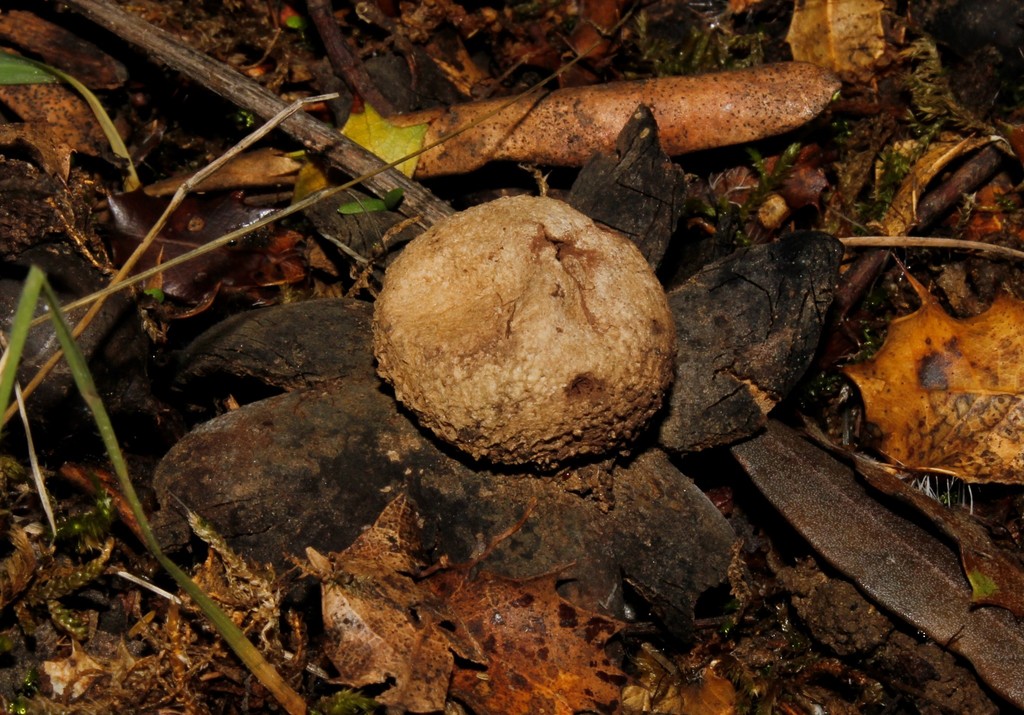
Astraeus telleriae
Astraeus telleriae is a species of false earthstar in the family Diplocystaceae. Described as new to science in 2013, it is found in the Mediterranean region, from southern Spain to Greece. The specific epithet honours Spanish mycologist Maria Teresa Telleria.
From the article Astraeus telleriae on Wikipedia (CC BY-SA), quoted section by section
Description
Similar in general appearance to other Astraeus earthstars, A. telleriae begins as a more or less spherical (globose) fruiting body 3–4 cm across that splits open into about a dozen pointed rays. The outer skin (exoperidium) is brown and splits into segments that curl back. The inner spore sac is pale buff to tan and covered with fine hairs, giving it a minutely woolly texture (a key diagnostic feature). When mature, the spore sac develops an irregular apical opening through which brownish spore dust is released. Microscopically, it produces globose warted spores about 7.5–12.5 μm in diameter. Like other earthstars, the rays of A. telleriae respond to humidity, curling closed when wet and re-opening as they dry.
Range & habitat
Astraeus telleriae is a Mediterranean species of earthstar. It is ectomycorrhizal, associating with pine and oak trees in warm, lime-rich soils. The species is known from southwestern Europe, particularly the Iberian Peninsula and the western Mediterranean. It has been confirmed from Spain (Catalonia and Madrid regions) and Greece, and generally occurs in dry woodland margins from sea level up to about 1,000. Its epithet honours a Spanish scientist, and indeed A. telleriae was first identified from Spain (holotype from Greece, but additional collections from southern Spain). A. telleriae is now one of several earthstar species recognized in Europe. Its discovery demonstrates that what was once thought a cosmopolitan earthstar is actually a complex of regional species adapted to specific climates.
== References ==
Wikipedia: “Habitat and distribution”
Where it lives
Recorded sightings
—
geo-referenced records in GBIF, from museums, herbaria and field observers.
Drag the globe to turn it. Dots are where records exist, not a range map; darker means more records.
In the stacks
Searching the stacks…
Every page naming Astraeus telleriae in the Biodiversity Heritage Library →
This page is assembled live from iNaturalist, GBIF, Wikipedia, the Source Library and the Internet Archive. It is not yet part of the hand-edited codex. iNaturalist taxon 1161229.