- Animals
- ›Arthropods
- ›Crustaceans
- ›Typical Crustaceans
- ›Malacostracans
- ›Decapods, Isopods, and allies
- ›Decapods and Krill
- ›Decapods
- ›Crabs, Lobsters, Shrimps, and Allies
- ›True Crabs
- ›Eubrachyuran Crabs
- ›Heterotrematan Crabs
- ›Xanthoid Crabs
- ›Round Crabs
- ›Euxanthinae
- ›Guinotellus
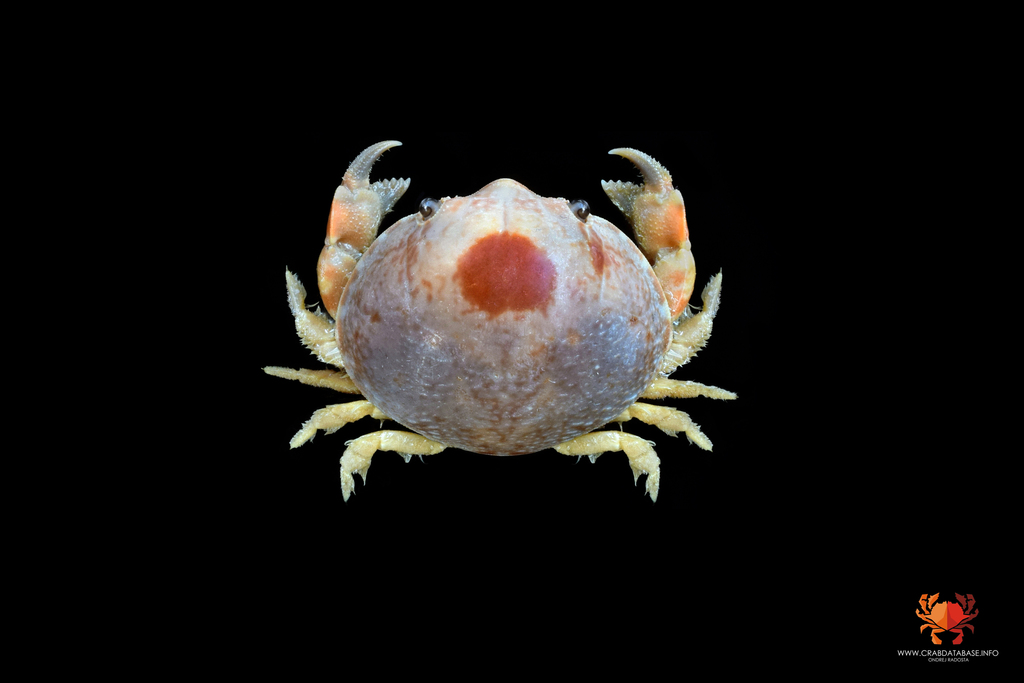
Guinotellus melvillensis
Guinotellus melvillensis is a species of crabs in the family Xanthidae, the only species in the genus Guinotellus. It is a benthic crab with an ovate carapace within the subfamily Euxanthinae.
Guinotellus melvillensis is a rare and unusual species of crab that has only been recorded in the Western Central Pacific, more specifically the Philippines. This species comes from the Xanthidae family (which comprises the common mud crabs), in the genus Guinotellus. G. melvillensis is the only crab of this family within the genus.
From the article Guinotellus on Wikipedia (CC BY-SA), quoted section by section
Description
The most distinctive feature of G. melvillensis is its oval-shaped carapace and shallow sub-hepatic cavities. Its carapace is broader than it is long, with a ratio of roughly 1:1.2, and it lacks distinction between different regions. The sub-hepatic cavities (or cavities beneath the liver) are not unique to this genus, though they are distinctively shallow and are divided by a prominent crest, with crests along their sides as well. This crest is thought to work in conjunction with another unique feature, which is its modified claw. This claw has a modified upper arm portion, or merus, being significantly reduced. This reduced appendage is closely aligned with its first and longest leg, with the two being coapted. The purpose of this modification is currently unknown. Their size ranges from 2.0 to 200 mm, with juveniles tending to have a smaller carapace width to length ratio. This species also has a distinctive gastrointestinal tract, with its dorsal lobe uniquely terminating in a hook shape; this is dissimilar to other Euxanthids, but is reminiscent of other crabs in its family, Xanthidae. It also lacks an external tooth. It is distinctive from other euxanthines due to its unusually shaped carapace. …
Range & habitat
This benthic species has been documented in four locations within the Philippines thus far, including Balabac Island, Sibutu Island, Putic Island, and southern Luzon. This area is known for being particularly dense in marine fauna, with many other species belonging to the infraorder Brachyura residing there. Adult Xanthids are generally found in shallow water, and as such, the known G. melvillensis specimens were collected between depths of 2 to 73 meters. The areas in which they have been found contain coral reefs with large seaweed expanses, residing specifically within coral or on reef flats. This species is postulated to live in subtidal and intertidal zones.
Wikipedia: “Habitat”
What it does
The diet of G. melvillensis is somewhat unknown but from information taken from the family Xanthidae it can be suggested. Crustaceans are described as opportunistic omnivores as they utilise different types of food. However, most crustaceans are mainly omnivores with a tendency for herbivory in food habitats. For the P. vespertilio, a crustacean in the family Xanthidae similar to G. melvillensis, the most important food source was algae which was obtained by scrubbing the encrusted coralline substratum, with red algae (Rhodophyta) being the most common species to be consumed. The P. verspertilio also feeds on brittle stars, gastropods and bivalves, which displays the range of food sources that the family Xanthidae can consume. It is possible that, like other Xanthids, it contains toxins as a result of its diet, and is thus poisonous.
Wikipedia: “Diet”
In human culture
Guinotellus melvillensis are commonly found with the benthic and tropical zones of the ocean. They are members of order Decapoda and are mostly gonochoric.
Habitat. This benthic species has been documented in four locations within the Philippines thus far, including Balabac Island, Sibutu Island, Putic Island, and southern Luzon. This area is known for being particularly dense in marine fauna, with many other species belonging to the infraorder Brachyura residing there. Adult Xanthids are generally found in shallow water, and as such, the known G. melvillensis specimens were collected between depths of 2 to 73 meters. The areas in which they have been found contain coral reefs with large seaweed expanses, residing specifically within coral or on reef flats. This species is postulated to live in subtidal and intertidal zones.
Mating. The reproductive behaviors of this species are not well documented, but based upon members of its order, Decapoda, they have separate male and female individuals that engage in courting behaviors. Copulation is only possible soon after the female molts, at which point the crabs mate via indirect sperm transfer.
Movement. The movement of these creatures is based on the walking legs that they possess. These walking legs densely setose at margins, less so on dorsal and ventral surfaces. …
Wikipedia: “Life history”
Where it lives
Recorded sightings
—
geo-referenced records in GBIF, from museums, herbaria and field observers.
Drag the globe to turn it. Dots are where records exist, not a range map; darker means more records.
In the stacks
Searching the stacks…
Every page naming Guinotellus melvillensis in the Biodiversity Heritage Library →
This page is assembled live from iNaturalist, GBIF, Wikipedia, the Source Library and the Internet Archive. It is not yet part of the hand-edited codex. iNaturalist taxon 1159940.