- Animals
- ›Chordates
- ›Vertebrates
- ›Cartilaginous Fishes
- ›Sharks and Rays
- ›Rays
- ›Stingrays
- ›Round Rays
- ›Urolophus
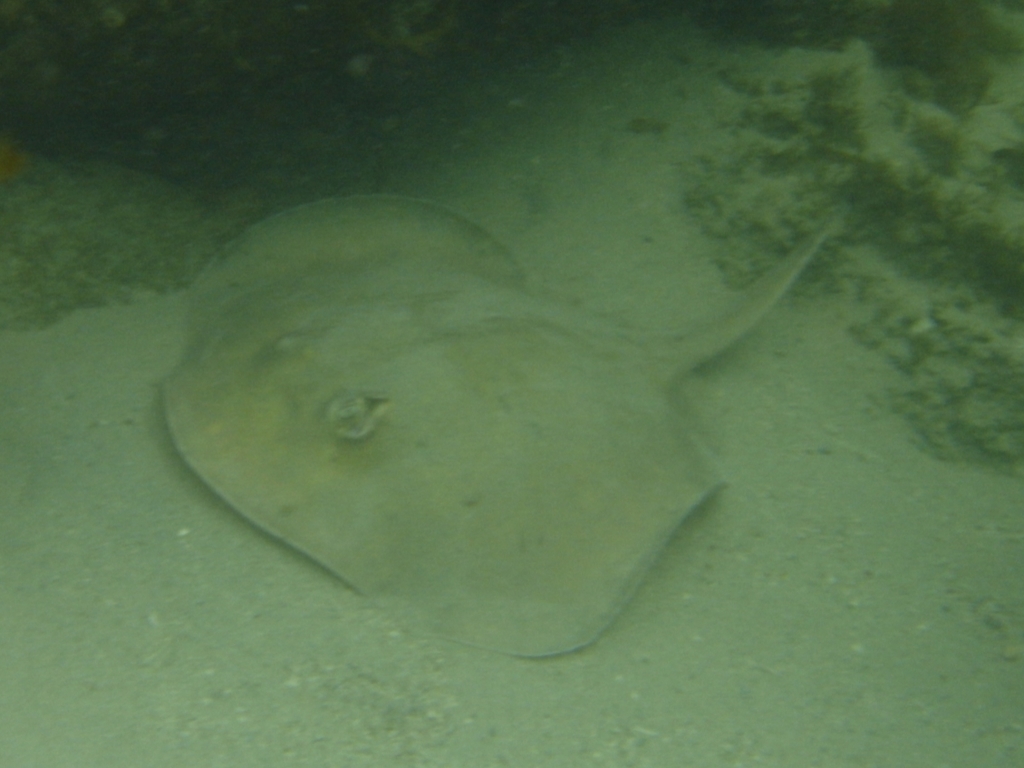
Lobed Stingaree
Urolophus lobatus
The lobed stingaree (Urolophus lobatus) is a common species of stingray in the family Urolophidae, endemic to southern Western Australia in shallow, inshore sand and seagrass habitats. This species is plain sandy in colour above and has a broad, rounded pectoral fin disc. It is characterized by an enlarged, semicircular skin lobe of unknown function on the inner rim of each nostril. Its tail is slender, with lateral skin folds and a lance-like caudal fin but no dorsal fin. The maximum recorded width is 27 cm (11 in).
A benthic predator, the lobed stingaree feeds mostly on crustaceans, and to a much lesser extent on small bony fishes, polychaete worms, and molluscs. It is aplacental viviparous, with females typically bearing a single pup every October or November after a gestation period of ten months. Developing embryos are nourished by maternally produced histotroph ("uterine milk") after they exhaust their supply of yolk. In the northern portion of its range, the lobed stingaree is frequently caught incidentally by trawlers. Though it generally survives the experience, it has a tendency to abort its young when captured. However, this species is not greatly affected by human activity overall, and it has been listed under Least Concern by the International Union for Conservation of Nature (IUCN).
From the article Lobed stingaree on Wikipedia (CC BY-SA), quoted section by section
Description
The lobed stingaree has a rounded pectoral fin disc much wider than long, with nearly straight leading margins. The snout is fleshy and forms an obtuse angle; the tip may protrude slightly past the disc. The medium-sized eyes are followed by teardrop-shaped spiracles, which have a rounded posterior margin. The outer posterior corner of each nostril forms a visible lobe. Between the nostrils is a skirt-shaped curtain of skin with a fringed trailing margin; the front corners of the curtain are enlarged into distinctive, semicircular lobes. The mouth is small and contains 9–10 papillae (nipple-like structures) on the floor; a handful of papillae are also found on the lower jaw. The small teeth have roughly oval bases. The five pairs of gill slits are short. The pelvic fins are small and rounded. The tail is slender and very flattened, measuring 87–100% as long as the disc and bearing a prominent horizontal skin fold on either side. There is a dorsally positioned, serrated stinging spine near the caudal fin, which is long, narrow, and leaf-shaped. There is no dorsal fin. The skin entirely lacks dermal denticles. This species is yellowish brown above, becoming slightly lighter at the lateral margins of the side, and white below; some individuals have irregular blotches and/or a dark stripe along the dorsal midline of the tail. The caudal fin becomes dark towards the tip. …
Range & habitat
Among the most abundant representatives of its family within its range, the lobed stingaree is found along a short stretch of the southwest Australian coast from Esperance to Rottnest Island. This bottom-dwelling species favors sandy flats and seagrass beds, from the intertidal zone to a depth of 30 m (98 ft). In the southern portion of its range, it tends to be found relatively far from shore. Individuals of different ages and sexes are not segregated from each other.
Wikipedia: “Distribution and habitat”
What it does
Almost 90% of the food volume consumed by the lobed stingaree consists of crustaceans, in particular mysids, amphipods, shrimps, and cumaceans, which are captured on or just above the bottom. This species also feeds on polychaete worms, small bony fishes, and rarely molluscs. Rays smaller than 19 cm (7.5 in) across take relatively more mysids, amphipods, and cumaceans, while larger rays take more shrimps and fishes, and have a more diverse diet overall. Its dietary composition also shifts seasonally, mostly reflecting the greater availability of shrimp in summer and fall and cumaceans in winter and spring. A known parasite of this species is a tapeworm in the genus Acanthobothrium. The function of its unique nasal lobes is unknown. Like other stingrays, the lobed stingaree is aplacental viviparous. Females have a single functional uterus, on the left, and an annual reproductive cycle. Mating occurs in November and October and ovulation from mid-November and mid-January, implying that the females store sperm internally for 1–3 months before fertilization. The gestation period lasts ten months; although up to six eggs may be fertilized, usually only a single pup (rarely two) develops to term. …
Wikipedia: “Biology and ecology”
Where it lives
Recorded sightings
—
geo-referenced records in GBIF, from museums, herbaria and field observers.
Drag the globe to turn it. Dots are where records exist, not a range map; darker means more records.
In the stacks
Searching the stacks…
Every page naming Urolophus lobatus in the Biodiversity Heritage Library →
This page is assembled live from iNaturalist, GBIF, Wikipedia, the Source Library and the Internet Archive. It is not yet part of the hand-edited codex. iNaturalist taxon 114798.