- Animals
- ›Chordates
- ›Vertebrates
- ›Ray-finned Fishes
- ›Spiny-rayed fishes
- ›Butterflyfishes, Angelfishes, and Allies
- ›Drums
- ›Totoaba
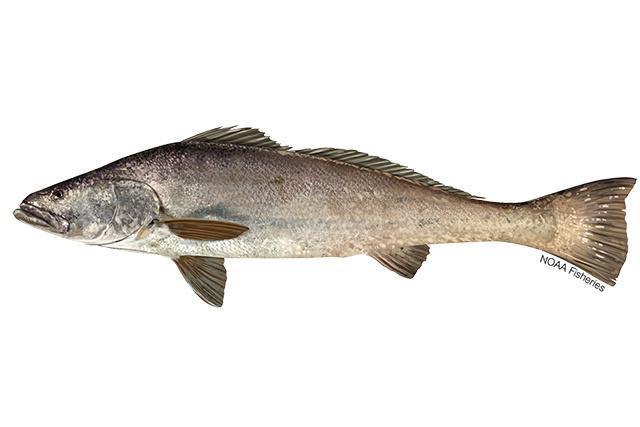
Totoaba
Totoaba macdonaldi
The totoaba or totuava (Totoaba macdonaldi) is a marine fish, the largest member of the drum family Sciaenidae, that is endemic to the Gulf of California in Mexico. It is the only species in the genus Totoaba. Formerly abundant and subject to an intensive fishery, the totoaba has become rare, and is listed on CITES, the IUCN Red List of Threatened Species, and the Endangered Species Act (ESA).
From the article Totoaba on Wikipedia (CC BY-SA), quoted section by section
Range & habitat
Although the totoaba population has declined due to nearly 50 years of overfishing, they have maintained their historical distribution range across the Gulf of California, inhabiting the northern part of the Gulf, the south of La Paz, the west of Baja California Sur, and the east of Mármol, Sinaloa. Interestingly, the genus Totoaba appears to have had a slightly wider range on the western North American coast in prehistoric times; a fossil otolith assigned to the extinct species T. fitchi is known from the Oclese Sand Formation in Kern County, California, suggesting that it reached as far north as there during the late part of the Early Miocene. New studies have indicated a possible expansion in range for the living totoaba population from their historical southern limit of west Bahía Concepción and east in the mouth of the El Fuerte River, Sinaloa to more southward bound areas such as in the Bay of La Paz and off Mármol. However, this range expansion is still being researched as there is a lack of information on the totoaba prior to its decline. The totoaba use different habitat areas of the Gulf for their ontogenetic migratory pattern which consist of pre-recruits, juveniles, pre-adults, and adults. Each location provides different environments to sustain that specific life stage. …
Wikipedia: “Distribution and habitat”
What it does
The totoabas' weight and size makes it the largest species in the drum family, together with the similar-sized Chinese bahaba (Bahaba taipingensis) and meagre (Argyrosomus regius). The totoabas' diet consists of finned fish and crustaceans. A recent study done in 2023 has used metabarcoding for the first time to identify a more specific diet for wild totoaba. The study found 11 species of prey consumed by the totoaba: Pacific anchovy (Centengraulis mysticetus), flathead grey mullet (Mugil cephalus), bigeye croaker (Micropogonias megalops), northern anchovy (Engraulis mordox), ocean whitefish (Caulolatilus princeps), milkfish (Chanos chanos), and Pacific sardine (Sardinpos sagax). Crustaceans known as krill from the Euphausiidae family were also identified. This more in depth understanding of diet allows for a better understanding of dietary needs for aquaculture feed considerations, biodiversity, trophic relationships, and ecology. Discovering the diet of the totoaba has proven difficult because their diet varies depending on the life stage it's in. …
Wikipedia: “Life cycle”
Where it lives
Recorded sightings
—
geo-referenced records in GBIF, from museums, herbaria and field observers.
Drag the globe to turn it. Dots are where records exist, not a range map; darker means more records.
In the stacks
Searching the stacks…
Every page naming Totoaba macdonaldi in the Biodiversity Heritage Library →
This page is assembled live from iNaturalist, GBIF, Wikipedia, the Source Library and the Internet Archive. It is not yet part of the hand-edited codex. iNaturalist taxon 114259.