- Animals
- ›Chordates
- ›Vertebrates
- ›Ray-finned Fishes
- ›Spiny-rayed fishes
- ›Puffers and Filefishes
- ›Pufferfishes, Porcupinefishes, and Molas
- ›Pufferfishes
- ›Tetraodon
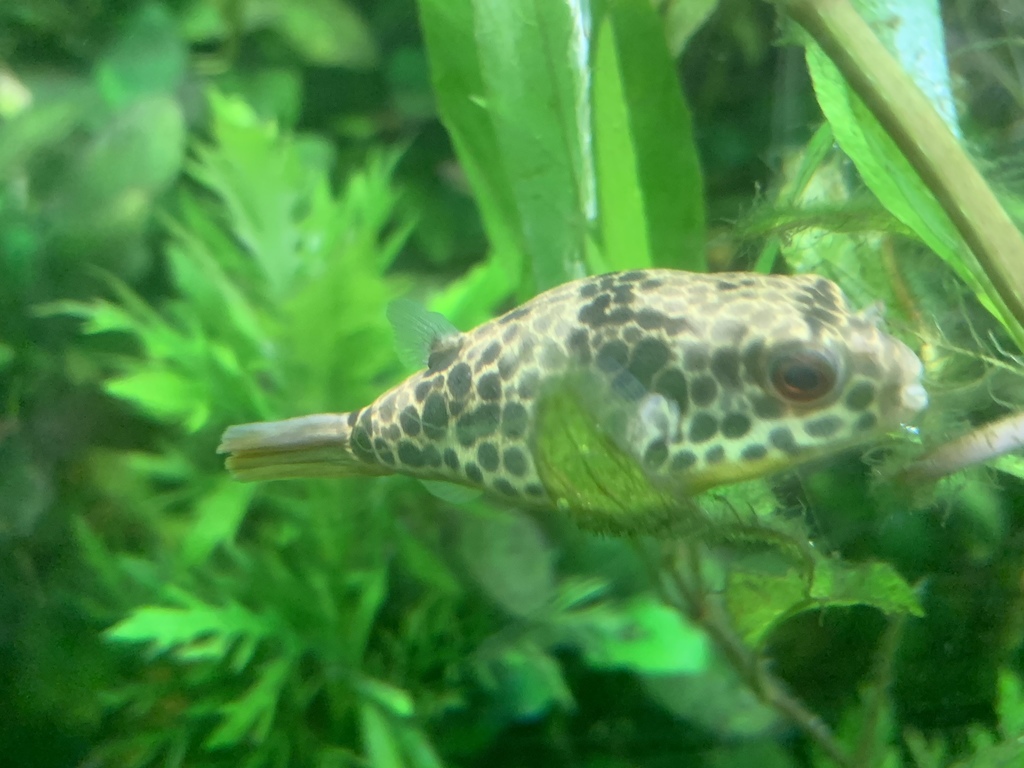
Spotted Congo Puffer
Tetraodon schoutedeni
Tetraodon schoutedeni is a species of pufferfish native to Africa's Congo Basin. Growing to a length of 9–11.5 cm (3.5–4.5 in), the species features a slightly rounded, globular body plan that tapers into a teardrop towards the tail; a design often seen in puffers. Additionally, they feature a light brownish-green body covered in black spots which derive its common name of the "Spotted Congo Puffer". this brownish-green body plan features scaleless skin that may oftentimes change color depending on environmental conditions and possible stress responses within the individual fish. The rest of the body design is conducive of the general anatomy of species belonging to the Tetraodon genus. These features include largely independently moving eyes, the ability to inflate their body and puff up as a defense mechanism, and a sharp beak composed of fused teeth that allow them to crack open their prey, which generally consists of insects and shelled organisms. Moreover, they contain the most distinctive feature of Tetraodon, which is tetrodotoxin, a neurotoxin that is enveloped within the skin and internal organs of the fish, although the species is not nearly as toxic as others of its shared genus.
Regarding sexual dimorphism, this species contains a few key differences between male and female fish. The males are oftentimes around 9 cm(3.5") while females may exceed 4". Additionally, females will appear rounder and slightly more swollen than the males. KFPI indicates that males tend to have a shorter snout and darker coloration of the spots along the cheek line
From the article Tetraodon schoutedeni on Wikipedia (CC BY-SA), quoted section by section
Range & habitat
Tetraodon Schoutedeni populations are often distributed throughout the Congo Basin, with much of the wild-caught populations being from the Ubangi River Basin. This species is believed to have invaded into freshwater from the northern coast of Africa 17–38 million years ago. Based on current studies, it is assumed that this species was the result of a single common ancestor between T. schoutedeni and four other species which diverged within the Congo Basin, giving us the species we observe today.
The modern range of T. schoutedeni is largely relegated to the Ubangi River Basin and the Lua River. While there isn't much information regarding other bodies of water, it is generally accepted that these species are widespread throughout this general region of the Congo River. Due to the demersal nature of the species, these fish are found within the large river systems where they can feed on benthic invertebrates, predominantly insects and mollusks. These fish are also strictly freshwater, making their environment more unique when compared to most other pufferfish, which are usually suited towards brackish or marine ecosystems.
Wikipedia: “Distribution”
What it does
Given the political turmoil that made accessibility of this fish limited for the pet industry, in captivity breeding efforts have developed greatly to better understand and distribute these pufferfish. Considering this, fish ethologists have come to understand their courting behavior greater than most other fish, especially because T. schoutedeni is so unique in this area.
The initiation of mating behavior begins with tandem swimming events where no actual spawning behavior occurs. In this unique case for this African freshwater puffer, a female can initiate in a pair or even trio with two males clung to its stomach. This has been observed to occur twice, often starting in the afternoon with actual spawning occurring in the late afternoon. Successful spawning behavior led to the male initiating biting behavior, which exhibits the male biting and clinging to the female's abdomen. This is then followed by the first round of tandem swimming, which leads to periods of the male biting and clinging to the abdomen of the female until she is ready to mate. Once the female is ready, there is a reorientation of the male before spawning which aligns the bellies of the two fish to initiate a successful spawn. The weakly adhesive eggs will then scatter onto the substrate or any décor to be left unguarded by either parent. Standard batches can generally range from 3–50 eggs. …
Wikipedia: “Biology and Reproduction”
Where it lives
Recorded sightings
—
geo-referenced records in GBIF, from museums, herbaria and field observers.
Drag the globe to turn it. Dots are where records exist, not a range map; darker means more records.
In the stacks
Searching the stacks…
Every page naming Tetraodon schoutedeni in the Biodiversity Heritage Library →
This page is assembled live from iNaturalist, GBIF, Wikipedia, the Source Library and the Internet Archive. It is not yet part of the hand-edited codex. iNaturalist taxon 113937.