- Animals
- ›Chordates
- ›Vertebrates
- ›Ray-finned Fishes
- ›Spiny-rayed fishes
- ›Leaffishes, Snakeheads, and Gouramis
- ›Gouramis
- ›Gouramis
- ›Luciocephaline Gouramis
- ›Sphaerichthys
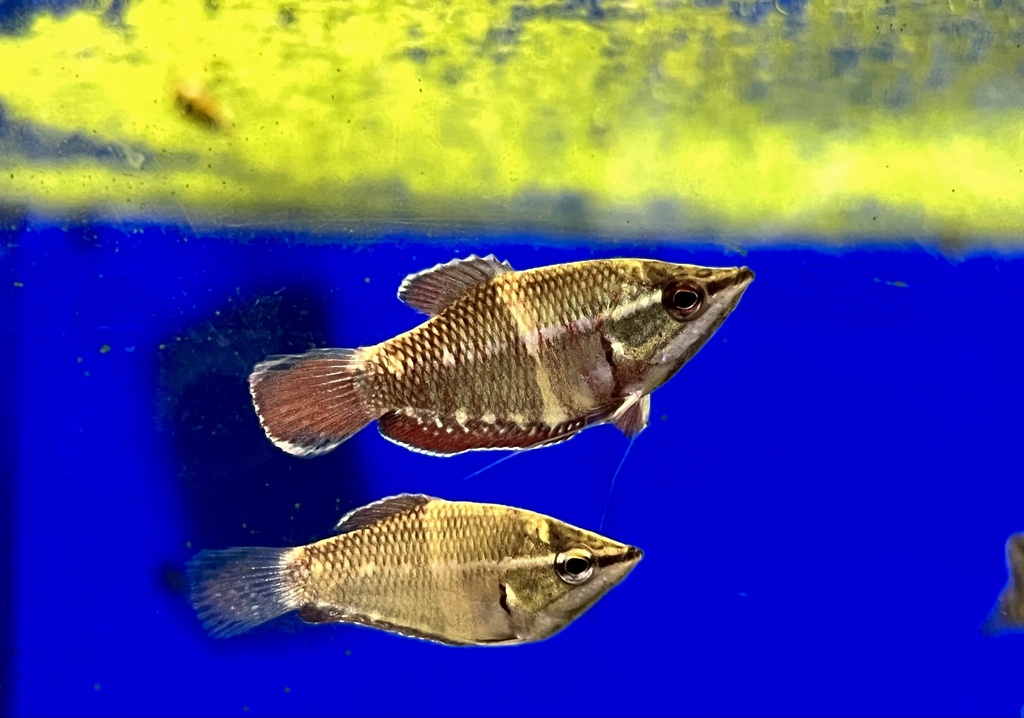
Samurai Chocolate Gourami
Sphaerichthys vaillanti
Sphaerichthys vaillanti, known as Vaillant's chocolate gourami, samurai gourami, or samurai zebra gourami , is a species of gourami. It is native to Asia, where it is known from mainly the Kapuas river in the west Kalimantan, (Kalimantan Barat)[1], region of Borneo in Indonesia. It is generally seen in pairs in small creeks or drainage where wood debris is abundant. It is known to mimic dead leaves as a form of camouflage. The species reaches about 6 cm (2.5 inches) in standard length and is known to be a facultative air-breather.
From the article Sphaerichthys vaillanti on Wikipedia (CC BY-SA), quoted section by section
Description
The male and female of this species have great sexual dimorphism as the females are brightly colored red with a predominant green and dark vertical stripes. The males are much simpler with a dull reddish brown with a few vertical and horizontal white lines. Juveniles are brown with clear caudal tails and white markings throughout. All of the coloring that these anabantoids have are to resemble the dead leaf litter and debris that is found naturally in their environment.
What it does
Unlike many other fish species, the female of these mouthbrooders actually initiates the courting behavior, and during this time, they will remain upright for many hours during reproduction. The female will then lay the eggs, about 10–40, and the male will gather them in his mouth. He will then hide while the female guards the area to protect the eggs.
Wikipedia: “Life cycle”
In human culture
This species was collected by Léon Vaillant, who mistakenly first thought of it as a frail gourami (Ctenops nobilis). It was then named after Vaillant by Jacques Pellegrin. The year of its description was 1832.
Wikipedia: “Discovery and history”
Where it lives
Recorded sightings
—
geo-referenced records in GBIF, from museums, herbaria and field observers.
Drag the globe to turn it. Dots are where records exist, not a range map; darker means more records.
In the stacks
Searching the stacks…
Every page naming Sphaerichthys vaillanti in the Biodiversity Heritage Library →
This page is assembled live from iNaturalist, GBIF, Wikipedia, the Source Library and the Internet Archive. It is not yet part of the hand-edited codex. iNaturalist taxon 112893.