- Animals
- ›Chordates
- ›Vertebrates
- ›Cartilaginous Fishes
- ›Sharks and Rays
- ›Sharks
- ›Galean Sharks
- ›Ground Sharks
- ›Catsharks
- ›Scyliorhinus
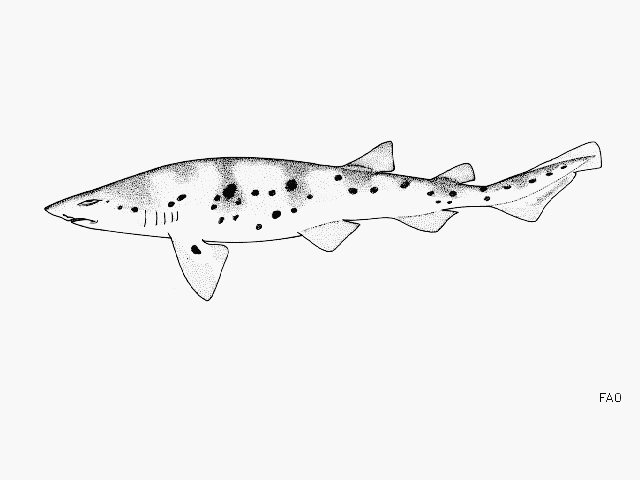
West African catshark
Scyliorhinus cervigoni
The West African catshark (Scyliorhinus cervigoni) is a catshark of the family Scyliorhinidae. It is found in the eastern Atlantic between latitudes 20° N and 17° S, at depths between 45 and 500 m. It can grow up to a length of 80 centimetres (31 in). At one time, the West African catshark was considered to be a subspecies of the nursehound, Scyliorhinus stellaris, but is now considered to be a separate species. The reproduction of this catshark is oviparous.
From the article West African catshark on Wikipedia (CC BY-SA), quoted section by section
Description
The West African catshark has a stout body and a somewhat flattened head, the greatest width of which is at least two thirds of its length. It has no nasoral grooves, the flap that covers the nostrils extends just as far as the mouth and there are labial furrows on the lower jaws only. The front edge of the anterior dorsal fin is immediately above the posterior end of the pelvic fin. The gap separating the two dorsal fins is about the same length as the base of the anal fin. The posterior dorsal fin is much smaller than the anterior one and its leading edge is above the rear part of the anal fin. The caudal fin is broad with a square-cut end and a medium-sized lower lobe. The skin is rough due to a covering of large, erect dermal denticles. The West African catshark can grow to about 80 centimetres (31 in). The background colour is greyish or brownish with distinct large black spots on the back and sides and eight or nine dark-coloured, saddle-shaped patches, the extremities of which often centre on the black spots. There are no white spots or patches as are sometimes found in the rather similar nursehound (Scyliorhinus stellaris).
Range & habitat
The West African catshark is found in the eastern Atlantic Ocean at depths between 45 and 500 metres (148 and 1,640 ft). Its range extends from Mauritania in West Africa to Angola. It is a bottom-dwelling species inhabiting the continental shelf on muddy and rocky seabeds.
Wikipedia: “Distribution and habitat”
Where it lives
Recorded sightings
—
geo-referenced records in GBIF, from museums, herbaria and field observers.
Drag the globe to turn it. Dots are where records exist, not a range map; darker means more records.
In the stacks
Searching the stacks…
Every page naming Scyliorhinus cervigoni in the Biodiversity Heritage Library →
This page is assembled live from iNaturalist, GBIF, Wikipedia, the Source Library and the Internet Archive. It is not yet part of the hand-edited codex. iNaturalist taxon 112374.