- Animals
- ›Chordates
- ›Vertebrates
- ›Ray-finned Fishes
- ›Spiny-rayed fishes
- ›Wrasses and allies
- ›False scorpionfishes, wrasses, and parrotfishes
- ›Wrasses and Parrotfishes
- ›Parrotfishes
- ›Scarus
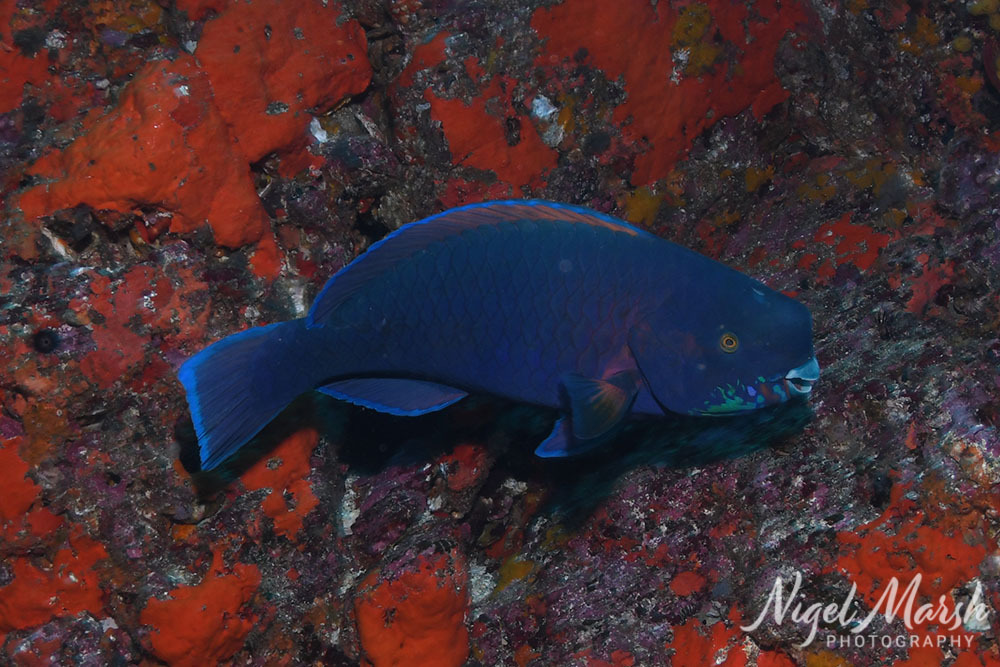
Knobsnout Parrotfish
Scarus ovifrons
The knobsnout parrotfish (Scarus ovifrons) or blue humphead parrotfish is a species of marine ray-finned fish, a parrotfish, in the family Scaridae which is famous for its characteristic blue color. It lives in reefs and coral reefs. It grows to a maximum length of about 90 cm. Its body is a strong blue color, and may have reddish-brown, white, or black spots on it. Adult fish have whitish spots on their cheeks and a lump on their foreheads. Young fish have no spots on their cheeks or lumps on their foreheads. It is found in the northwestern Pacific Ocean off Japan and Taiwan.
From the article Knobsnout parrotfish on Wikipedia (CC BY-SA), quoted section by section
What it does
It primarily feeds on epilithic red algae and detritus growing on rocky surfaces. Coralline algae is less commonly fed on. Large fish that are over 40 cm in length have also been recorded feeding on live Acropora solitaryensis coral. By limiting algae growth, parrotfishes encourage the growth of coral on reefs.
Wikipedia: “Diet”
Toxicity
The flesh of the knobsnout parrotfish is toxic, and causes severe food poisoning if ingested. From 1953 to 2013, there have been 27 reported cases in Japan of people being poisoned upon eating the fish. Poisoning causes severe muscle pain associated with rhabdomyolysis. It is not well understood what the toxin is. It is possible that the toxin is accumulated from its diet, but it is unknown what food item would be the source of the toxin.
Where it lives
Recorded sightings
—
geo-referenced records in GBIF, from museums, herbaria and field observers.
Drag the globe to turn it. Dots are where records exist, not a range map; darker means more records.
In the stacks
Searching the stacks…
Every page naming Scarus ovifrons in the Biodiversity Heritage Library →
This page is assembled live from iNaturalist, GBIF, Wikipedia, the Source Library and the Internet Archive. It is not yet part of the hand-edited codex. iNaturalist taxon 112156.